What Bette Midler, Julie Andrews, Adele, Celine Dion, Bernadette Peters, and a Bunch of Other Divas Can Teach Novelists about Voice

A Facebook friend clued me into this great comic work that I want to in turn share with you. In it, Christina Bianco sings Total Eclipse of the Heart as more than a dozen different divas, most of which you will know if you’ve been listening (even accidentally) to the radio during the past few decades. Watch the video and then let’s continue with our discussion below.

You did watch it right? To the end? Don’t cheat!

Okay. It doesn’t take a very big leap to apply this fantastically fun video to writing fiction, does it? The same song sung in many different voices.

In your current WIP, are you purposefully cultivating a compelling voice? One that will be recognized? One that is unique? Or has voice slipped your mind as you focus on plot or making sure you don’t mix tenses?

Voice is one of the main elements of fiction that is nearly impossible to define or teach, but every agent and editor out there says they are looking for what? A strong voice. A unique voice.

Voice changes the reader’s experience of the book. With my first completed novel manuscript, the voice was originally fairly flat and matter-of-fact, which was purposeful as I wrote the first draft. But upon revising many times, I realized that the least interesting and least fully realized character in the entire story was my protagonist. Everyone else was alive. She was dead. Problem? POV and voice.

So I changed from 3rd person POV to 1st person POV, and as I made that change, the voice followed. A detached voice turned into the voice of someone who was easier to relate to, who had believable reactions to things, who questioned her own motives and choices, who was thoughtful and introspective, but who invited the reader into her world.

Same story, different voice.

Next time you read through your manuscript, pay attention to the voice. Are you coming across the way you really want to? Is the voice drawing the reader in or keeping him at arm’s length? Is the voice honest or tricky? Above all, whatever voice you develop, is it consistent?

Because while it’s fun to watch a six minute YouTube video with twenty different voices, no reader wants to be jerked around like that.
Wildflower Wednesday: Water Hemlock

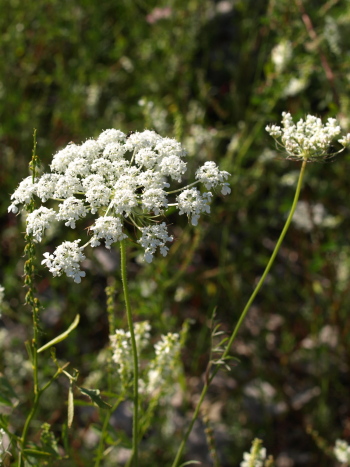
waterhemlock

Common Name: Water Hemlock

Scientific Name: Cicuta maculata

Habitat & Range: wet, sunny meadows, ditches, my garden

Bloom Time: summer and fall

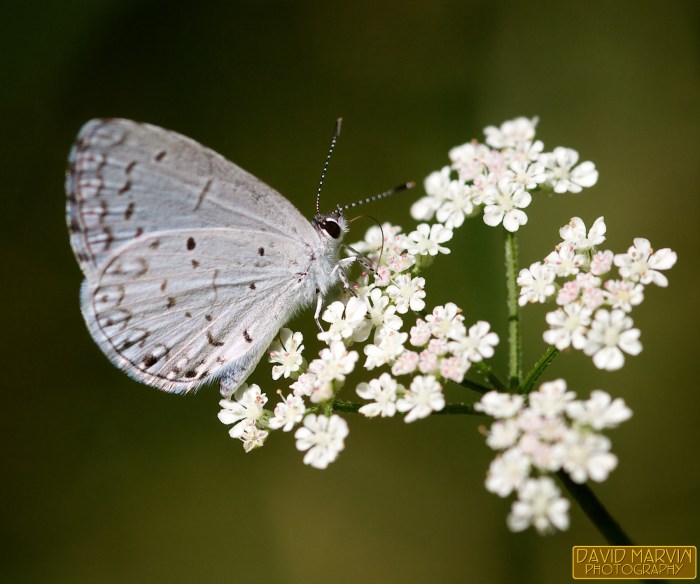
About: Last week I mentioned that Queen Anne’s Lace was in the carrot family and the root was edible (as a coffee substitute). Water Hemlock is also in the carrot family. It looks very much like Queen Anne’s Lace and like Cow Parsnip (also edible). The taproots even smell like carrots. But DO NOT CONSUME any part of this plant in any fashion as it is Michigan’s most poisonous plant. Just a small amount will cause convulsions and then death. If you have children or pets and you see this in your yard, eradicate it. Pull plants up by the root and throw away. Don’t add them to your compost pile (I’m not sure anything bad would come of it, but better to be safe than sorry).

When we moved to our house, which has several wet spots, I saw quite a bit of this plant but thought I had successfully removed it. When we came home from two weeks’ vacation earlier this month, I found a couple lurking in my vegetable garden and near the driveway. Weeds always seem to find a way. I pulled them up before I thought about taking photos, so I borrowed a photo from my friend and butterfly/dragonfly photographer extraordinaire David Marvin.

I’m also going to direct you to this website for many detailed pictures of the plant so you know what’s what when you think you’ve encountered this plant. The telltale sign is the leaf, which has veins that end in the V of the serrated leaves rather than at the tips.

Reference: Wildflowers of Michigan by Stan Tekiela; Adventure Publications, 2000

Finding Your Story’s Triple Point

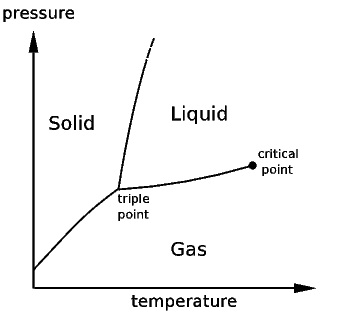
Remember in high school chemistry class when you first learned about triple point? No? Let me refresh your memory. The triple point of a substance is the temperature and pressure at which the three phases of matter (solid, liquid, and gas) coexist in a kind of equilibrium. It’s not any of the three and yet it’s all of the three at the same time. Mind blown. In our class we used to annoy the teacher by asking what the triple point of human flesh was.

Here’s a handy chart:

chart

The triple point of your story (and I’m just making this up here, folks–it’s not a real thing so don’t bother googling it) is when all the right elements of your story come together and you reach the point where you can really take off writing. It could be research, outlining, and a sudden burst of inspiration. It could be characters, plotting, and finally landing on the right point of view. It could be just the right combination of procrastination and pressure (looming deadlines!) It might be a hundred different factors finally converging and giving you the perfect kick in the pants you’ve been waiting for.

In the Bartels household the past couple weeks there’s been a lot of flirting with literary triple points and I think I’ve just reached mine.

Ah, the happiness and contentment one can feel with a good start on a big project. I’m two good chapters into a new novel, one that has been brimming with possibilities in my mind for some time but which has had several false starts and one fairly detailed and then discarded outline. I’ve been struggling not with characters, themes, or plot, which are all firmly implanted in my mind and loosely drawn out in a series of notes, but with form. It was the last piece of the puzzle I needed in order to really get started, to reach the triple point.

Any time you are trying to tell a story in the present that has parallels to and lessons to learn from the past, it can be hard to decide the best method for revealing the important parts of the backstory–especially if the backstory spans a long time period. I’m personally dealing mostly with 150 years of a family history. It feels like a lot to wade through to decide what is most important and determine the best method for slowly uncovering that information in the course of the narrative. But my husband (who is also a writer) is working on a new novel where the backstory covers centuries and crosses oceans. But he too is right there, hovering at that triple point.

I’ve had a few aha moments in the past few days, moments that rendered my earlier outlining fairly useless, but moments that may not have happened if I didn’t first try something that didn’t quite work for me. Luckily, I’ve been able to salvage most of the writing, removing chunks to save for later in the book and revising the remainder to lay the right hints and focus on the right thematic elements. I did kill some darlings in the process, but of course that is inevitable.

Now I feel some real inertia and the road ahead looks pretty clear. The trick will be to harness that and make the time needed to use it wisely.

FridayNightRide05

What are you working on right now? What problems are you facing? What happy moments of clarity have you experienced? Have you ever experienced the exhilaration of reaching your story’s triple point?

Wildflower Wednesday: Queen Anne’s Lace

Queen Anne's Lace

Common Name: Queen Anne’s Lace

Scientific Name: Daucus carota

Habitat & Range: dry, sunny meadows and roadsides statewide

Bloom Time: summer and fall

About: So many of our wildflowers are non-native European garden plants that have escaped, and this is one of them. A member of the carrot family (and thus a host plant for black swallowtail butterflies) Queen Anne’s Lace is a common and well-known plant. I recall hearing the story behind the little cluster of dark red flowers in the center as a child: that Queen Anne (whoever that was, I was not sure) was making lace and pricked her finger with the needle and a drop of her blood got on it. But now I’m fairly sure handmade lace is made with a tiny crochet hook (right?) so I’m thinking Queen Anne must have had to work pretty hard to draw that drop of blood. At any rate, her namesake plant is now considered an invasive, though I’ve not heard of any plans to rid the state of it.

The root of Queen Anne’s Lace can apparently be dug, dried, ground, and used as a coffee substitute. But beware that in the family of flat-topped flowers (which we shall explore in the coming weeks) there are many lookalikes–and some of them are deadly. So hold off on making that “coffee” until you really know what’s what. Next week: water hemlock.

Reference: Wildflowers of Michigan by Stan Tekiela; Adventure Publications, 2000

queenanne4
Here’s what’s become of Queen Anne’s Lace in the fall.

How to Find the Best Beaches in Michigan’s U.P.

Mosquito Beach
One of my favorite places in the world: Mosquito Beach.

I don’t typically highlight websites on this blog, but in preparing for my upcoming hiking trip to Grand Sable Dunes and other parts of the east side of Pictured Rocks National Lakeshore (and also in thinking about August’s short story) I happened upon this excellent website: Some Yooper Beach.

For the uninitiated, Michigan’s Upper Peninsula is locally referred to as the U.P. (pronounced Yoo Pee, not “up”) and those who live there are called Yoopers. This particular Yooper has done the world a great service by visiting TONS of U.P. beaches and then describing them and sharing photos of them on his website. If you have ever thought of visiting Lake Superior, spend some time on this site first to see which part of the 2,726 miles of shoreline (nearly 1,000 of which are in Michigan) you would most like to visit.

Mosquito Beach
We spent more time at Mosquito Beach than any other place on the trail.

Another handy website is the Lake Superior ShoreViewer. What it lacks in interesting commentary, it makes up for in comprehensive photos of what appears to be the entire Michigan shoreline. Though it would be super nice if you could zoom in on the photos (which you can’t).

I’ve added both of these sites to my page of Michigan Links. If you didn’t know about that part of this site, why don’t you go check it out now? I’m sure you have tons of time to waste, right?

Beach at Coves
The beach near Coves campsite.

The Mad, Mad Adventure of Writing to a Title

Ideas for writing come from all over–overheard conversations, awful dinner parties, a moment in time that hits you just right and sparks something inside of you that can only be described as the literary gene. But sometimes, you have to make the ideas come. Like when you’re on a deadline, self-imposed or not.

For several of my short stories this year I’ve started with a title idea and/or cover image rather than actual plot or character ideas, and it’s been interesting to see where that leads my writing. Because of this, I’ve run into a rather interesting situation I thought I’d share with you creative types out there.

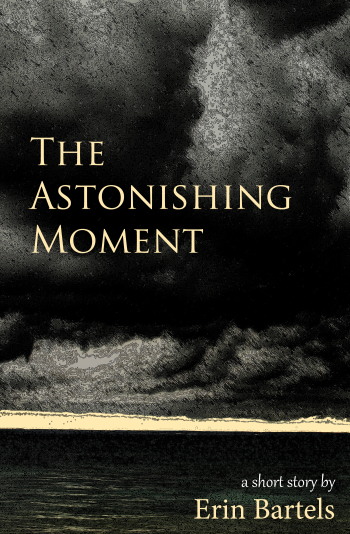
For August’s short story I started with a title which I drew from a quote from Virginia Woolf’s diary where she is describing a total solar eclipse that she and her friends saw. I loved the phrase “the astonishing moment” which she used to describe the moment the eclipse was total and the light in the world simply went out. So I pulled that phrase out and thought it would make a compelling title to write to. I popped it on a photo I took up at Lake Superior whilst hiking Pictured Rocks last summer and thought perhaps I’d do a story with hiking as a backdrop. Here’s the cover I came up with:

OLYMPUS DIGITAL CAMERA

But then Saturday night when I started to think about getting started writing, I decided to reread the section of Woolf’s diary that had inspired the title and pull out a quote with which to begin my story. Here’s what caught my fancy:

“We kept saying this is the shadow; and we thought now it is over—this is the shadow; when suddenly the light went out . . . . How can I express the darkness?”

~Virginia Woolf

Clearly that quote and my original cover concept do not match.

Rather than lose the pathos of that quote by omitting it and just writing the story I had (very) vaguely formed in the back of my mind, I decided to try again at the cover art. I pulled a photo I just took up at Mackinac Island, manipulated it a bit, and came up with this:

OLYMPUS DIGITAL CAMERA

Clearly this new image does fit the quotation. I’m pretty sure the story will not be about hiking. I’m pretty sure it will be “maritime” in flavor. And I’m pretty sure some bad things will happen to the characters.

And that’s all I’m sure of.

Storm clouds gather over the Mackinac Bridge

Storm clouds gather over Mackinac

This is one of my favorite shots from my recent trip up to Mackinac Island. More to come later, but I wanted to share this one with you. Besides the incredible storm clouds rolling in from the Upper Peninsula, what made this photo (and the rest from this particular twenty minutes or so) such a pleasure is that no one was around when it was taken. Solitude during the peak season on Mackinac Island is hard to come by sometimes. And I really needed it that night.

Wildflower Wednesday: Fringed Gentian

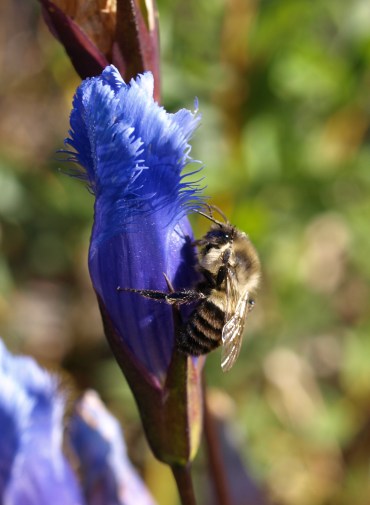
Fringed Gentian

Common Name: Fringed Gentian

Scientific Name: Gentianopsis crinita

Habitat & Range: wet prairies & meadows, along streams and lakes

Bloom Time: late summer & fall

About: I see fringed gentian regularly up at Camp Lake Louise, but I only have pictures of it from odd years because…it’s a biennial! It takes two years to bloom and, like most wildflowers, should not be picked or dug up. Since 2013 is an odd year, I was on the lookout for them on our trip this year, but it’s been a cool summer and the late summer wildflowers were not in bloom yet when we were up there.

In addition, like many other wildflowers, it depends on a mycorrhizal relationship. In other words, it can only grow where certain bacteria or fungi are present in the soil, so if you decide you are the special exception and you’ll just go ahead and take that plant home thank you very much, it won’t grow in your yard anyway, so please leave it be and bring home some nice photos instead.

Fringed Gentian

The fringed gentian has been the subject of some poetry over the years, including

Emily Dickinson

God made a little gentian;
It tried to be a rose
And failed, and all the summer laughed.
But just before the snows
There came a purple creature
That ravished all the hill;
And summer hid her forehead,
And mockery was still.
The frosts were her condition;
The Tyrian would not come
Until the North evoked it.
“Creator! shall I bloom?”

William Cullen Bryant

Thou blossom bright with autumn dew,
And colored with the heaven’s own blue,
That openest when the quiet light
Succeeds the keen and frosty night.

Thou comest not when violets lean
O’er wandering brooks and springs unseen,
Or columbines, in purple dressed,
Nod o’er the ground-bird’s hidden nest.

Thou waitest late and com’st alone,
When woods are bare and birds are flown,
And frosts and shortening days portend
The aged year is near his end.

Then doth thy sweet and quiet eye
Look through its fringes to the sky,
Blue–blue–as if that sky let fall
A flower from its cerulean wall.

I would that thus, when I shall see
The hour of death draw near to me,
Hope, blossoming within my heart,
May look to heaven as I depart.

and Robert Frost 

I felt the chill of the meadow underfoot,
But the sun overhead;
And snatches of verse and song of scenes like this
I sung or said.

I skirted the margin alders for miles and miles
In a sweeping line.
The day was the day by every flower that blooms,
But I saw no sign.

Yet further I went to be before the scythe,
For the grass was high;
Till I saw the path where the slender fox had come
And gone panting by.

Then at last and following him I found–
In the very hour
When the color flushed to the petals it must have been–
The far-sought flower.

There stood the purple spires with no breath of air
Nor headlong bee
To disturbe their perfect poise the livelong day
‘Neath the alder tree.

I only knelt and putting the boughs aside
Looked, or at most
Counted them all to the buds in the copse’s depth
That were pale as a ghost.

Then I arose and silently wandered home,
And I for one
Said that the fall might come and whirl of leaves,
For summer was done.

Fringed Gentian

Reference: Wildflowers of Michigan by Stan Tekiela; Adventure Publications, 2000

10 Degrees Cooler in the Shade

OLYMPUS DIGITAL CAMERA

Hot off the virtual press (thanks to the near universality of wifi, even on Mackinac Island) is July’s short story, 10 Degrees Cooler in the Shade. This story started at simply pairing a title idea (with no thought of possible plot, characters, setting, content, etc.) and a photo I took at the Ingham County Fair a year or so ago. (Aside: The 2013 Ingham County Fair starts today and runs all week!) I asked my husband to suggest a name of a guy that sounded like he might be a carny (no offense to those of you out there who might share this name). And off my imagination went.

One of the fun things about writing a bunch of short stories this year is trying out different genres, and this is one I’ve never written–suspense. I hope you enjoy it!

Buy it here for 99 cents for your Kindle and Kindle apps.