Getting Over Myself and Getting Scrivener

scrivenerlogoLast night I downloaded the trial version of Scrivener and went through the very lengthy but mildly entertaining tutorial. Then I started fiddling. A day later I have a huge and growing character list with descriptions, a few settings drawn out, and an entire novel outlined with chapter synopses written.

Oh my goodness, I love this program. When I wrote my first manuscript I wrote it start to finish, no outline to speak of until I was halfway through writing it and finally knew where I wanted it to go (and where it wanted to go, frankly). The thought of conceiving of an entire novel and outlining each scene struck me as very difficult. Maybe impossible for me, despite the fact that I’m a fairly organized person (stop laughing, Mom). Hence, though the program sounded intriguing, it also sounded daunting and pedantic.

But here I sit, book one of a series completely outlined and waiting to be written. Books 2-4 have been loosely sketched out (like we’re talking major plot arcs, nothing detailed). And I feel great about it.

If you’ve never given Scrivener a try, I urge you to check it out. You can try it free for 30 days (non-consecutive, meaning 30 real days whether taken all at once or stretched out over 10 years) and it’s only $40 to buy. A super cheap tool to help you get your story organized (or organised as they, being British, would spell it) and get yourself a large part of the way down the road to having actually written out that book.

It has a ton of features to help you, including tools to organize and access your research; format your work depending on what it is (nonfiction, novel, screenplay, short story, etc.); track characters, themes, and keywords; and tons more I can’t remember because that tutorial was so dang long.

Still unconvinced? Joanna Penn wants you to use it too.

Guess who’ll be presenting at a writers conference this fall…

It’s official: I will be presenting a workshop at this year’s Breathe Christian Writers Conference October 18-19, 2013. I’m quite excited to be doing my first presentation on a topic that is important to me and I encourage all you writers in the great state of Michigan to attend the conference. Last year it was refreshing and helpful and I’m sure this year it will be even better (not necessarily because I’m presenting, but, you know…because that’s what you say when you’re trying to make something sound great and worth your time, which it totally is).

I will be sure to keep you all updated as the list of presenters and speakers is finalized and released. In the meantime, I’ll be putting together an ebook to support my talk and further develop the concepts I’ll be presenting. Look for it by the end of the summer.

Choosing Your Mood, Creating Your Future

We woke up this morning to delightful sunshine piercing through the cracks of the blinds. It put me in an excellent mood. Then I raised the blinds in my son’s light-filled east-facing room and saw it. Snow. Over everything. Mood instantly changed.

We’d been dusted while we were sleeping and as I write this all that snow has melted (and the clouds have rolled in). But that 10-second emotional rollercoaster this morning has colored the rest of my day.

I got a call from our trusted mechanic today and what we thought might be a small job that would cost a couple hundred dollars has turned out, upon closer inspection, to be something that will cost more. A lot more.

A productive morning has given way to a mentally sluggish afternoon.

A search for something pleasant and entertaining to read in the blogosphere over lunch became a descent into articles about models starving themselves (and eating tissues to feel full) and postpartum depression.

A morning of smart eating has given way to a craving to eat all the rest of the Easter candy in the house. (I haven’t given in. Yet. And at least I’m not eating tissues.)

Life can spin you around pretty quickly, in small ways and big ways. My problems, in the scheme of things, are very small. And then I see something like the video below and the sun comes out again in a big way.

Anything is possible. You can do it if you put your mind to it. So what are you going to do with the life you’ve been given?

April’s Short Story Is Here–and It’s Free Today Only!

The next morning the sun was behind a cloud, but they started on, as if they were quite sure which way they were going.

‘If we walk far enough,’ said Dorothy, ‘I am sure we shall sometime come to some place.’

This line from chapter 14 of The Wonderful Wizard of Oz by Lyman Frank Baum did not inspire April’s short story, but it did provide the title after it was written. I’m particularly proud of We Shall Sometime Come to Someplace as a story that attempts to combine the three main conflicts (man vs. nature, man vs. man, and man vs. himself) into one short tale, and also alludes to three particular well-known stories that involve portals and other worlds of some sort.

I first had the inkling of an idea for this story a couple years ago during a drive in March when the skies were studded with clouds that looked like they belonged to the month of July. It grew from the short note I jotted down about it and an element of one of my recurring dreams.

Because I like this story so much, I’m offering it free on its release day (and that, my friend, is today) so click here and get your free copy! (No, this is not an April Fool’s joke; it really is free.)

We Shall Sometime Come to Somplace

Taking My Own Writing Advice (or, My Terrible Epiphany)

I hope you won’t mind if I direct most of this post at myself. Because, frankly, I need a good talking to/kick in the pants/smack upside the head.

Myself in a Mirror

Listen, Erin, you have some problems. It seems like everyone compliments your writing (all those agents who declined to take you on had very nice things to say about your technical skill) but there are some serious problems with your manuscript for A Beautiful Fiction that, even if you self-publish, you’re going to want to fix. You know what these are.

Problem 1: Beta readers find it difficult to sympathize with your protagonist.

Your rationale: My narrative voice is detached in an attempt to counter the tendency in a lot of modern fiction to tell too much and therefore not allow the reader to think at all.

Solution: Uh, DUH! Switch from 3rd person to 1st person so you can let people inside your protagonist’s messed up head! (Yes, this will mean rewriting the entire 85,700-word manuscript.)

But that’s not all is it? How about…

Problem 2: Story takes too long to get going.

Your rationale: It just wouldn’t make sense to start later or move things along faster because the storyline would be completely implausible.

Solution: Start at the point the action is intense, then flash back a bit here and there to fill in the details. Seriously, it took you this long to figure this out? For crying out loud, you just wrote a blog post about this very technique for a different story!

(Yes, I admit, it was when I was rereading my own blog post [hanging my head in shame] that I realized this advice could be applied more broadly in my own work.)

There are probably other problems in that manuscript, but two is enough to work on for now. So get your butt in gear, Erin, because you have got a LOT to do now.

Sheesh.

In my defense, though, I will say that had I not stepped away from that manuscript for about six months, I would not have come to realize these possible solutions to my problems. Now that I can look at it more objectively, I can get back to work and make A Beautiful Fiction beautiful indeed.

When the Painful Thing Is Less of a Pain than Avoiding the Painful Thing

It was bound to happen. Fate or Providence had written it into the very fabric of the universe from eons past. We knew in November 2011 that it was inevitable. The only question was when. And 8:09am on Tuesday, March 26th, 2013, was the answer.

I locked my only car key in the running car.

Yes, folks, these things will happen. When we don’t prepare and make provision for our own idiocy, it will catch up with us in the end.

Here’s what makes this extra frustrating.

1. I had been planning for over a year and a half to get a copy of the key made (but put it off because it’s one of those special keys that only a dealership can duplicate and I didn’t want to spend the time/money stuck at a Ford dealership when I could be working, doing fun things with my family, etc.)

2. I have a remote to unlock the car which recently broke off my key chain and had even more recently just been in my coat pocket where I could have easily accessed it to unlock the running car Tuesday morning. Just the day before I had unceremoniously dumped it into my purse which, you guessed it, was sitting idle in the passenger seat in the running car.

3. There is a keyless entry pad on the driver’s door but since we got this vehicle used from a non-Ford lot, we don’t know what the code was. I was told I could get it changed at a dealership (see point number one for why I didn’t).

Yes, my laziness caught up to me on a cold, snow-sprinkled morning in late March and so I sat in my office awaiting the locksmith, typing out this post. And here’s the kicker. When I called the Ford dealership and set up a service appointment to get a second key made, get a new keyless entry code, and a new remote they told me it would take “about an hour.”

An hour. Just an hour of my time, tens of thousands of which I have undoubtedly squandered in my lifetime thus far. And in reality, it took a half hour. (Oh, and $150.)

Sometimes the tasks that seem odious to us are really not that big of a deal. Perhaps it’s time to stop putting them off until some unknown future time. Because they will catch up with you. They will lock you out and then smirk as you rush around trying all the doors, looking for a way in, cursing yourself for waiting.

What have you left undone? Think maybe it’s time to just get it over with?

Beginning at the End

Some stories start at the beginning. Some start somewhere else. It’s not always an easy thing to recognize when your story actually begins. I’m still unhappy with how A Beautiful Fiction begins and may need to massage it before publication. For one of my current novels-in-progress (yes, you can tell I’m not a full time writer just by this statement alone I think) I think I’ve just discovered where it truly begins.

You see, as I began last November to write the book I’m now calling My Life in a Minor Key (you may remember my derailed and then failed NaNoWriMo plans) I knew how it would begin and how it would end (a change from how I wrote A Beautiful Fiction, for which I had no plan at all of how it would end when I started). The first and last chapter would be book ends that echoed one another and I had a vague idea that the entirety of the book would be one big literary chiasmus.

I still kind of like the idea of that structure, but it occurred to me randomly and out of the clear blue cloudy gray sky the other day that what I really ought to do is start with the very last chapter. Rather than being a straightforward narrative in which the reader discovers only at the end what has happened to a character, I believe it would be better told already knowing the climax and then backtracking to see what could have possibly led this character to this point.

Breaking Bad Season OneThis is not a new idea. You see it in a lot of post-Tarantino movies. The very first episode (and then many others) of Breaking Bad did just this, starting at the climactic moment of the episode, giving the audience absolutely no background to understand what the heck was going on, and then restarting a bit earlier to fill in all that missing information. The joy of watching in these cases is not discovering along with the characters what will eventually happen. It’s knowing the end and then, like a detective, sorting through all the little events that lead up to it.

Sometimes, if a story is long enough, you as a reader or audience member won’t even remember that you really already know how it will end. Remember how the 1999 film American Beauty started? Kevin Spacey told you he would be dead in less than a year. But I don’t know anyone who remembered that fact by the time they got to the point he actually dies in the movie. (Wait, you’ve seen it, right?)

Thinking of your own WIP, where does the story really begin? What is the most engaging way you can start it so that a reader simply must read on? Sometimes it takes a few chapters of writing to get to that point. Sometimes you need an outside reader to tell you where things really pick up, then try using that as the starting point. If modern cinema has taught us anything, it’s that people really don’t need to know much at the beginning to get sucked into the story. In fact, too much information and exposition up front is kind of tedious.

As for me, I’m beginning at the end this time around. I guess we’ll see how it all works out. Eventually.

Dogs, Quilts, Graphic Design, and the Beauty of a Barter Economy

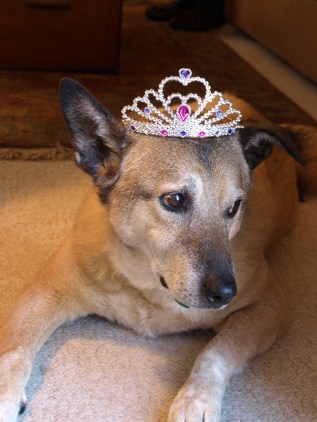
Each March my sister and her family go to Florida. Each March we watch her now geriatric dog, Max, while they are away.

Princess Max

Each July, my family goes to camp in Northern Michigan. Each July my sister watches our dog, Sasha, dig a giant hole in her backyard and sit in it.

Sasha Digs

You scratch my back, I’ll scratch yours.

Exchanging services is a very old way to get something you need without having to fork over money. All it takes is your time and sometimes your talent.

Earlier this winter a colleague in the art department needed someone to turn a bunch of biking and running t-shirts into a quilt. I happen to sew a lot and I’ve made a t-shirt quilt for someone else before, so I volunteered. But any time I’ve sewn for someone else, there is the awkward question of “how much is this going to cost?”

Rather than send my coworker an invoice for something I knew would be fairly simple and for which I would probably only spend $5-10 on materials (since she was giving me a bag full of all the fabric I would need) I asked if perhaps she would use one of her talents for me in exchange.

So Heather will at some point be designing a book cover for me. My initial thought was that it would be the cover for my novel, which I intend to self publish later this year. But I’m also considering whether I might rather have her do the cover for the collection of short stories I will have in 2014. But we’ll work it out.

What talent do you have to offer? What needs do you have to be filled? Find a few people you can help out who can help you out in return. Develop a pool of talented people who can all mutually benefit from each other’s skills and passions.

Are you a good editor? See if you can offer your services free to an influential website in exchange for free advertising space on their page.

Do you know an editor who doesn’t have time to clean her house? Offer your services in exchange for proofing the work you want to publish.

Do you have a friend with connections? How can you help that friend in exchange for some introductions?

Need a better website design? Can you offer your techie friend free fresh baked goods for a year?

Want some professional looking headshots? That friend of yours with the amazing camera and Photoshop skills probably needs something too. Could you supply that need?

Writing and publishing take a lot of time and effort. But amazingly, in this day and age, they may not take as much money as you think.

FIRST WARNING: In this barter economy, you must have something to give. I have known a person or two who only calls or emails me when he needs something and has never offered anything in return. Don’t be that guy. Even if you’re just asking for advice about an aspect of publishing or website design or whatever, you should at least offer something in return, or just show up with a gift that says you appreciate the time your friend has taken to help you.

SECOND WARNING: Don’t let this exchange of services make you start thinking of the people in your life purely in terms of what they can do for you. People can smell this kind of thought process a mile away and you’ll find yourself losing friends instead of gaining help.

Share and share alike and we all benefit.

The Past, the Future, and This Unending Winter

March 16, 2013, Fenner Nature CenterMichigan, like quite a large swath of the country, is in the midst of a depressing cold snap the likes of which puts me in mind of Laura Ingalls Wilder’s The Long Winter. We haven’t started twisting straw into kindling or burning our furniture yet, but one can’t help but feel that everyone is teetering on the edge of that kind of desperation lately.

Last year the temperatures in mid-March were a full 50 degrees higher then they have been during the past week. This was not necessarily good, as it caused massive fruit crop failures when temps dipped below freezing again (for example, Michigan normally produces about 96 million tons of apples a year while in 2012 we only managed 2 million tons). But still, I don’t think I’m speaking out of turn when I say that it would be nice to have temps in the 40s rather than the 20s at this point in the year.

Being stuck in this winter is like being stuck in a story. You get to a certain point where you feel frozen. You can’t push forward. You can’t go back. You’re just…there. Waiting for the thaw in your brain so you can get on with it already.

That’s how I feel right now. Frozen in time. Tired of what has come before. Waiting to see where things will go in the future. Ready to move on. But stuck frozen in place.

How do you hasten spring? How do you thaw the fertile soil of your creative mind? It seems clear to me that we cannot rush the changing of the seasons, as much as we might want to. There are plenty of tips and tricks to get beyond blocks, but sometimes maybe we just have to wait it out, trusting that the thaw will come, the waters will flow, the flowers will bloom, and the story will move on to the next chapter.

A Cruel and Gentle Month

Sugarbush 2013Oh, March. You fickle month. You bringer of sunshine and rain, then ice and snow. You can’t decide whether to reveal the toll the winter has taken on the earth or to cover it all back up again. The birds sing, the red-winged blackbirds and robins and turkey vultures have returned, the very first crocuses have bloomed and frozen. The sap and the rivers are running, but I am sitting inside with my coffee wondering just how much longer until I can get out in the gardens and start cleaning up your mess.

Here’s a poem about March I wrote in 2007 and have been modifying ever since. I think I may have it how I want it now.

March

Month of crows
Driven rain in slush-filled gutters

All the flotsam of winter’s rage—
Empty bags whipped in wheezing wind

Parking lot valleys in the shadows of
Mountains formed from filth and snow and abandoned shopping carts

The frail sun pretends to shine
A sudden squall and all is beaten down again

But then
quietly
pushing up
through mud
comes the green

Stretching
reaching
hoping
comes the green

The sun shines stronger
the days grow longer
and all my fondest hopes of spring
see fulfillment in one blossoming
flower