Yes! NaNoWriMo Is Over . . . Now What?

My last guest post at the Breathe Christian Writers Conference blog today. Now that National Novel Writing Month is over, what are your next steps?

***************

Finally! It’s over. After thirty days of breakneck writing, it feels good to take a moment to breathe. But once you’ve done that, there are a few more things you should consider doing as this year wanes and a new one dawns on the horizon…

Finish your rough draft.

Unless you’re writing middle grade fiction, you’re going to find that most novels are not 50,000 words. YA is generally around 70,000. Contemporary fiction is about 80,000–100,000. Historical fiction and sci-fi/fantasy can get up near 120,000. That’s not to say you can’t write just what you darn well please, but if you want to someday publish your novel, you need to take into account reader expectations and publisher needs. So if you found yourself at 50,000 and felt like things were just getting really good, keep drafting! If you had concluded your story around 50,000, go back to the beginning and rewrite and revise, adding details, subplots, dialogue, and whatever else you need to make your story full and rich.Keep Writing Quote

My advice? Don’t put your 50,000 words away and decide to finish the draft when the holidays are over or in the summer when you finally have some time. Push ahead and finish it now, before the fire is quenched by time and you begin to doubt yourself. Pound out the rest of that draft on the same writing schedule you’ve been keeping in November. Just get it down. It will be a great Christmas present to yourself to have it finished.

Click here to read the rest!

Then go write some more!

Your NaNoWriMo Check-Up

I’m back at the Breathe Christian Writers Conference blog today, guest blogging about the dreaded midway point of National Novel Writing Month.

***************

Okay, NaNos, we’re just about halfway through the month. If you’ve been keeping up with the average daily word count goals, that means you’re hovering around 25,000 words right now. Good for you! If you’ve been falling behind, don’t fret—all is not lost! It ain’t over ‘til December!

If you’re stuck back at 7,845 words or if you’ve lurched ahead to 36,276 words, you have the same goal in front of you—make it to 50,000. And you have the same erin-b-realitychallenges—keeping up steam, moving your narrative forward, finishing strong. It’s as easy to get stuck at 40,000 as it is at 4,000. So how are you going to win National Novel Writing Month?

Here are a few ideas to keep you going:

Reclaim your time and double down on your efforts. Life just took over. I just don’t have the time. I thought I could fit it into my schedule, but it was just too much. NO! None of us have the time. We must all make the time. Get up earlier. Stop watching so much football. Throw your phone in a lake. Novels don’t get written because there are people out there with nothing to do. They get written because people stop making excuses and start making their dreams a reality. You can do this!

Don’t resolve anything at the end of your chapters. You propel your narrative forward the same way you propel readers forward—with tension…

Click here to read the rest!

Then go write some more!

Five-Day Check-up

Well, writers, we’re five days into this NaNoWriMo thing. How are you doing? At the moment I’m sitting on 13,051 words, ahead of where I thought I’d be at this time. The secret? All that pre-writing work I did in September and October!

Capture

If you’re falling behind, don’t give up! Do some extra brainstorming, take an hour or so off of work, and get back up on that horse! Find a big block of time on a Saturday morning or a Sunday afternoon where you can get away from your life and go give life to your characters.

If you’re not part of this wacky writing experiment, how is your November going? Are you enjoying the last vestiges of fall? Are you starting to fret over Christmas? Are you taking the time to eat some s’mores?

November only comes once a year (thankfully <–pun not intended) so milk it for all it’s worth!

Your NaNoWriMo Pep Talk

I’m guest blogging about National Novel Writing Month over at the Breathe Christian Writers Conference blog today.

***************

Are you ready? Are you stoked? Have you been brainstorming? Outlining? Researching? Dreaming? Because it is that time of year again, friends—National Novel Writing Month.

Conceived by someone who understood that sometimes the hardest thing to do is to sit that butt down in a chair and pound EBartelsout the words—and not quit when the words that yesterday were gushing forth like water from a fire hose today suddenly slow to a trickle—NaNoWriMo is about prioritizing your writing every day for just one month. The experience can be exhilarating and exhausting, frustrating and freeing, all at the same time. And if you’re thinking about participating in NaNoWriMo this year, I want to offer you a few tips and tricks to make it a success…

Click here to read the rest!

Then go write!

Moving a Novel from Brain to Page

The last time I was drafting a novel, I used checklists, maps, house plans, foam boards, photos, a loose outline, and a bunch of notes to keep myself on track. It worked beautifully. That manuscript, working title The Bone Garden, is making the rounds among some literary agents I deeply respect. I have high hopes for it to be my debut novel.

OLYMPUS DIGITAL CAMERA

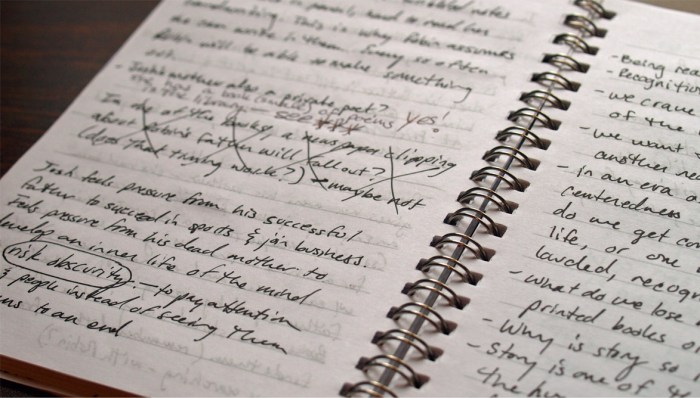
But in the meantime, I’m beginning my work on a new manuscript. This time around I’m doing some of the same preparatory work. I’ve been busy reading background material and making notes.

OLYMPUS DIGITAL CAMERA

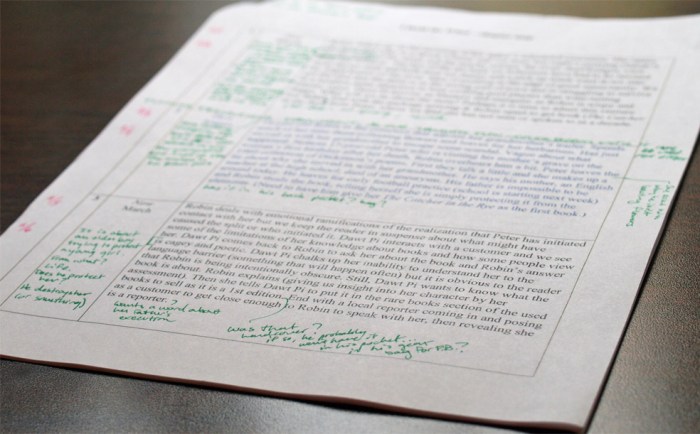
I’ve managed to outline the first half of the book and am already adding notes to it.

OLYMPUS DIGITAL CAMERA

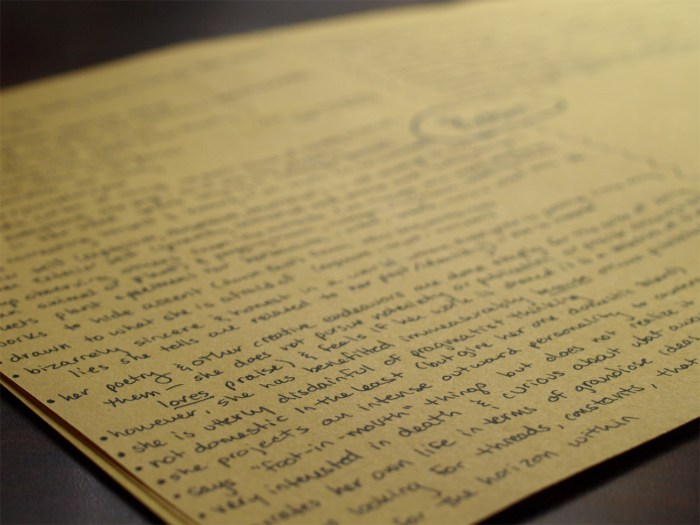
I’ve been spending a lot of time simply focusing on who my protagonist is and where she is coming from, work that I’ve not done quite as much of on the front end in the past.

OLYMPUS DIGITAL CAMERA

I’m doing much more of this preparatory backstory work now because I’m hoping to write in a very deep first person point of view, and it’s hard to do that if you don’t know your protagonist intimately from the very start.

OLYMPUS DIGITAL CAMERA

I’ve made a list of big thematic questions that will be considered in the course of the story. I’ve even written the beginnings of a query letter to focus my mind on the core story.

OLYMPUS DIGITAL CAMERA

All of this preparation amounts to me being able to start off the drafting process with a clear idea of where I’m going and how I’m going to get there. Every day new information falls into place. Every day I add to my little notebook. Every day the story takes up more permanent residence in my brain.

And on November 1st, the first day of NaNoWriMo, it will begin to take up residence on the page.

Writing for Our Better Selves

OLYMPUS DIGITAL CAMERA

These are the first lines of Elizabeth Barrett Browning’s Aurora Leigh, a poem in nine books which was particularly beloved of Emily Dickinson. I’m just diving in to my copy, an 1884 printing of the 1859 text. This quote strikes me, a professional copywriter who is ever writing for others, as a lovely, selfish thought. That is what my fiction is–writing for me, for my better self.

My Mind Full and My Pen at the Ready

The scales have tipped, the tumblers in the lock have fallen into place, the dominoes are all lined up and the finger is making contact with the very first one.

What am I talking about? My next novel.

Next novel? But you haven’t even published your first one. Yes, that’s true. But writers write. And this next one, which I hope will be my second to be published (eventually), has been brewing in my mind since the day after I typed “The End” at the bottom of my last manuscript. And on Thursday night, a key plot element was birthed in my mind like a baby star and I am just about ready to really start writing.

Since early March, I have been feeding my mind a steady diet of classic literature in preparation for writing this next novel, and a few weeks ago I finally picked up this beautiful book, a gift last Christmas…

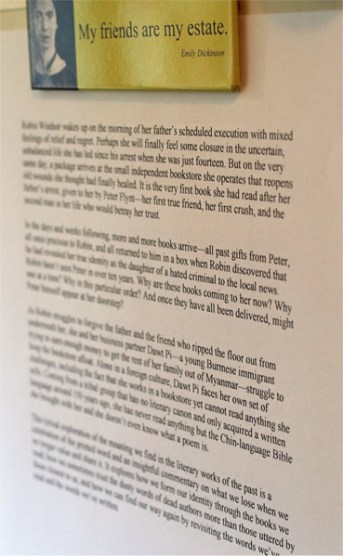
dickinsonI’m smitten anew and excited to say that Emily Dickinson’s life, spirit, and poetry will get a major nod in the novel. In fact, the backbone of the story is constructed of books and poems, the kind that stay with us throughout our lives and to which we return again and again. It is precisely the kind of story the English major in me can hardly believe she will be privileged to write–one that celebrates our vast body of literature in English, makes a case for the singular importance of the printed book, and traces how our identities are wrapped up in what we read at formative points in our lives.

I’m so excited to get started, I don’t know that I will be able to wait until NaNoWriMo, which I had been thinking of attempting for the third time. And if I cheat, I simply could not wear a t-shirt like this with any sense of integrity…

tee shirt

And this is kind of how I feel about that shirt…

napoleon-dynamite-gifWill patience prevail? Only time will tell.


Fear, Courage, and What Makes Your Writing Stand Out

My workshop at the Breathe Writers Conference was on rewriting and revision. I had so much I wanted to cover and not enough time to do it, thus I was forced to truncate my closing remarks. I’m sharing them here in full.

**********************************************

Sometimes as we are revising, we run across something in our own writing that makes us uncomfortable. A bit of truth that slipped out when we weren’t watching. Maybe we let a character say something shockingly true. We read it later and are stunned that it came from within our minds and hearts. We think, “Maybe I shouldn’t say that, shouldn’t let my character say it.”

In the novel I’ve been working on this year, the overarching theme is the really the sovereignty of God—that everything that happens, including the tragic and awful, happens within His will and is part of His plan for our lives for a reason. That theme is played out in the stories of three women. Two of these storylines focus heavily on race, one during the Civil War, another during the Civil Rights era. In writing about the way white people in this country have viewed and treated black people over the decades, in writing about prejudice and lynching and rioting, and in writing about interracial relationships and marriage, I have had plenty of opportunities to censor myself. There have been many times I’ve thought, “People think this way, people say things like this—but will readers think that’s me? Will they think I think that way?” No one wants to be seen as racist.

And on the other hand, there was a powerful pull to remain politically correct, to treat black characters only as victims. Besides the fact that this is an incredibly demeaning label to put on an entire race, when you look at individual lives, not everyone in this world is a victim. (And victims often make the most uninteresting characters in fiction.) One of the climactic scenes is of the Detroit Riots of 1967. As a writer I could not escape from the fact that that scene included young black men destroying property, stealing, swearing, and even shooting at firemen who were trying to keep the neighborhood those same young men lived in from burning down. But a privileged white woman writing about poor, unemployed black men committing crimes? Is that allowed? Or can only African Americans comment on such an event? I was in high school and college during the 1990s, so I have to fight against near-constant “political correctness” indoctrination rearing its head, because all the PC movement ever did was bury issues under a veneer of civility where they continued to fester, ready to explode because they are never resolved.

In fact, in order say anything worth saying about the reality and experience of racism in the North, I had to avoid both extremes of piling on the white guilt and portraying black characters as victims. That’s been done to death. And in between those two extremes is where we find truth—and truth is never without tension. There’s a lot of fear in writing about explosive topics like race, war, the sanctity of human life, the sacredness of the union of husband and wife. And yet those explosive topics are important. And if we censor ourselves in the public square or the intellectual square, we allow others to set the trajectory of our culture.

In revision, sometimes the things that you feel most strongly that you should delete are the things you should keep. When you feel you should censor yourself because of what a reader (often a very specific one, like your mother or spouse or a friend) might think of you, that’s when you should stop, take a deep breath, and move on. Leave that bit in there. That’s what makes your writing interesting, original, individual, and worth keeping. Deep down, we know that the things that frighten us a little or surprise us—those are the things that actually are saying something. The moments we allow ourselves to really say what we mean—those are the things that really need to be said.

Betsy Lerner, in her excellent book The Forest for the Trees, said it this way:

“If you dream of having your work stay alive beyond your tenure on earth, if you hope to see it beside the unforgettable voices that are part of our literary diaspora, then you must be fearless in every aspect of your writing. . . . Most important, give up the vain hope that people will like your work. People like vanilla ice cream. Hope that they love your work or hate it. That they find it exquisite or revolting…‘Note just what it is about your work that the critics don’t like and cultivate it. That’s the only part of your work that’s individual and worth keeping.’ Throw off the shackles of approval. . . . if your book causes a commotion, even the negative kind, you will have made a platform for yourself, something very few writers ever attain. . . . You cannot censor yourself; successful writing never comes through half measures.”

Yes, if you run across a sentence or a paragraph or a chapter that you realize just doesn’t do anything, chop it out of there! It’s dead weight! But if you feel the pull to remove something because it’s uncomfortable or you fear the criticism of others, and yet that part of your work does further your story and does give your reader deeper insight into a character—or into the human condition—be brave. Keep it. Leave it in. That’s the thing that readers will remember. That’s the thing that will make readers sit up straight and listen—because you are someone with something important to say.

Don’t edit out of fear. Don’t edit to protect yourself. Edit to make that shocking truth, that encapsulation of reality hit home even harder. Edit to make that meaning crystal clear.

Because things that need to be said are often those things we wish to hide–about ourselves, about others, about our glorious, messed-up world.

The Joy of a Good Writers Conference

This weekend I spent a couple days in the company of other writers at the Breathe Christian Writers Conference. It was my third year attending, my second year leading a workshop, this time on taking our writing to the next level through rewriting and revision. We had a fantastic keynote speaker, Julie Cantrell, and I’m looking forward to reading her book, Into the Free. And we enjoyed inspiring words and a charge to write the truth and write at the highest level of excellence we can from Dr. Michael Wittmer, a professor at Grand Rapids Theological Seminary and a friend.

Besides those entertaining and encouraging presentations, I was able to attend workshops led by several talented writers, professors, and professionals, including

-Dave Beach, a psychologist who turns his expertise toward creating characters that are highly developed and nuanced by examining them through various psychological lenses. Check out his website, characterdoctor.com to try it out!

Zachary Bartels and Ted Kluck, who took us through all the pluses and pitfalls of indie and traditional publishing, highlighting their own successes and failures in both arenas, and teaching us how to read between the lines while working with editors and big publishing houses. Check out their indie micropress, Gut Check Press.

Dr. Michael Stevens and Dr. Matt Bonzo, who gave us insight into the life’s work of Wendell Berry, who spent fifty years writing about one small locality and made the people and the events in this little rural Kentucky town speak to readers on a universal level. I’m very interested to read their book after dipping into Wendell Berry ‘s work.

I was also privileged to spend time in the company of writers like Tracy Groot, Suzanne Burden, Alison Hodgson, Andy Rogers, Josh Mosey, and others. Breathe is an intimate, noncompetitive group–far more intimate than the huge ACFW Conference we went to in St. Louis this year–and I appreciate the camaraderie there.

The whole affair has me even more excited for the second annual Write on the Red Cedar Conference that my own writing group, Capital City Writers Association, is holding January 16-17 in East Lansing, Michigan. We’re ecstatic to welcome literary agent and author Donald Maass as our keynote, along with other writers, journalists, editors, and agents from around the country. If you’re a writer in the Midwest, this is a not-to-be-missed opportunity to learn from some of the best in the business for a very reasonable price.

You’ll be hearing more about that conference in the months to come. In the meantime, our very busy season at home is hopefully slowing down a little bit. Around here there are gardens to ready for the winter, desks to clean off and organize, quilts and crochet throws to make, rooms to clean…and a new novel brewing in my mind.

October is half over. I want to really live intentionally during the second half. How about you?