I’m happy to tell you that February’s short story, The Door, is now available on Amazon. Click here to preview and purchase this slipstream story for Kindle. Just $0.99.
As before, here is a very short excerpt to give you a flavor of the writing.
Wesley laid the canvas aside, sat on his stool, and stared blankly at the wall for a long time. As he sat, the weak February light moved slowly through the room as the day progressed until finally it rested upon the wall in such a way as to suggest a door where there was none. Something in Wesley clicked.
And why not? Why not a door?
In addition, for one day only I will be putting Beneath the Winter Weeds on sale. On Valentine’s Day (February 14th starting at 12 AM Pacific Standard Time for all you lovely international readers who may not celebrate this silly holiday) you can click here and download January’s short story absolutely free! It will only be free for 24 hours, so snap it up while the getting is good.
We all run in various circles. I don’t mean that in the sense of having no direction, just a dog chasing its tail and not getting anywhere. I mean it more in the sense of social and professional circles.
In the two main circles in which I find myself running about, the word submission has two distinct meanings.
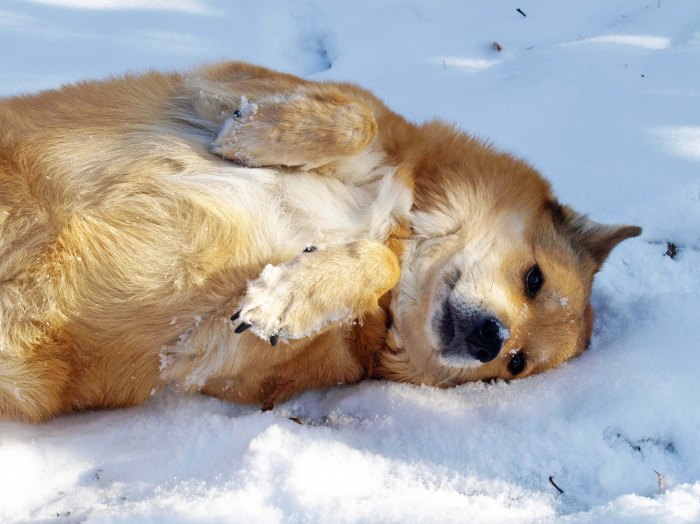
This is what submission looks like for a dog. We humans generally avoid this sort of vulnerability at all cost.
In the circle labeled Writing, submission is a noun (a story or a poem sent to some contest or publication) or a process (the act of sending that story or poem to that contest or publication).
In the circle labeled Faith, submission is always a verb (us submitting to God, husbands and wives submitting to each other, us submitting our plans to God’s will).
In practice, these can feel like the same thing for several reasons.
1. It’s not easy. Submitting a story, querying an agent, sending your tender literary child out into the world–it’s hard. Taking the first step in handing control of your work over to someone else and risking their rejection is difficult in the same way it is hard to trust someone else with control of your life and happiness. It’s kind of scary at first. Submission of any kind requires courage.
2. It’s a long process. Waiting is the name of the game if you are submitting stories to magazines or entering contests or sending out queries. It will usually take months to receive a response and in the meantime you can feel like you’re in a kind of literary limbo. When you hand your plans over to God you can feel that his timing and yours do not always (usually) match up one to one. It’s going to take longer than you want it to. Submission of any kind requires patience.
3. You have to keep doing it, over and over. Submit, get rejected, repeat. That’s the process you need to follow until your work matures, hits a nerve, happens to be timed just right. You can’t give up. Similarly, submitting to God is not a one-time thing–it’s an ongoing process. You have to do it daily. You’re never done submitting. Submission of any kind requires persistence.
4. Eventually, it pays off. You can’t publish something if you don’t submit it, and if you are a good writer who is consistently trying to improve your craft, eventually you will get published. In the same way, submitting to God or to a spouse can seem at first as if you’re getting the short end of the stick–you lose the control over your daily life, you turn over the fulfillment of your needs to someone else. What if they get it wrong? What if they neglect you? But the reality is, God is better at fulfilling your needs than you are, and a loving spouse is as well. Submission of any kind requires trust.
Courage, patience, persistence, trust. Do you have those qualities? Which one do you do best? Which is hardest for you right now? If you’ve shied away from submitting your writing and sharing it with the world, what is holding you back?
Don’t let fear of rejection keep you from submitting. Everyone gets rejected. But if you never submit, never turn anything over out of fear that once you do everything is beyond your control, you can never be the writer or person you were meant to be. If you’ve been given the gift of being able to write well, that gift was given for a reason. Use it. Share it. Submit it to God. And for goodness’ sake, submit it for publication!
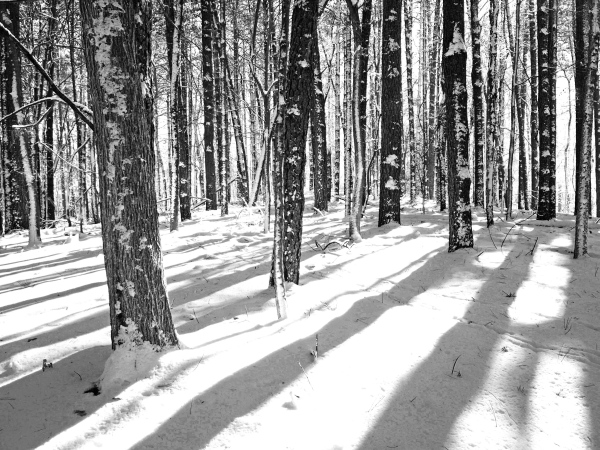
What if we could go right from January to March? Right from the beautiful snowy newness of the first month of the year to the month when crocuses and daffodils start pushing through the soil? Here are 11 good reasons February should just be skipped altogether.
1. Too cloudy. I have no proof for this, but February seems a lot cloudier than January. If it’s going to be 20 degrees, shouldn’t the sun at least be out? White ground and blue sky look great together. Gray skies just make the snow look kind of dirty.
2. SAD. A large percentage of the population hits the Seasonal Affective Disorder wall in February. See earlier point about clouds. In Michigan we all get even more mopey and downtrodden than normal and the littlest things can drive us to despair. What? The timer on the coffee didn’t go off? I may as well go back to bed for a week.
3. No good holidays. Groundhog Day? Seriously? You do realize that if it just happens to be cloudy on February 2 (see earlier point about clouds) that there will be no shadow–and then spring will still come on the spring equinox. Valentine’s Day? Too much pressure and too much pink. Also, hearts are so ’80s. President’s Day? Just another reason for Art Van Furniture to make irritating commercials.
4. A culinary wasteland. All the indulgent feasting of the holidays (the real holidays) is done. The sudden desire in January for fresh fruits and vegetables in order to start the year off right by eating healthier has worn off, but it’s still too snowy for grilling and eating outside.
5. $$$. You get the heating bill for January and realize that you will now have to set the thermostat at 56 degrees in order to pay your bills.
6. Cabin fever is spreading. Forget the flu; cabin fever is as harmful to the mind as H3N2 is to the body. We’re all getting a little stir-crazy in the north. It’s that time of year people plan vacations they can’t afford and spend untold hours trolling the interwebs for time shares in Florida. We just want to see some green foliage and eat outside again. Is that too much to ask?
7. Supplies are running low. We’re running out of firewood up here. There’s that unsettling feeling in the back of our minds that soon things will get a bit desperate and we’ll be twisting straw together until our hands are raw in order to feed the cookstove like Laura Ingalls in The Long Winter. Okay, maybe we don’t have cookstoves, but we have been forced to buy wood because we’re down to the half rotted wood at the bottom of the pile.
8. We’re getting fatter. Yes, there are treadmills and gyms in Michigan, but what we need is good old-fashioned yard work and ice-free sidewalks so we can get off our big butts and get some exercise. We need to build sheds and trim our trees and mow our lawns and dig in the dirt. We need to take the dog for a walk without fearing that the sight of a squirrel will set off a chain of events that ends with us flat on our backs and in need of weekly chiropractic adjustment for the foreseeable future.
9. We’re desperate for fresh local produce. February just adds yet another month that we have to wait before we can eat real strawberries that taste like strawberries rather than the pitiful excuse for strawberries they ship up from Mexico.
10. It’s getting stuffy in here. Our windows have been closed way too long and despite the fact that we’re keeping up with the laundry and vacuuming regularly, the whole house is starting to smell vaguely of an evil mixture of wet dog, old pillow, and potato skins.
11. Seriously, it’s way too cloudy. I just can’t say that enough.
There you have it, folks–all the valid and compelling reasons we should skip over February entirely and get on to March. So, how can we get this done?
According to a fat little marmot, we will be having an early spring. But I don’t put much stock in what marmots say, so I imagine that spring will come officially on March 20th and that we in Michigan will still have to suffer the insult of an April snowfall and wait until May to plant our tomatoes.
However, I do know of one thing that will be coming early. One day after I wrote this, I finished this…
Once I settled my mind on the point of the whole thing, the writing of February’s short story went from slow-drip to freely flowing. And that feels so very good. I’ll leave it alone until my “editor” has a chance to critique it, but I’m itching to get it styled and uploaded to Amazon. I imagine it will be ready around Valentine’s Day. Though I’m not sure of it’s “giftability.”
I’m also eager to get started on my next story. Here’s a peek at what’s coming down the line for March…
My dreams are rarely guided by what we might call a plot. Nothing actually happens in them. They are scenes that flow nonsensically one into the next and go NOWHERE.
My husband can attest to this. The poor man is often subjected to partial recounts of my dreams–partial because at some point he simply walks away because he knows this is going nowhere and yet will not end. He even used my “method” of dreaming in a sermon to illustrate the difference between reading Scripture as a bunch of boring, unrelated stories (“and then this happened and then this happened and then this happened”) and reading it as God’s very well plotted and intentional story (which he generously compared to my more deliberate method of writing) in which we find purpose and meaning. In case this interests you, you can listen to it here. It also contains a fascinating tidbit on the real St. Nicholas, who was apparently a bit of a hothead and prone to decking heretics. True story.
Now, I’ve been busily working on February’s short story, The Door, which I have deliberately made a bit dreamlike. Last week I realized that this was becoming a problem. It was becoming much too much like one of my actual dreams–rambling and random and pointless.
So I stopped writing. And I started plotting. I thought about this story in the shower. I thought about it in bed. I thought about it in the car. I thought about it but did not write down anything I thought of. I just allowed myself to think it through, to think myself into a plot, a purpose, a point.
While turning back toward home on an ill-fated trip through white-out conditions to my office today (Lake Effect Snow = 1, Erin = 0), everything fell into place like fat snowflakes aiming directly for their spot on the ground (rather than swirling madly around my car). I got home safely, put a space heater at my feet, and got back to work with the lovely feeling in the back of my mind that I now know where this story is going.
Dreams are okay. Their very weirdness is interesting. But interesting is not really enough for a story. Writers, we owe our readers a bit more than a rambling but interesting story. We at least owe them a compelling plot or, as is often the case in shorter fiction, a point.
How can you take those intriguing but (admit it) pointless scenes and weave them into a larger tapestry to make them an essential part of your plot? How can you give your readers a clear (though pleasantly winding) path through your forest of very lovely, very interesting trees?
Creative people, when you were young did you imagine yourself being “discovered” at some point? Be honest. When you were a child singing slightly off-key in your room, wasn’t there some part of you that was sure that somehow in your dinky Midwestern town, as you were one day following your mother back out to the car with a cart full of groceries, singing quietly to yourself, that a random Nashville bigwig would overhear your angelic voice and sign you on the spot?
No? That was just me then?
Surely when the pencil drawing you made in seventh grade art class was selected to go on some foam board display in the hallway you imagined that during the next parent/teacher conferences a famous art critic would wander past the cafeteria and stumble upon your flawless execution of a winged horse, track you down in a mad rush of inquiry, and whisk you away to some fine art institution in New York where you would blossom into the absolute toast of the cutting edge art scene.
Am I getting closer?
How about this. Despite the keen awareness in college that you were perhaps not quite as remarkable as you were lead to believe in your small hometown, that you were surrounded by many talented people and could even enjoy being part of this community of young visionaries, there was still a place in your psyche that was reserved for illusions of grandeur, that believed that your creative writing teacher would read your complex and sophisticated short story about losing your best friend and immediately pass it on (with gracious apologies to you for not asking first) to her friend at The New Yorker and you would assume your natural and rightful position as the brightest young literary star to come from your town in…ever.
Admit it. That was you. Some small part of you, anyway.
If it was not you, it was certainly me at various times of my young life. Even in my twenties I felt sure (well, perhaps not quite as sure as I had been in my teens) that the promise that teachers and parents saw in me would simply materialize into worldly success on a grand scale with little effort on my part (and that it would be nothing less than I deserved).
Considering this, you may think turning thirty a few years ago would have sent me into a shame spiral at having not accomplished artistic feats that would last through the ages and get me interviewed on NPR. Actually it felt really, really good. Rather than be despondent that I would never be considered a young prodigy admired the world over for my natural talent and easy charisma, I felt a lightening of spirit as the pressure to live up to the expectations I had placed upon myself was lifted from my shoulders. It was not until the silly desire for admiration was gone that I began to write anything worth reading.
Why do I write today? To exercise my gifts, to enjoy the process of creation, and to share in the exchange of ideas that is one of the many things that distinguishes us from the rest of creation. I love to read and I think when you love to partake in an activity you naturally want to contribute. My experiment of writing and publishing a short story each month of this year is part of a determined effort to contribute.
Sometimes story comes in a torrent and your fingers have trouble keeping up. This was my experience with the last 20,000 words of my novel A Beautiful Fiction. Sometimes story comes in drips. This is my experience with February’s short story (which, it so happens, I started only a couple weeks in to January). This story is dripping from my brain in a slow but fairly methodical fashion, I manage a paragraph or two every few days. So I suppose it’s a good thing I started early.
What do you do when your story resists being told? Do you rush it, force it out? Do you hold to stringent word count goals and so daily fill up pages with stuff you know you will trash later? Or do you change your writing goals to fit the pace of your inspiration?
If you’re writing on a publisher’s deadline, you may not be able to take a leisurely approach to story creation. You take X number of days to write and fill each day with Y number of words in hopes that you will have Z by the time your work needs to be handed over to an editor. The benefit of this method of writing, of course, is that you are generally more productive, are probably better paid for your work, and you can more quickly move on to the next project/contract/royalty payment. You can get yourself out from under a story that was difficult. You can see the end of the struggle.
If you write as a hobby or are publishing your own work independently, you may allow yourself more leeway. You can let your story out slowly, savor the process a bit more, perhaps. You don’t have to worry so much about those times when the next step your character must take is unclear. You can simply wait for the next drip.
Since I have imposed my own arbitrary deadlines for short story creation this year, and since I’m ahead of the game at the moment, I’m not terribly worried at this point about the slow drip. And I know that once things reach a critical point the stream of words will begin to flow more easily as I come to the end. For the moment, anyway, each drip-drop of a sentence onto the page is satisfying to me. My bucket is about halfway full now–and I feel that the tipping point may be coming soon.
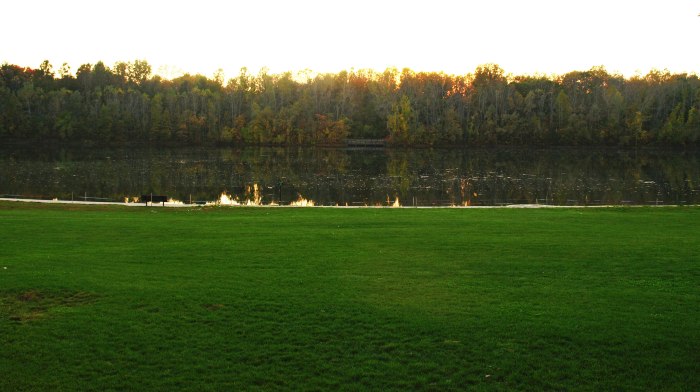
As part of my continuing Destination Lansing series, I bring you Hawk Island County Park. Once a gravel pit (many of the older members of our church remember swimming there back in the days before there was “public safety”) Hawk Island has been transformed into one of the best parks I’ve ever been to.
The pit was cleaned out, filled with water, and stocked with fish. There are pedal boats and picnic shelters to rent, a great playground, a beach and a splash pad, volleyball courts, horseshoes, picnic tables galore, a dog park nearby, and plenty of gently rolling, well-maintained lawns for relaxing on a blanket with a good book or getting a tan.
The Lansing River Trail runs right through it, making it easily accessible by bike, foot, or rollerblades. CATA bus route 18 will get you there, as will your car. There is a fee to park, so I suggest getting the yearlong parking pass as it will save you lots of money and encourage you to get out there and use the parks our taxes maintain!
On days when it’s above 40 degrees, we usually hop on the River Trail (I’ll post on this awesome Lansing feature in the future) near where it splits off to go to Michigan State University and ride roughly south through Potter Park and Scott Woods. Gorgeous ride at any time of year.
And as much as we love Hawk Island in the warm months, it is now equally awesome in the winter. When the picnic tables are all stacked and leaned against trees and the splash pad is covered with snow, Hawk Island’s new tubing and snowboarding hill takes center stage. Tow ropes take you up the hill of groomed snow (which they make, so no worries that the snow cover has been light this year) and then you head down, either sitting in one of their tubes on one side of the tow ropes or on your own snowboard or skis on the other. There are jumps and rails for the snowboarders, and it is loads of fun to watch them as you sit in your tube and get pulled up the hill.
Open in the evening on weekdays from 4pm until 9pm and from 10am to 9pm on weekends, Hawk Island Snow Park is, in my mind, the best new thing to come to Lansing. We enjoyed a gorgeous evening there a couple weeks ago with friends, the beautiful sun setting behind light clouds making everything glow. And a nice bonus was that all the people who were working on the hill that night were very nice (and in an age when good, cheerful service seems hard to come by, the employees of the Ingham County Parks System should be commended as they are invariably, in my experience, both competent and considerate).
I’m a big proponent of not letting weather keep you inside. If you have the right attitude and dress correctly for winter, you can thoroughly enjoy being outside in the fresh, invigorating air. Layer up your clothes, get some adult snowpants, wear good boots, get off your duff, and go have some fun!
I’m putting together a list of helpful, funny, and inspirational writing books as part of a workshop handout and I thought it might be helpful to the blogosphere at large to list and link to them here. You may want to bookmark this page refer back to it when you’re running dry.
I’ve grouped them very generally, because there is inspiration within books on the craft, and there is certainly instruction and advice to be had from the more narrative ones, so I encourage you to check them all out at some point. And if I’ve missed your favorite, add it to the comments.







 Erin Bartels
You must be logged in to post a comment.