How Far We Haven’t Come

Remember how I was so pleased in my last post to be able to work on something new? Well my brain swiftly switched gears back to something old. Something incomplete. Something festering.

Back on December 10, 2013, I wrote a blog post entitled Adventures in Shameful American History that discussed a number of cultural and historical realities I was struggling with as I completed research for a novel I was writing called The Bone Garden. It was before the deaths of Michael Brown and Eric Garner and Freddie Gray, before the unrest in Ferguson and the riots in Baltimore, before the massacre in Charleston.

In January and February of 2014, I wrote the first draft of a novel that turned out to be frighteningly timely. It traces the race relations within several generations of one white family, from auspicious beginnings as participants in the Underground Railroad, to a mixed bag of love and hate during the Civil Rights era, to a new reconciliation in the modern time. For the next year, I worked hard on that novel, revising it multiple times, editing it to a high gloss. But there was always a problem with the modern-day timeline. I fixed some of it, but it still never felt quite right to me. It wasn’t as good as it could be. Compared to the other two timelines, it seemed…too easy.

The day after the shooting in Charleston, I attended a prayer vigil at Union Missionary Baptist Church in Lansing, Michigan. The crowd was relatively small in number but great in spirit. There were mostly African American worshipers, but a fair number of white worshipers as well. The Spirit was moving and pain was released and anger was expressed and sorrow was felt. It was deeply emotional and raw.

Growing up in a white small town in the Lutheran church, I had never been part of a service quite like that before. I’m a Baptist since I married a Baptist pastor, but it’s not a “shoutin’ church,” if you know what I mean. It’s not a charismatic congregation. It’s pretty tame. But I have been privileged to join together with other churches in the city every year, usually during Holy Week, to worship together. Stiff white Methodists and shouting black Baptists and proper Presbyterians and calm Congregationalists, all worshiping together. These have been some of my most memorable times in the house of God.

Even so, this prayer vigil was qualitatively different. It was a lament.

I drove away from that service with a heart that was still heavy. Yes, I believed God would give comfort to the bereaved. But it still happened. There was still a terrible racist person who murdered nine people, including some in their seventies and eighties, for no reason other than his idiotic, misguided, backward, reprehensible beliefs. Beliefs that were taught. And are taught. All over the place. Still.

And I realized what bothered me about the modern-day storyline of The Bone Garden. It wasn’t true. Fiction — good fiction — tells the truth. And I wasn’t doing that. I wanted my modern day white characters to be better than their fictional predecessors. But they aren’t. Yes, some are more understanding and more accepting and more loving. But others are not. They cannot be. Because Dylann Roof exists. Thousands of Dylann Roofs exist, and more of them are being trained up every day. And I do a disservice to the truth to ignore that when writing this story.

So I’m back at it, working hard to make things real. No matter how difficult it is for us to stomach. We look back at our parents’ generation and think that we are better than them. We would never support segregation or turn the other way when peaceful marchers were set upon by dogs and attacked with fire hoses. We would never have let 100 years pass between the Emancipation Proclamation and Selma.

But is that the truth? Obviously not. That Confederate flag flying high in South Carolina? It’s not down yet.
The Beauty of “The End”

Almost four months ago to the day, I wrote this post about my rather unsatisfying writing vacation at Gun Lake, where I had hoped to finish a good first draft of my current WIP, but only succeeded in getting lots of words down on the page that I knew I’d have to fix later. I’ve been picking away at it on and off since then, adding layers and altering plot lines and deepening characters. And I am happy to be able to say that it is now ready for my first beta readers’ critiques. It feels so good to not only have it finished, but to be happy with it. I’m not truly done, of course. Once I get feedback from a few readers I’ll have plenty to edit. But the first big hurdle — writing the dang thing — has been cleared.

In reaching The End, there is a loosening of something that had been wound tight in my chest, a liberating sensation that I am now free to work on a new story, one that has been forming in my mind for weeks, like a flock of birds ahead of winter’s snows. After all, The End is really just the beginning of something new…

Lessons We Can Learn Halfway to Black Belt

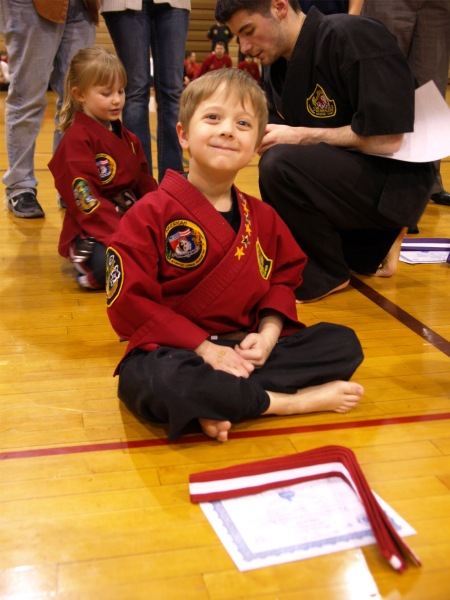
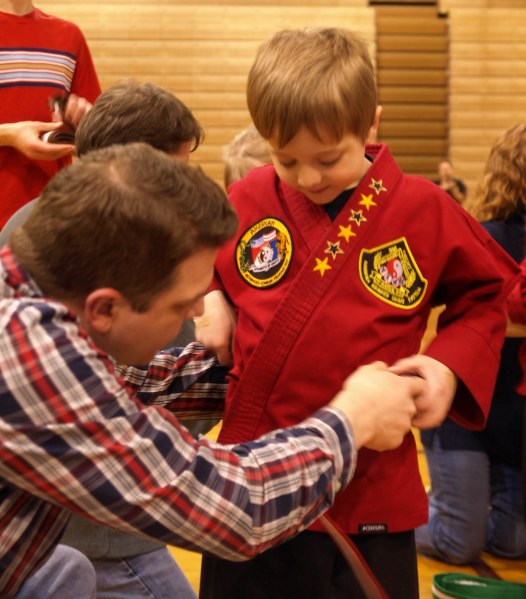
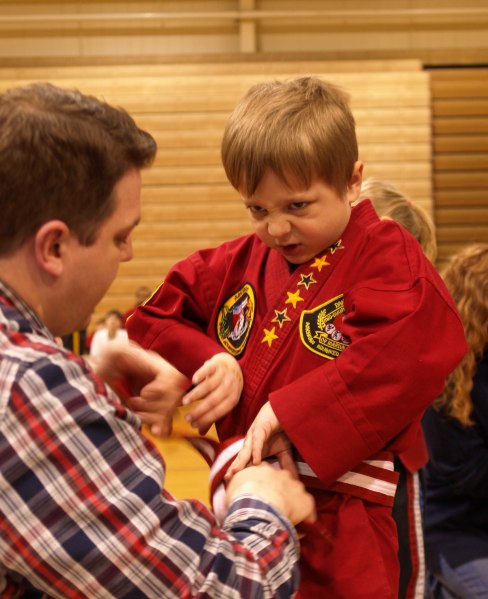
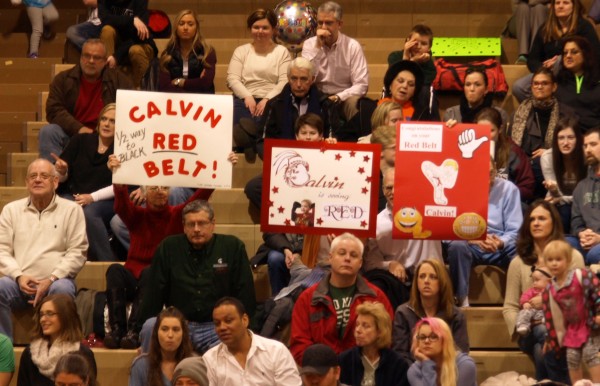
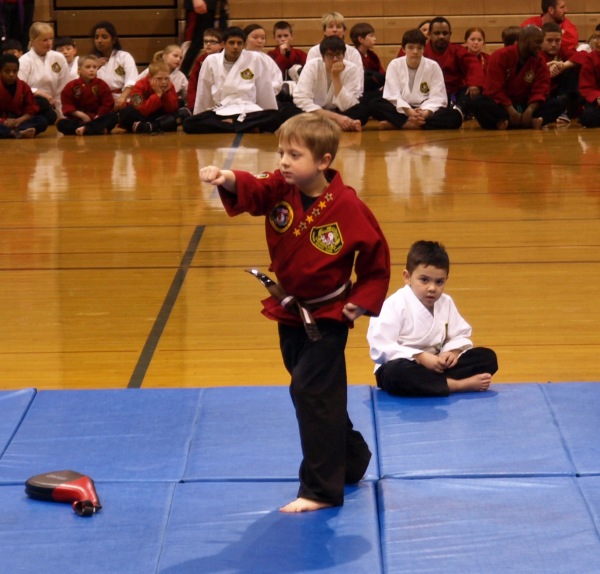
Last weekend our son was awarded his red belt in karate (which is just our shorthand for the real name of the marital arts system he practices — the American Advanced Combat System — which was developed by Sensei Dan Timlin and is based on Bruce Lee’s system of Jeet Kune Do). At his dojo, this means he has moved up to the advanced class, and he’s still just six years old.

OLYMPUS DIGITAL CAMERA

When we started him in martial arts about a year and a half ago (largely due to his obsession with TMNT and ninja stuff in general) we talked to him about the investment of time and money it would entail, about how when we start something, we don’t just quit when we get bored or tired of it.

OLYMPUS DIGITAL CAMERA

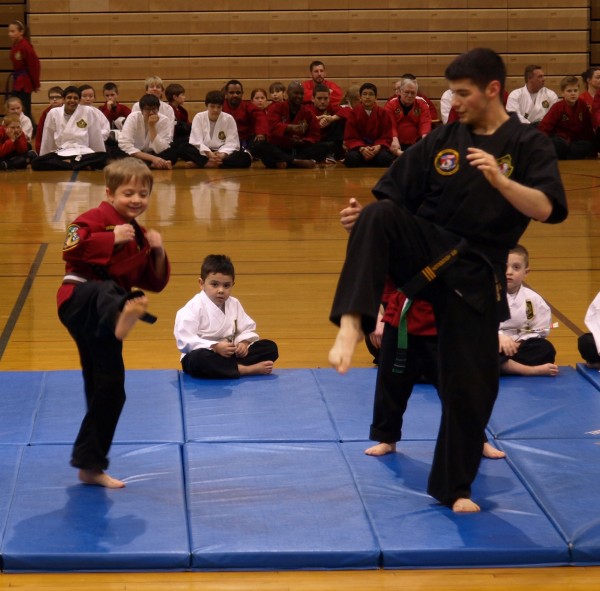
We needn’t have said a word about it because his enthusiasm and dedication has not waned one iota. The young guy next to him in the photos above and below is one of his instructors. He’s a fantastic teacher and incredible to watch on the academy’s demonstration team. He was just sixteen when Calvin started as a white belt in the basic class. He started at the dojo at age eight. When Calvin is eight, he will already be a black belt. When I think of my son someday being able to do the things that this young man does, I get giddy with anticipated pride.

OLYMPUS DIGITAL CAMERA

Now, I’m posting about this partially to share my joy in my son’s dedication and his achievements. But it’s not all about bragging (it is a little about bragging).

It’s also about persistence and drive and dedication to an art. It’s so easy to start something big and then quit when we feel like we’re not making enough progress. Calvin could have watched his teacher do incredible takedowns and disarms and flying kicks and thought to himself, “I’ll never be able to do that. It looks too hard and I don’t think I’m fast enough or strong enough.” But he didn’t. He saw some majorly cool moves and thought to himself, “I want to do that.” And then patient and caring teachers came alongside him and said, “You can do that — but it takes discipline, training, and focus, and we’ll help you get there.”

OLYMPUS DIGITAL CAMERA

And his parents came alongside and gave him encouragement, took him to practice three nights a week, reinforced the lessons he was learning at the dojo, trained with him at home. Because while in some ways martial arts are an individual sport, no one learns best in complete isolation.

What about you? Are you trying to write all on your own? Trying to figure out your camera all on your own? Trying to figure out how to make a certain effect in a painting or Photoshop or a recipe all on your own? What are you trying to do solo that would be easier if you had support, if you had a teacher or a more experienced friend who could answer your questions?

It’s tempting to do art alone, especially if you’re an introvert. And there are plenty of opportunities to practice alone, and that’s not bad. But who do you have who can encourage you and help you adjust your technique if you’re doing it wrong or perhaps just not the easiest or most efficient way?

When I went out to take pictures of the aurora on Saint Patrick’s Day, it was a friend who told me that the aurora was active. That same friend was there when I had questions about how best to photograph them because he and I once had almost the exact same camera. There were a few things I had to figure out by myself, but he was there on the other end of the phone when I had questions. And when I posted a photo on Facebook, he was the first to compliment me on it. How encouraging!

In my writing, I have two great groups of writers who can encourage me to stick it out when the going gets rough and who can share expertise and advice. One is online (Women’s Fiction Writers Association) and one is in the flesh (Capital City Writers Association). Another writing community that is so instructive and encouraging is Writer Unboxed. Beyond that, my husband and a few close friends serve as encouragers, first readers, and sounding boards.

You can do so much more and so much better work when you have a community of like-minded individuals supporting you. If you quilt, join a quilting group or guild. If you paint, organize outings to paint plein air. If you love to bake, create your own informal school or throw a recipe sharing party. If you write poetry, find a local place that can host readings and put the word out to poets in your area. If you’re a musician, schedule a jam session.

When things get tough and your art won’t cooperate or you’ve faced rejection, that’s when you need support. And you’ll find that if you cultivate a community intentionally, that support will be there for you the moment you need it. Those people will keep you from quitting, they’ll celebrate your successes with you, they’ll help you grow, and they’ll feed your desire to succeed.

Your initial passion and intensity may come from within…

OLYMPUS DIGITAL CAMERA

…but you can bet that it’s easier to maintain when others are there to hold you up.

OLYMPUS DIGITAL CAMERA

Me on the Radio

I finally got up the courage to listen to a radio show that I was on back in…oh, was it last year? Yes. Yes it was. I was sure I sounded like kind of an idiot, but as it turns out, I don’t. I shared this interview time with Alyssa Alexander, a Lansing area author and a fellow member of the Capital City Writers Association. Alyssa also does not sound like an idiot (so kudos to the both of us).

So if you want to hear more about me, what I do for a living as a publishing professional, and a bit about why I still read and prefer printed books to ebooks, please give it a listen.


The Only Stuff You Can Control

Today I was with my first grade son in line at Jo-Ann’s to buy elastic (part of a TMNT shell modification to hold smoke bombs, of course) when the older gentleman directly ahead of me turned around and asked me if he could speak to my son. I said, “Sure.” The man said, “Young man, do you want to hear a joke?” It went something like this:

“What did one snowman say to the other snowman?”

“What?”

“Do you smell carrots?”

It took a little explanation for my boy to quite get it. But then he thought it was funny. The man took his turn at the register, we took ours, and I’ll probably never see him again.

Why do I tell this story? Mostly because I’ve been thinking a lot about control this week. I have been really up and down creatively and professionally. Few would know it because I generally keep my struggles to myself (that’s the German Protestant side of the family coming out). I don’t broadcast my troubles to the world. Except for my husband and a few very close friends, no one would know the mental and emotional state I’m in is anything but balanced and generally positive. This isn’t because I’m putting on a front or trying to craft a life that seems perfect. It’s because 1.) everyone has enough troubles of their own (many light years worse than my own) and 2.) it’s no one’s business.

What does this have to do with snowmen smelling carrots? (It’s because their noses are carrots, by the way.)

There’s so little in life over which we exercise any real control. Most of the time, we can’t control who talks to us or what they might say. I was so taken aback that this man asked my permission to talk to my son, it shook me out of my standard way of interacting with strangers (which is basically to ignore them unless they engage me, and then, using lightning swift and probably premature judgment based on age, sex, dress, and whether or not I’m hangry, to determine if I will immediately be on the defensive or will give them the benefit of the doubt). This man gave me the option to shut him down before the conversation even started. Of course I didn’t (who would?) and of course after I said he could talk to my son, he might have said any number of inappropriate or terrible things. But he put the control in my hands.

I can’t make my house worth what it was worth when we bought it. I can’t give myself a promotion. I can’t make people take a chance on my writing. I can’t make an overly sensitive person chill out. I can’t raise the temperature outside above freezing (or even raise it one degree). I can’t stop my son from growing. I can’t make my dog’s back legs work better.

But there’s a lot I do have control over. I can keep my house clean and livable. I can do my best work each day. I can keep improving. I can disengage from people that baffle me and go buy a plane ticket to visit a childhood friend I miss terribly. I can put on another pair of socks. I can enjoy this moment in time. I can let my dog lick leftover syrup from the breakfast plates.

Writing this post won’t get me over what’s bothering me right now. I wish it would. Time, prayer, and likely the changing of the seasons in a month or so will help. But in the meantime, I’m trying to focus on what I can control and leave the rest up to Providence.

The Work We Accomplish and the Work We’ve Yet to Do

GunLakeFireplaceI’ve just returned from a weekend excursion with my husband to Gun Lake where we sat (and slept) by a roaring fire for three days of writing with no responsibilities, interruptions, or internet. The house at which we stayed isn’t remote or lonesome–Gun Lake is fully developed. But there’s something about driving an SUV through a foot of unplowed snow on a long driveway that approximates the feeling of remoteness.

Temperatures were in the single digits and wind was fierce, making the frozen lake look and feel like the arctic tundra. Glancing ahead to the extended forecast, I see that the remainder of February will be very cold. No brief thaw for us this time around. Which is all well and good, I guess, as it inevitably leads to misguided feelings of euphoria that spring is just around the corner. We know better.

And anyway, who needs spring? Our indoor projects are not yet accomplished. As I type this, I hear the sounds of hammering below me as my husband puts the trim along the bottom edge of some new shelves in the family room. Today’s big project will be going through our son’s toys with him, weeding out the unused stuff, and making the basement family room into Toy Central, thus ridding the living room of constant six-year-old related clutter (I hope).

Sometime this week or next I’d like to get back to my rabbit mosaic and add the background tiles. The workroom and laundry room in the basement need serious reorganization and cleaning (so much sawdust!). There’s an embarrassing amount of piled-up fabric in my sewing area. And I’d really like to finish the prep work for a quilt I’ve been making for my son for the past three years (during which I’ve been periodically cutting out and hand-basting the edges of nearly 3,000 little hexagons) so I can get the top sewn together (again, by hand) and then quilted (by machine!) before he graduates from college (again, he’s six).

And somewhere in there I’d love to get the first draft of I Hold the Wind completed. I had had hopes of doing that this past weekend at the lake, but here I am home again with an incomplete draft. I’m happy that I made some more progress on it, but I left the lake with a nagging dissatisfaction with my work. It wasn’t bad, just…inadequate.

This morning I opened up a file on my computer titled Big Questions. It’s a list of, well, big questions that I want to consider and perhaps answer in this story. They are the themes and issues I wanted to explore. They’re what made this story idea so appealing to me in the first place. But somewhere in the middle and toward the end there, I got so focused on getting the plot down that I stopped thinking about these big questions. It happens. You may have to get through Lamott’s shitty first draft before you can make a story all that you believe it can be. Still–it’s painful to write stuff that’s not up to one’s own standards.

What I accomplished at the lake was forward motion. What’s needed now is depth. And depth can be achieved by slowing down, digging back in, focusing on character, and shining light on the little details that create poignancy and permanence in a reader’s mind.

And what better way to spend a long string of cold February mornings?

An Incredible Weekend with Literary Agent Donald Maass

Phew! What a week and what a weekend. By the grace of God, the prayers of many, and the workings of modern medicine, I was able to function on Friday and Saturday for Write on the Red Cedar. I also managed to get quite caught up today at work, despite almost a week of painful delirium where I think I may have answered a dozen emails, all with a mere sentence if possible. And now I am almost at 100% again.

OLYMPUS DIGITAL CAMERAOne of the highlights of my weekend was driving Donald Maass from the airport to the Kellogg Hotel and Conference Center, chatting about my writing. Don gave a fantastic, uplifting keynote address Saturday morning before launching into two hours of instruction on Writing 21st Century Fiction. As insightful and winsome as he is in writing, he is even more so in person. I was lucky enough to sit by him at lunch while our table shared stories of family, publishing, MSU shenanigans, and Michigan’s natural beauty.

After lunch, Zach and I answered questions about traditional publishing at a “roundtable” discussion, which I think was helpful and enlightening for the participants. Then I presented a workshop I’ve done at the Breathe Christian Writers Conference called Finding Your Writing Rhythm. I felt a little rushed with only 45 minutes, but I got some good feedback from attendees and, best of all, my voice held out.

Next I attended a great workshop on character led by author Kristina Riggle. She had some wonderful insights about how to create characters that walk off the page and feel like real people.

After a quick agent/author panel, I tried my first real solid food in nearly a week and managed not to choke (huzzah). Then I settled in for four hours of Writing the Break-Out Novel with Donald Maass. Wow. Writers, if you ever, ever have a chance to sit under this man’s teaching, you need to do it. Don is engaging and funny and challenges you–commands you, even, but in the nicest of ways–to think differently about your writing, to forego the easy solution for the creative solution, to raise every aspect of your craft to the next level, to take control of your fiction and thereby take control of your reader’s emotions in order to create fiction that moves and sticks with people.

I have a notebook full of ideas that Don drew out from me through his probing questions and exercises. I’m excited to get back into my first draft of I Hold the Wind and to get The Bone Garden back out to make even more improvements.

But I think the most important thing that Don said, for me at least, was this (I’m paraphrasing): You have the time. No novel is so timely that it can’t wait a few more months or a year or more for the author to make it better, to make it as good as it can possibly be. Don’t be in such a hurry. I’m going to try to take that to heart this year and truly enjoy every minute of the process of writing rather that always wishing for the next step to be here.

There is time. There is always time.

Accepting the Pace Life Wants to be Lived

I’m a week away from the writing conference I am helping to put on (Write on the Red Cedar). We’re sold out. All the nitty-gritty details are being dealt with. I’ve been busy updating the conference blog almost every day, which may partially explain my slow posting on this blog. And even though we haven’t run into any huge snafus yet, I still feel a bit like this guy…

OLYMPUS DIGITAL CAMERA

Like I have one little part of this thing in hand, but also I am going to trip up at any minute. I’ve started having dreams about things going wrong, like back when I was in high school plays and I would have dreams of shoddy scenery falling down during a performance. But mostly, I’m excited.

I am still slowly plugging away at the first draft of my current WIP. My ideas are at a slow burn. I type a paragraph then do other things, come back and type another. I stopped drafting the other day to jot off a very short story (fewer than 1,500 words) as a fun diversion. The novel draft won’t be done by conference time, but it should be finished by the end of the month, which is fine with me. That will give it enough time to sit and simmer before Zach and I take a long weekend writing retreat during which I can do the first big revision.

As frantically busy as November and December were, in writing and in life, January has gotten a slow start. And I’m okay with that. Winter’s really here now, and it bids us take our time.

Waiting for the Snows

But for a few days in November, mid-Michigan has been naked this winter. Today was rainy and in the 40s and felt like spring, a melancholy masquerade in late December. Two days out from Christmas with no snow on the ground and even the most summer-loving Midwesterner must feel an itching wistfulness. When we moved to Lansing from Grand Rapids in 2005, it was a green (brown, really) Christmas. During the week following, I was working in my new yard, pulling English ivy from walls, trimming tree limbs with a saw my father got me for Christmas, and digging up sandstone rocks from beneath the ground. I was more than 50 pounds lighter then than I am today, eager to make my new home my own. Nine years later and I have nothing to do in the garden despite the warm temperatures and the soft earth. The garden is “finished” as far as that goes.

I won’t lie; the lack of snow has got me down. What is winter without snow except a long, dull stretch of cloudy sky and gray-brown earth? Tomorrow is Christmas Eve. There are lights on the house, presents under the tree, family coming for good food. I’m anticipating the smiles on the faces of my son and husband as they open up their gifts. I’m listening to carols and playing them for my son on the guitar at night. Tomorrow night is our candlelight service at church. Everything is as it should be–except the snow. Funny how one thing out of place throws off the whole thing.

One thing out of place.

When I turned my calendar to December a few weeks ago, I was met with an envelope containing a letter I had forgotten I’d written. Last night I cheated and opened it a week early. At my husband’s bemused urging, I read it out loud. It was cheesier than I can imagine myself being. Or maybe it wasn’t cheesy so much as it was too sincere. We had a couple good laughs during my oration. Still, I was pleasantly surprised to find that most of my hopes for myself had come to pass in 2014. One very particular one did not–one thing out of place–but I am slowly becoming okay with it. Perhaps the most surprising thing was that I was ahead of where I had claimed I hoped to be when it came to my writing. And yet, for much of the second half of 2014, I have been impatient and felt as though I was lagging behind. My January 2014 self, the one who wrote that letter, seems a more reasonable person than my December 2014 self. And I’m glad that she reminded me just how much I have accomplished this past year.

So I wait for the snow and I wait for the fulfillment of a goal I hadn’t really given myself a year ago. I remind myself that I’m right on track and that Christmas comes whether it snows or not. I may feel that there is still one thing out of place, but in reality it is just my own impatience. God’s time is rarely our time, is it?

Yes! NaNoWriMo Is Over . . . Now What?

My last guest post at the Breathe Christian Writers Conference blog today. Now that National Novel Writing Month is over, what are your next steps?

***************

Finally! It’s over. After thirty days of breakneck writing, it feels good to take a moment to breathe. But once you’ve done that, there are a few more things you should consider doing as this year wanes and a new one dawns on the horizon…

Finish your rough draft.

Unless you’re writing middle grade fiction, you’re going to find that most novels are not 50,000 words. YA is generally around 70,000. Contemporary fiction is about 80,000–100,000. Historical fiction and sci-fi/fantasy can get up near 120,000. That’s not to say you can’t write just what you darn well please, but if you want to someday publish your novel, you need to take into account reader expectations and publisher needs. So if you found yourself at 50,000 and felt like things were just getting really good, keep drafting! If you had concluded your story around 50,000, go back to the beginning and rewrite and revise, adding details, subplots, dialogue, and whatever else you need to make your story full and rich.Keep Writing Quote

My advice? Don’t put your 50,000 words away and decide to finish the draft when the holidays are over or in the summer when you finally have some time. Push ahead and finish it now, before the fire is quenched by time and you begin to doubt yourself. Pound out the rest of that draft on the same writing schedule you’ve been keeping in November. Just get it down. It will be a great Christmas present to yourself to have it finished.

Click here to read the rest!

Then go write some more!