Just Because It’s Good Doesn’t Mean It’s Bad

For much of middle America, spring is a mixed blessing as the same warm air that brings the flowers back also brings severe weather.

Living in an area with only mild tornado activity and no hurricanes or tropical storms (one of Michigan’s many excellent qualities), I love a good rainstorm and I especially love the sound of thunder. When the skies darken and the atmosphere rumbles and tumbles around me, I get a feeling in my gut that is hard to describe. A bizarre sort of mixture of deep awareness of the season and of the power inherent in nature, fond childhood memories of watching storms with my dad in the open garage, and that vague nagging instinct to seek cover. Just a pinch of terror to season it all. Gives me goosebumps just writing about it.

There have been times in my life when I have worried about the weather. A few tense cross-state car rides in whiteout conditions (once with a vanload of youth groupers for whom we were responsible). The first tornado warning I experienced with my infant son in the house. I recall our Little League coach telling us not to hang on the metal chain link fence while menacing clouds glowered and jagged lightning danced on the horizon lest lightning strike, travel through the metal, and kill half a dozen of us in one fell swoop. But during most storms I am safely tucked away inside with a plan worked out for staying that way in case of emergency (interior basement room, away from the windows, stocked first aid kit, etc.).

However, I remember vividly a summer storm when I was 13 or 14. Our softball and baseball games were all canceled and parents were whisking their ball-capped kids from the field and driving down country roads bordered by ditches, heading for basements at home. The reason I remember this day is two-fold.

First of all, the air was different. Whereas a winter storm might cause a whiteout, what we were experiencing as my mom drove me back into town after dropping a friend off at his house was a greenish-brownout. The air was thick with dirt and organic matter that was being stirred up by a supercell not far from us. The thing about those videos of tornadoes on YouTube is that you can only see the actual tornado if it is a good distance from you. Once it’s close, you can’t always see it. That’s the scary part.

Second, and much worse than the eerie air swirling around the car, my sister was unaccounted for. Well, we knew she was at a friend’s house, but that was not good enough for my mother. She needed to see her eldest daughter, to have her in our own basement, not someone else’s. So we cut through the dense air to pick her up and bring her home. As a mother now, I can more easily imagine what my own mother must have felt during those soul-tense moments.

The rest of that day is a blur. The next morning trees were down all over town, but I don’t actually remember the worst of the storm. In fact, I don’t even remember actually seeing Alison get into the car or rushing inside our house or going to bed at night. But I remember that car ride between the softball fields out in Hampton Township and the house-lined streets of Essexville.

When you read really good fiction, the same thing happens. You are left with a feeling, sometimes hard to describe but real nonetheless, that you can’t get from mere recounting of events. There are a number of books that I adore that I could not easily summarize for someone else because what happened in the book is not what I remember. I remember how I felt when I read it. There are other books for which I could give a plot synopsis to a friend who asked what it was about. But if I’m recommending a book it is almost never because of plot and I tend to say little about what happens (which always sound so sterile when recounted to another) and more things like, “I can’t explain it to you. You just have to read it.”

A good storyteller can cause physiological reactions in a reader’s body through black marks on a white page. The process is astonishing and awe-inspiring to me. Letters are arbitrary. Phonics are meaningless. Words alone convey some form of reality, but not in whole. But when those letters and sounds and words are strung together in an artful way, more than meaning is produced.

I’ve read a lot in recent years about how authors should remove the parts of their writing that they think are the best because they are probably overwritten and self-indulgent. Not so fast! I’m here to declare that not every story is best told with spare language. Granted, some certainly are and the most talented writers (in my mind) can use very little language to convey deep emotion. Still I would not recommend arbitrarily deleting those passages just because it is currently popular to do so. Maybe have some beta readers test them. Find out what clicks and what doesn’t. Some probably are overwritten. But some of them really may be excellent writing that works and helps to tell your real story. What I mean by the “real” story is not the plot, not what happens, but what you want the reader to feel, what you want him to remember long after that last page.

It’s the difference between this…
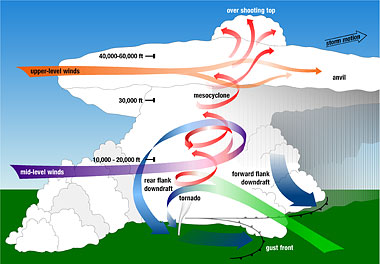
Photo credit: Weather Wiz Kids (http://www.weatherwizkids.com/weather-tornado.htm)

And this…

Photo credit: I dunno. It's sort of fuzzy where this originated, but I found it here: http://www.fanpop.com/clubs/national-geographic/images/6968510/title/tornado-wallpaper)
Photo credit: I dunno. It’s sort of fuzzy where this originated, but I found it here: http://www.fanpop.com/clubs/national-geographic/images/6968510/title/tornado-wallpaper

Strive to write in such a way that your deeply held emotions and experiences are made alive and immediate for your readers. Pick out the details that say more than you could say in a paragraph of words and make those details hardworking representatives of the whole. This will keep your good descriptive writing in your story without overdoing it.

For example, in my story of the car ride to get my sister and get home before the tornado struck, I could spend paragraphs describing the weather, how tornadoes form and the destruction they can cause, my own thoughts and the thoughts of my mother, spelling out everything for the reader so there would be no mistaking what happened. But that’s not what made the ride memorable. I don’t remember my own thoughts and I don’t have access to my mother’s thoughts. I was not thinking about the physics of tornado formation at the time. I don’t know if my sister was worried at her friend’s house or whether she was relieved at the sight of her mother pulling up in the driveway to get her.

What I remember is the way the air looked and that feeling you get in your gut when you don’t feel safe. That’s it. So if I were to tell that story, that’s what I would focus on. And if I did it well, I would hope that I could get a reader, even one who had never been in a similar situation, to know what it felt like. And I could probably do it in just a few sentences if I worked hard at it. It might start as a couple overwrought paragraphs, but being a copywriter by trade, I think I could get it down to three really hardworking sentences. I certainly wouldn’t discard it altogether.

You’ve read scenes like that, or even entire books. They make you forget you’re on your couch or tucked under your covers. They pull you in completely. That’s great writing. And that’s what I hope we’ll both create–and keep.

Life Lessons from an Injured Bat

I realize that not everyone loves bats. In fact, the photo below may make some of you shudder involuntarily. Forget all the arguments for their usefulness and their harmlessness, they just give you the creeps. But bear with me a moment, because I think there is a lesson to be learned from this particular little bat.

OLYMPUS DIGITAL CAMERAI found this little brown bat on the ground when I was putting out some yard bags this past weekend. He was lying on his belly in a dirty bare patch on the still-dormant lawn beneath the lone ash tree on our street (perhaps in the entire city of Lansing) that has thus far miraculously survived the onslaught of the insidious emerald ash borer and getting run into by a car.

I could see this little bat was breathing and, knowing a little something about bats, I knew first of all that it could not fly from a ground position (bats must drop from a height to fly) and that I should by no means touch it, even begloved in thick leather, because if it bit me (which, being frightened and/or hurt, it surely would) I would have to get an expensive and painful series of shots to ward off rabies. So I went to the garage to get a long-handled flat shovel, not to bash the poor thing to death, but to pick it up safely.

I carefully scooped it up, eliciting a threatening display of tiny white teeth but little more in the way of resistance. Then I walked it to the large mostly-dead sugar maple by the garage, well away from the road and any possible contact with unsuspecting children or adults with no sense. I placed the blade of the shovel against the tree and let it slowly grip the bark and huddle against the rough bark. It crawled around a little to find a place sheltered from the wind and remained. A day later it was still there.

I wanted so desperately for it to fly away. I wanted it to leave the shelter of the tree and fly off back to the group of bats it must have wintered with. I suspected that that might be at the top of the very tree I put it on since it has hollow parts. But it hunkered down and did not move. Perhaps it was injured and could no longer fly. Whatever the reason, despite my efforts, it remained frozen in place.

Here’s why I bring this up here on a blog that is mostly about writing. Sometimes as a writer you get knocked down, whether you are a bestselling megastar or someone who has shared your work with only a few close friends or a bunch of strangers on the interwebs. You get a bad review (or maybe lots of them). You get a rejection letter (or maybe lots of them). You get silence (which is sometimes worse than negativity). You’re face down in the dirt wondering what hit you.

I hope that each of you have someone in your life who cares, who scoops you up, talks tenderly to you, and helps you get back on your feet. That person may not have the power to make you fly again, but maybe just knowing that there are those out there who care about you and your work will give you some sense of camaraderie, some feeling that you matter. Because you do. Whether or not you ever sell that screenplay or ever capture an agent or ever make a dime from your writing, you matter.

Then, once you’re back in the shelter of that tree, that place of safety, I hope you will take off and try again. Don’t hunker down and give up. Because your best days are waiting for you up ahead. Create your art. Share your stories. Take flight.

Getting Over Myself and Getting Scrivener

scrivenerlogoLast night I downloaded the trial version of Scrivener and went through the very lengthy but mildly entertaining tutorial. Then I started fiddling. A day later I have a huge and growing character list with descriptions, a few settings drawn out, and an entire novel outlined with chapter synopses written.

Oh my goodness, I love this program. When I wrote my first manuscript I wrote it start to finish, no outline to speak of until I was halfway through writing it and finally knew where I wanted it to go (and where it wanted to go, frankly). The thought of conceiving of an entire novel and outlining each scene struck me as very difficult. Maybe impossible for me, despite the fact that I’m a fairly organized person (stop laughing, Mom). Hence, though the program sounded intriguing, it also sounded daunting and pedantic.

But here I sit, book one of a series completely outlined and waiting to be written. Books 2-4 have been loosely sketched out (like we’re talking major plot arcs, nothing detailed). And I feel great about it.

If you’ve never given Scrivener a try, I urge you to check it out. You can try it free for 30 days (non-consecutive, meaning 30 real days whether taken all at once or stretched out over 10 years) and it’s only $40 to buy. A super cheap tool to help you get your story organized (or organised as they, being British, would spell it) and get yourself a large part of the way down the road to having actually written out that book.

It has a ton of features to help you, including tools to organize and access your research; format your work depending on what it is (nonfiction, novel, screenplay, short story, etc.); track characters, themes, and keywords; and tons more I can’t remember because that tutorial was so dang long.

Still unconvinced? Joanna Penn wants you to use it too.

April’s Short Story Is Here–and It’s Free Today Only!

The next morning the sun was behind a cloud, but they started on, as if they were quite sure which way they were going.

‘If we walk far enough,’ said Dorothy, ‘I am sure we shall sometime come to some place.’

This line from chapter 14 of The Wonderful Wizard of Oz by Lyman Frank Baum did not inspire April’s short story, but it did provide the title after it was written. I’m particularly proud of We Shall Sometime Come to Someplace as a story that attempts to combine the three main conflicts (man vs. nature, man vs. man, and man vs. himself) into one short tale, and also alludes to three particular well-known stories that involve portals and other worlds of some sort.

I first had the inkling of an idea for this story a couple years ago during a drive in March when the skies were studded with clouds that looked like they belonged to the month of July. It grew from the short note I jotted down about it and an element of one of my recurring dreams.

Because I like this story so much, I’m offering it free on its release day (and that, my friend, is today) so click here and get your free copy! (No, this is not an April Fool’s joke; it really is free.)

We Shall Sometime Come to Somplace

Taking My Own Writing Advice (or, My Terrible Epiphany)

I hope you won’t mind if I direct most of this post at myself. Because, frankly, I need a good talking to/kick in the pants/smack upside the head.

Myself in a Mirror

Listen, Erin, you have some problems. It seems like everyone compliments your writing (all those agents who declined to take you on had very nice things to say about your technical skill) but there are some serious problems with your manuscript for A Beautiful Fiction that, even if you self-publish, you’re going to want to fix. You know what these are.

Problem 1: Beta readers find it difficult to sympathize with your protagonist.

Your rationale: My narrative voice is detached in an attempt to counter the tendency in a lot of modern fiction to tell too much and therefore not allow the reader to think at all.

Solution: Uh, DUH! Switch from 3rd person to 1st person so you can let people inside your protagonist’s messed up head! (Yes, this will mean rewriting the entire 85,700-word manuscript.)

But that’s not all is it? How about…

Problem 2: Story takes too long to get going.

Your rationale: It just wouldn’t make sense to start later or move things along faster because the storyline would be completely implausible.

Solution: Start at the point the action is intense, then flash back a bit here and there to fill in the details. Seriously, it took you this long to figure this out? For crying out loud, you just wrote a blog post about this very technique for a different story!

(Yes, I admit, it was when I was rereading my own blog post [hanging my head in shame] that I realized this advice could be applied more broadly in my own work.)

There are probably other problems in that manuscript, but two is enough to work on for now. So get your butt in gear, Erin, because you have got a LOT to do now.

Sheesh.

In my defense, though, I will say that had I not stepped away from that manuscript for about six months, I would not have come to realize these possible solutions to my problems. Now that I can look at it more objectively, I can get back to work and make A Beautiful Fiction beautiful indeed.

Beginning at the End

Some stories start at the beginning. Some start somewhere else. It’s not always an easy thing to recognize when your story actually begins. I’m still unhappy with how A Beautiful Fiction begins and may need to massage it before publication. For one of my current novels-in-progress (yes, you can tell I’m not a full time writer just by this statement alone I think) I think I’ve just discovered where it truly begins.

You see, as I began last November to write the book I’m now calling My Life in a Minor Key (you may remember my derailed and then failed NaNoWriMo plans) I knew how it would begin and how it would end (a change from how I wrote A Beautiful Fiction, for which I had no plan at all of how it would end when I started). The first and last chapter would be book ends that echoed one another and I had a vague idea that the entirety of the book would be one big literary chiasmus.

I still kind of like the idea of that structure, but it occurred to me randomly and out of the clear blue cloudy gray sky the other day that what I really ought to do is start with the very last chapter. Rather than being a straightforward narrative in which the reader discovers only at the end what has happened to a character, I believe it would be better told already knowing the climax and then backtracking to see what could have possibly led this character to this point.

Breaking Bad Season OneThis is not a new idea. You see it in a lot of post-Tarantino movies. The very first episode (and then many others) of Breaking Bad did just this, starting at the climactic moment of the episode, giving the audience absolutely no background to understand what the heck was going on, and then restarting a bit earlier to fill in all that missing information. The joy of watching in these cases is not discovering along with the characters what will eventually happen. It’s knowing the end and then, like a detective, sorting through all the little events that lead up to it.

Sometimes, if a story is long enough, you as a reader or audience member won’t even remember that you really already know how it will end. Remember how the 1999 film American Beauty started? Kevin Spacey told you he would be dead in less than a year. But I don’t know anyone who remembered that fact by the time they got to the point he actually dies in the movie. (Wait, you’ve seen it, right?)

Thinking of your own WIP, where does the story really begin? What is the most engaging way you can start it so that a reader simply must read on? Sometimes it takes a few chapters of writing to get to that point. Sometimes you need an outside reader to tell you where things really pick up, then try using that as the starting point. If modern cinema has taught us anything, it’s that people really don’t need to know much at the beginning to get sucked into the story. In fact, too much information and exposition up front is kind of tedious.

As for me, I’m beginning at the end this time around. I guess we’ll see how it all works out. Eventually.

The Past, the Future, and This Unending Winter

March 16, 2013, Fenner Nature CenterMichigan, like quite a large swath of the country, is in the midst of a depressing cold snap the likes of which puts me in mind of Laura Ingalls Wilder’s The Long Winter. We haven’t started twisting straw into kindling or burning our furniture yet, but one can’t help but feel that everyone is teetering on the edge of that kind of desperation lately.

Last year the temperatures in mid-March were a full 50 degrees higher then they have been during the past week. This was not necessarily good, as it caused massive fruit crop failures when temps dipped below freezing again (for example, Michigan normally produces about 96 million tons of apples a year while in 2012 we only managed 2 million tons). But still, I don’t think I’m speaking out of turn when I say that it would be nice to have temps in the 40s rather than the 20s at this point in the year.

Being stuck in this winter is like being stuck in a story. You get to a certain point where you feel frozen. You can’t push forward. You can’t go back. You’re just…there. Waiting for the thaw in your brain so you can get on with it already.

That’s how I feel right now. Frozen in time. Tired of what has come before. Waiting to see where things will go in the future. Ready to move on. But stuck frozen in place.

How do you hasten spring? How do you thaw the fertile soil of your creative mind? It seems clear to me that we cannot rush the changing of the seasons, as much as we might want to. There are plenty of tips and tricks to get beyond blocks, but sometimes maybe we just have to wait it out, trusting that the thaw will come, the waters will flow, the flowers will bloom, and the story will move on to the next chapter.

Overcriticizing Your Own Work (or How NOT to Take a Compliment)

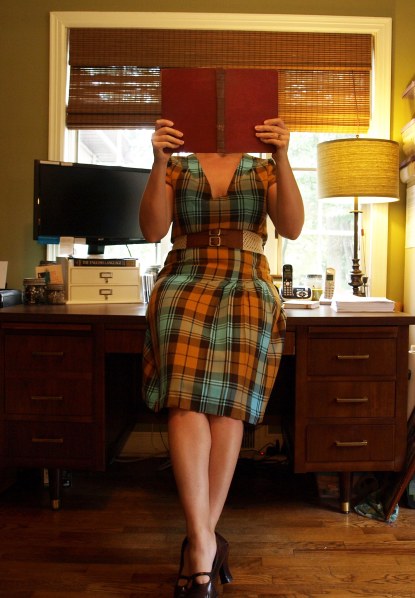
OLYMPUS DIGITAL CAMERAOn Sunday I wore this dress for the first time. I made it back in early September (if you found this blog through the Sew Weekly, you may have seen it before).

Normally I’m someone who dives in, wings it, fixes along the way if necessary, and comes out of the creation process with something I like. Something that fits. Something that works.

Not so with this dress. I thought I’d be smart and really measure and really fit the pattern to my body, and so I ended up thinking I needed to lengthen the bodice (that’s the top part of the dress, for you non-seamstresses out there). But it turns out I must have done that all wrong. And I neglected to check the neckline while doing my alterations. So I ended up with something way too low-cut for comfort and bunchy around the torso to boot.

It went straight into the closet and I decided I would take the time to fix it later. Yeah, right.

Then Sunday morning I decided to finally wear it. I’ll wear it, I reasoned, so I can really get a feel for what needs to change. I put a light turquoise tank underneath to deal with the neckline problem and wore it to church.

I got a lot of compliments on it. No one noticed the flaws (except perhaps my close fellow seamstress friend who may have been wondering about the bizarre bodice issues). People loved the fabric (which I also adore and which is one of the reasons the fit issues were such a huge disappointment to me). They loved the pleats. They loved the whole package.

But as I received their kind comments I quickly told them about all the flaws I needed to address. Not being seamstresses, they all adopted a somewhat glazed over look in their eyes and were probably thinking, “Geez, Erin, I was just trying to give you a compliment.”

Not surprisingly, this whole experience got me to thinking about writing, editing, and sharing our work with others…

Lesson 1: We’re all our own worst critics. Well, unless we’re deluded. We see the flaws in our work that others do not. What we need to ask ourselves is whether we can be satisfied that others see beauty when we ourselves see something that’s almost-there-but-not-quite-yet.

Lesson 2: If you’re not happy with it, go ahead and work to make it exactly what you wanted. If it will continue to eat at you and keep you from confidently showing your work to the world, keep making it better. Go ahead. Indulge yourself in all those little edits. However, you may, like me, discover that you constructed your creation so well and so precisely that to fix it you have to do a lot of work and everything you alter will mean some other part needs to be altered as well. (This is why I like making clothes but not altering them.)

Lesson 3: At some point, you really just need to let go and let the thing be what it is. Sometimes the more we work on something the worse it really gets. I’ve worked a piece of clothing to death. I’ve probably worked over my first as-yet-unpublished novel almost to death. Sometimes you just have to call it quits and move on to something new.

Lesson 4: Don’t point out the flaws that have already gone unnoticed. It’s not humility. It’s false humility. It’s fishing for the other person’s comfort and reassurance (and more compliments). It’s giving you a chance to talk about yourself more. Just gracefully say thank you and move on to another subject, perhaps returning the compliment to them somehow.

Now then, where’s my seam ripper?

Banishing Clutter and Getting Your Literary World in Order

32/40 bags in 40 daysToday I took a huge load of junk I don’t need to Goodwill. I filled my Explorer to the gills and then passed it all off on an unsuspecting lone worker who is on the front lines of the redistribution of stuff in this community. Every time I handed him yet more bags of stuff (32 in all on this trip) I could see his resolve strengthen a little bit. He would sort through my castaways if it was the last thing he ever did.

Other loads I’ve dealt with today: two of dishes, three of laundry, one of trash. And I have to tell you that it feels so good to walk out into the warm, sunny day (we actually hit the mid-40s in mid-Michigan today!) carrying out the stuff I don’t need.

It’s like editing. (You knew that was coming, didn’t you?) You go through your manuscript or article or story and find the useless stuff, the stuff that doesn’t help anyone, the stuff that you thought you’d use but that instead just ended up as unsightly clutter that distracts you from the real focal point.

What parts of your latest creation could use a good spring cleaning? Trust me, you’ll like your story better once you can get yourself to part with the unnecessary clutter.

Anticipation, Distraction, and Writing It All Out

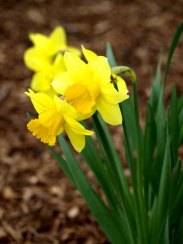
Waiting for DaffodilsMy distracted mind has not been on writing lately. It’s been on spring cleaning. It’s been on my son’s impending move from preschool to elementary school. It’s been on things I want very much to see clearly (and soon)–on the snow melting, on the sight of green leaves and yellow daffodils, on what the future may bring. It’s been on very physical things. No room in my brain right now for the mental work of writing.

Planning. Expectation. Preparation. Yearning. Possibilities. A desire I didn’t realize until it was spoken aloud. But that’s how writing works, too. Sometimes you don’t realize what you want to write about until you start writing about something else. If you’re not careful, you can write yourself into things you would never have expected.

Are you stumped about what to write about next? Don’t know which way to turn on the road of your life? Can’t see as far into the future as you would like?

Just write. Write yourself into a compelling story. Write yourself into a plan for dealing with what’s bugging you. Write out your dreams. Write the future you want. You just might get to know yourself better. You just might discover you have much more to say than you realized. You just might be able to re-distract your mind until the thing you anticipate has finally happened.