“I don’t want to read the book. I’ll watch the movie.”

How many of you out there have heard this song from Switchfoot’s first album in 1997?

It was a favorite GenX anti-anthem of mine in college. I joined the members of Switchfoot in lamenting our generation’s general laziness and lack of ambition. But then this week I found myself in this very situation.

In 2003, Donald Miller’s memoir Blue Like Jazz came out and seemed to almost singlehandedly resurrect the memoir genre for the Christian subculture. Devotees sprang up everywhere I looked, so I figured I ought to read it for myself. However, despite enjoying memoir (I’ve read several over the past few years that contained some of the most lovely writing and emotion I’ve ever encountered in written form) I just couldn’t get into it. It seemed…I dunno…just a bit too whiny.

Whatever it was, I couldn’t relate, and so I couldn’t get past the first chapter. I’ve read nice quotes pulled out of that book and I’m sure Donald Miller is a great writer, but his story of growing up without a father, questioning God’s existence and God’s love, hiding his faith from others during college–it just didn’t resonate because my life experience has been different.

And that’s fine. Lots of people bought Miller’s book. Lots of people love it. He doesn’t need me to be a success.

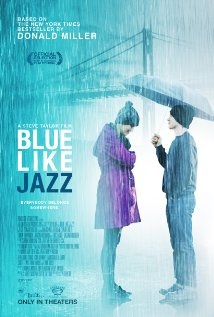
BlueLikeJazzSomewhere along the way, Blue Like Jazz became a movie. A movie I had no interest in seeing, but that my husband, a compulsive consumer of Christian movies (both sincerely and ironically), kept badgering me about. Okay, badgering is too strong a word, but it kept coming up. And on an evening when there was nothing either of us wanted more than to finally sit down and vegetate, I said I’d watch it.

Blue Like Jazz the movie was pretty good. The acting was beyond the moon when it comes to Christian films. The book had been plucked for the most compelling storytelling bits. And it was made by the incomparable songwriter-turned-director Steve Taylor who wrote, among other things, most of the Newsboys songs I love.

The reason I bring this up is not to critique the book or the movie, but to talk about narrative. Narrative in a memoir and narrative in a movie are different. Unless we’re talking about some art house film at Cannes, movies generally have a stronger narrative and more forward motion than a memoir. A memoir feels recollected (because it is) while a movie, even if it begins with a voiceover from the narrator, and even if we then hear that voice now and then later on in the film, is experienced as though it is just now happening because we viewers get to see the action as it happens on the screen.

The medium isn’t necessarily the message, but it sends a message. It creates expectations in people that, when left unmet or when trampled upon, create dissatisfaction.

Occasionally you read an article that should really be given a book-length treatment. Occasionally you read a book that really only has enough substance for an article. Occasionally you read a short story that you wish was a novel. Occasionally you read a novel that would have been far better as a short story. Occasionally a memoir is better as a movie.

Is the form in which you are writing truly the best form for what you want to get across? Are you writing a novel because that somehow feels more legitimate than a short story? Are you trying to stretch a theme out to be a book when it would actually have more impact as a series of blog posts? What expectations do readers have of your chosen genre? Are you meeting and exceeding those expectations?

You Can’t Have Fireflies without Mosquitoes

When my husband and I experienced our first summer in Lansing we were entranced by the steady green sparkle of fireflies illuminating our neighborhood. In the twilight of July evenings, every yard was graced with twinkling lights like tiny meteorites burning up in the earth’s atmosphere.

As a child I watched movies where people caught fireflies in jars and wished for the opportunity to do the same. When evening came my lawn was simply a blank and ever-darkening mat of common grass. Catching fireflies seemed a right of passage I had been denied. I had always assumed they didn’t live in Michigan.

Fast-forward to this very week when Michigan is overrun with a bumper crop of mosquitoes courtesy of the very rainy spring and a sudden uptick in temperature. The air is thick with moisture and the relentless buzz of bloodsucking, six-legged vampires. Our almost-five-year-old son was mobbed the other day and suffered about eight bites on just one foot and ankle. He scratched. The ankle swelled. And he ended up looking like he’d sprained it it was so swollen, red, and purple.

Zach and I realized that we would all need bug spray for any excursion beyond the walls of our house until this first wave of mosquitoes dies off. It occurred to us that, despite growing up in what is essentially reclaimed swampland in the Bay City area, as children we never put bug spray on to go play outside. We got occasional bites, but we weren’t mobbed.

When we were growing up, our community sprayed for mosquitoes to keep the population down. On heady summer nights I would be out playing in the yard and from far off I’d hear the steady beep, beep, beep of the mosquito truck. Mom would hear it too and call me in. Then we’d tear around the house shutting all the windows to keep the poison out.

It was Zach who made the connection. No mosquitoes meant no fireflies. The poison spewing from the truck wasn’t genetically engineered to kill only mosquitoes. Anything that was out at twilight and not hidden away in some protected spot would suffer death. The good was destroyed along with the bad.

No mosquitoes, no fireflies.

We work hard to eliminate adversity in our lives, don’t we? I know I do. I want to get along with everyone if I can. I want my work to hum along without bumps along the way. I want my writing career to progress at a steady pace without big setbacks. I want my son to grow up without feeling the sting of rejection from friends or the public humiliation of messing up a play in baseball. I want my husband to feel constantly fulfilled and consistently loved by everyone.

But this can’t happen, can it? Life isn’t all fireflies. And if you eliminate the mosquitoes, the good times don’t feel nearly as good because there’s nothing negative to which it compares. It’s like taking an antidepressant that not only keeps you from falling into despair but at the same time keeps you from fully experiencing joy. Everything becomes a flat line. A flat line means you’re dead.

So we cover our bodies in DEET, hoping to avoid West Nile even as we are likely increasing our cancer risk. We do what we can to keep the mosquito bites at bay. And we look forward to seeing the fireflies in July.

Yes, That Really Is Your Voice

Not so very long ago there were these things called tape recorders. Many of you who are older than thirty probably remember these devices. And I’d wager that most of you remember listening to your recorded voice at one time or another and thinking, “That’s what I sound like?”

I’m not sure this is a pleasant experience for anyone. It’s definitely worse if you hear yourself singing–those church or school performances you thought you’d nailed but then CRINGE, oh, that was most certainly not the right note right there. Or there.

In our own heads we sound one way, but the world at large experiences us in a different way. And if you’re going by numbers, the world has you beat about 7,000,000,000 to 1.

The same is true with our writing, I believe. To me, certain sentences may sound lyrical and fraught with meaning, while to another they may sound clunky and trite. The opposite is also true. At times we write things that sound common to us and yet they may strike another in such a profound way that they print them up and tack them to their wall or put them on their refrigerator as a reminder.

Here’s what I think you should do with this little observation:

If you’re going about blithely assuming everyone reads your writing the way you do, the way you intended, take some time to examine it from another’s perspective. Are there ways you could make your meaning more clear? Are there ways you are closing off access inadvertently? Are you talking down to people? Are you assuming your reader is more knowledgeable about your subject than they actually are? How can you try to make others hear your voice as you do?

Conversely, if you can’t even bear to share your work with others for fear that they will see you for the hack you are, can you step out in courage and faith and let a few friends read your work? Isn’t it possible that you don’t sound as bad as you think?

I have a number of kind “no thank yous” filed away that tell me that not everyone reads my writing the way I intend it to be read. I can let that bother me, let it beat me down until I give up. Or I can learn from them. I can work to fix the fixable things so that my writing is read by another they same way it came out of my head in the first place.

Remember, perception is reality…except when it isn’t.

What Are “Acceptable” Sins for the Protagonists of Christian Novels?

During the past decade I have read hundreds of Christian novels. I wouldn’t generally seek Christian novels out above “secular” novels (I’m more of a classics girl myself), but I read far more of them than anything else in my life because it’s part of my job. Over the years, I’ve read some with really fantastic writing, some with really intriguing plots, some that got me a little choked up, some that made me laugh out loud. There’s a lot of great writing that comes out of Christian publishers. And on top of that, much of it is truly edifying–meaning you come away from the experience not just having been entertained but having been educated and encouraged.

Now, in order to write a good, believable, engaging story a writer needs to have characters with flaws, problems, issues, whatever you want to call them, that he or she struggles with and, as is generally the case in Christian fiction, overcomes. You have to have conflict, and Christian novels have plenty.

From what I can tell, of the three main conflicts (man vs. man, man vs. nature, man vs. himself), anymore you normally only run into man vs. man and man vs. himself, often in the same work. Most of the time, for whatever reason, the man vs. nature conflict is left by the wayside or plays a minor role.

For Christian fiction, man vs. man is pretty easy to formulate. Christians believe in good and evil and generally have a fairly black and white view of what is sinful and what is not (and before anyone accuses me of painting with too broad a brush, remember that I count myself among this group). More and more today we have Christian novels that are willing to touch on and examine those gray areas that are difficult to parse out, but when it comes to man vs. man, there is a bad guy who really is a bad guy far more often than a bad guy who is just a victim of his circumstances or misunderstood (the convenient way to reject traditional morality that so popular in storytelling today).

When it comes to man vs. himself (or woman vs. herself) things get trickier. I see a lot of man vs. his sinful past or man vs. his mistrust of women because he’s been burned before. I see a lot of woman vs. her fear of what society will think of her or woman vs. her fear of abandonment or woman vs. her fear of not living her dreams or woman vs. her fear of becoming a spinster. (Are you sensing a pattern here for female protagonists?) What I see less often is man vs. his sinful nature or woman vs. her sinful nature. It’s out there, and some of the bestselling Christian novelists are those who tackle those difficult subjects, but it’s not the norm.

I can’t help but think, though…isn’t that the main conflict of all of our lives? If we all struggle against our flesh, why don’t we see it more plainly and more often in Christian fiction? Why are certain sins so much easier to read about than the sins we are tempted to commit or have committed (or are currently committing)? Why is it so much more common in a Christian novel to read about serial killers and stalkers and grisly crime scenes (which, let’s face it, most of us don’t struggle with on a daily basis) than, say, adultery? Which sins are okay for a Christian author to explore and expose in his or her writing?

Now, I will say that many Christian novels explore sexual sin, but most that I have read (and I certainly haven’t read everything out there) do it from a distance. Either the protagonist struggles with lusting after someone they’re not married to (and so the solution is to get them together by the end of the book so they can explore their desires for one another within the bounds of Christian marriage) or the only sexual sins in the book are those that belong to the antagonist–a pushy suitor who receives his punishment by the last chapter or a rapist who is finally caught or killed. We sometimes read about protagonists who were sexually abused in the past and finally find peace for themselves and forgiveness for the ones who abused them. But that’s not their sin they are struggling with–just their misunderstandings and misinterpretations about their worth and their own culpability.

I’m not saying that these are not things worth exploring in Christian fiction. They are. What I am saying is that we should be willing to examine every kind of sin and show the way to redemption and wholeness. Being human and having hearts that are desperately wicked, we all need to come to terms with the fact that we are all capable of sexual sin, from the more obvious ones like adultery to the subtly sinister ones like emotional affairs or lusting after someone in your heart. Yes, some people will have been forced by circumstance into sinful behavior (like the victims of sex trafficking). But sometimes, people are faced with a choice–and they choose sin.

I have read a novel–a well-written and well-researched novel by an author I respect–where the principle character was the Samaritan woman who meets Jesus at the well. (Unfamiliar with the story? Find it in John 4.) Now, the Bible tells us that this woman had five husbands and the man she was living with was not her husband. And in the fictionalized account I read, I was curious to see how the author would deal with this. I was amazed–flabbergasted, really–when I got to the end of the book and not one of those relationships was the result of the woman choosing to live in sin. She was only and entirely a victim of her circumstances.

Really? Why? Why couldn’t the author allow that woman to make some bad choices?

How many Christian novels have you read in which the protagonist is struggling with sexual sin in her own life? You might find a few that deal with men and pornography, but what about women? What about a female main character who is involved in an affair?

If statistics tell us that those who call themselves Christians live no differently from those who claim no religious affiliation (spend a day combing the Barna Group website if you don’t believe me), then can’t we assume that a majority of Christian marriages are touched by infidelity? (Some statistics show that as high as 60% of marriages will be affected by infidelity.) If we publish fiction that helps readers find release and forgiveness for the shame that comes with being a victim of sexual abuse (which, we can all agree, a victim should not be made to feel), can we not also publish fiction that exposes the slippery slope toward adultery and shows the way to forgiveness and restoration? If we never show that situation, do readers of Christian fiction get the subliminal message that if they mess up they shouldn’t talk about it? Shouldn’t seek forgiveness?

Recently I gave my friends on Facebook, many of whom are voracious readers of Christian fiction this challenge:

Okay, readers of Christian fiction: give me your best example of Christian novels in which the PROTAGONIST is currently struggling with sexual sin beyond temptation (i.e., he/she is having an affair, sex before marriage, etc.). The protagonist does not have to be a Christian, but the novel should be geared toward the Christian reader.

I did get back a good number of responses. Some we had to throw out because they were biblical fiction or retellings of biblical fiction (and thus the characters were so far away in time and space that we can’t as easily appropriate their struggles as our own–they are “other people”). Some we had to throw out because the protagonist was a prostitute (also “other people”). Some we had to throw out because it turns out the protagonist was the victim of rape or sexual abuse (see above for why this doesn’t count). Some we had to throw out because the protagonist was not currently struggling through the sin (it was the backstory rather than the action), though she may have been struggling with the consequences of that sin. Some I question because the protagonists are Amish (also sort of “other people”).

In the end, I’m not sure if I have specific titles to share because I haven’t read them and can’t say for certain if they truly fit the bill, but Francine Rivers was mentioned the most. And I do recall some YA fiction from Melody Carlson that fits. (I guess it’s okay to warn teen girls of the consequences of sexual sin, but we just assume most adults have got it all together?) Karen Kingsbury, Patti Hill, Lisa T. Bergren, and Susan May Warren made the list. It seems there might be some others out there.

But when you compare a handful of books from a handful of authors to the entire body of Christian fiction at large and you’re left with relatively little. And so I’m left with some questions.

Is there a market for Christian fiction that allows that even the “good guys” fall into sin and–and this is the most important piece of this–that there is still forgiveness for those people?

Is this an under-served market with room for growth?

Do we relegate all stories that deal frankly with this issue to the general market, which rarely points the way to true redemption and freedom in favor of a false promise of freedom (i.e., do whatever makes you happy and doesn’t hurt others)?

Or are people just not willing to sympathize with a protagonist who fails in this way? Can we not put ourselves in her shoes because we’re “above” that type of sin? (Actually, I think this gets really close to the issue.)

I’d love for others to weigh in on this. If you read Christian fiction, do you know of stories that fit the bill here? Would you be turned off by such a story? Why? If you write Christian fiction, what is your experience with exploring this subject in your writing? Is what I’m saying on target or have I missed the boat? If you work for a Christian publisher or are a buyer for a bookstore, what are your thoughts on this?

I’m not making a pronouncement here. I’m attempting to start a conversation…
Ideas Are Like Deer…

This morning spent a very peaceful morning alone walking the woods of Fenner Nature Center with my camera. Pre-motherhood, I did such things quite often. Once you have a child tagging along it is a different experience. Still a good one, but different. As the sun was rising into the hazy morning sky, I walked at my chosen pace with silent steps and no speech, listening to myriad birds singing springtime songs and watching the woods for things to photograph.

OLYMPUS DIGITAL CAMERA

Not too far into my walk I saw the flashing white tail of a deer as it bounded out of my path. So I stopped, then moved forward slowly until I was at a point where I could see her through a little clearing in the trees. She looked at me, assessing the threat level. I was still, waiting for her to decide I could be trusted at that distance.

We looked at each other for several minutes. Then she started nibbling at the burgeoning plant life around her and flicking her white tail. This seemed to signal her friends. She was joined first by one other doe, who regarded me with just a bit of suspicion before she too began foraging. And soon thereafter two more friends joined them before they all moved on into the woods.

OLYMPUS DIGITAL CAMERA

It occurs to me that this is how our ideas come sometimes. We are out enjoying life when a flash of white catches our eye and we stop a moment, then approach the idea slowly so as not to scare it off. We watch it closely, take in its form, maybe snap some photos or write some notes in order to capture it before it moves on. And if we are patient enough, more ideas come tumbling into the clearing in our mind.

Ideas can be timid, fleeting. Push too much and they can be pushed right out of our minds. But patience, stillness, a willingness to observe and record, can capture them forever.

Taking Your (Literary) Place in the History of the World

SoutheastAsiaMonday as I was tutoring my Chin friends, the two school-age boys, Moses and David, expressed their frustration with learning to write in English. Both are making strides in speaking and understanding speech, but in their classwork they find it difficult to transfer their newfound confidence with the spoken English word to paper. During the discussion that followed, David (14) said “English is too hard. I have to write a poem. What is a poem?”

What is a poem? What a question. I tried to answer this question by comparing poetry to other forms of literature. For instance, I said, To Kill a Mockingbird is a novel (long fiction) and there are short stories (short fiction) and poetry would be even shorter, often rhymes, and usually follows some sort of pattern or rhythm. Then I began to recite some Robert Frost to give him an example.

I got confused looks in response.

David was recently supposed to read To Kill a Mockingbird in English class. I’m pretty sure he got to at least chapter 10 and as I looked through the book (which I haven’t read since I was his age) in order to help him with an essay a few weeks ago, I really felt for him. It would be hard enough to read a novel written in “proper” English for someone who just started to learn the language two years ago. But that book is written in dialect. Oh, my.

We got through our lesson, I answered some questions about how to buy airline tickets for a trip they are taking to Texas for a friend’s wedding, and then I got in my car and began to drive home to start making dinner. It was on the drive that it it hit me: The Chin do not have anything that can compare to the vast body of literature, both past and present, that exists in the English language.

They do not have libraries filled to bursting with novels, plays, short stories, poetry, histories, religious works, or diaries in their native language, one of almost 50 spoken by their ethnic group alone. The only written works I have seen in the Chin language they speak are the Bible and the English-Chin dictionary. I’m not sure what else exists out there, but their language did not even have a written form until at least the 1800s, so there can’t be much.

As a native English speaker who grew up with a history and a body of literature that is written and read, I can hardly conceive of not having hundreds of years of thought to access at the turn of a page or the click of a mouse. It is not that these lovely people do not have a history, it’s that they cannot access it.

Over the past couple years as we have met each week I have explained various American holidays, which often entails explaining American history, which then occasionally requires a lesson in world history. As a history buff and a history minor in college, I know all of this information off the top of my head. But when I ask my friends the history of their own country, I can get very little information from a time before the oldest in the family (at age 42) was alive. I cannot fathom knowing only what has happened in my own lifetime.

Why do these people not know their history? The biggest reason is because in Burma/Myanmar they were impoverished and persecuted. You don’t wile away the hours reading or even talking history when you are struggling every hour of the day to make a living from poor soil and avoid harassment by a military regime. The secondary reason is because no one wrote it down.

When you write, whether you write personal letters, diary entries, emails, blog posts, self-help books, novels, or histories, you preserve a small part of life for the generations that will come. If your words survive on paper or in digital form, people who live long after you are gone can surmise how you lived, what was important to you, what you feared.

When you write, you are in a small way immortal. That’s powerful stuff. It should cause us to examine what we are saying to posterity when we write, when we post on Facebook or Twitter, when we choose to put our nebulous thoughts into little black characters on a page.

What history are you writing? What legacy are you leaving? Does it say something important? Or will the generations to come find ours a trivial generation not worth studying?

My Chin friends are writing themselves a new history in a new country with new freedoms and new challenges. I hope my own small contributions to the vast body of literature in English will be so brave. And I hope yours will be as well.

Choosing Your Mood, Creating Your Future

We woke up this morning to delightful sunshine piercing through the cracks of the blinds. It put me in an excellent mood. Then I raised the blinds in my son’s light-filled east-facing room and saw it. Snow. Over everything. Mood instantly changed.

We’d been dusted while we were sleeping and as I write this all that snow has melted (and the clouds have rolled in). But that 10-second emotional rollercoaster this morning has colored the rest of my day.

I got a call from our trusted mechanic today and what we thought might be a small job that would cost a couple hundred dollars has turned out, upon closer inspection, to be something that will cost more. A lot more.

A productive morning has given way to a mentally sluggish afternoon.

A search for something pleasant and entertaining to read in the blogosphere over lunch became a descent into articles about models starving themselves (and eating tissues to feel full) and postpartum depression.

A morning of smart eating has given way to a craving to eat all the rest of the Easter candy in the house. (I haven’t given in. Yet. And at least I’m not eating tissues.)

Life can spin you around pretty quickly, in small ways and big ways. My problems, in the scheme of things, are very small. And then I see something like the video below and the sun comes out again in a big way.

Anything is possible. You can do it if you put your mind to it. So what are you going to do with the life you’ve been given?

Anticipation, Distraction, and Writing It All Out

Waiting for DaffodilsMy distracted mind has not been on writing lately. It’s been on spring cleaning. It’s been on my son’s impending move from preschool to elementary school. It’s been on things I want very much to see clearly (and soon)–on the snow melting, on the sight of green leaves and yellow daffodils, on what the future may bring. It’s been on very physical things. No room in my brain right now for the mental work of writing.

Planning. Expectation. Preparation. Yearning. Possibilities. A desire I didn’t realize until it was spoken aloud. But that’s how writing works, too. Sometimes you don’t realize what you want to write about until you start writing about something else. If you’re not careful, you can write yourself into things you would never have expected.

Are you stumped about what to write about next? Don’t know which way to turn on the road of your life? Can’t see as far into the future as you would like?

Just write. Write yourself into a compelling story. Write yourself into a plan for dealing with what’s bugging you. Write out your dreams. Write the future you want. You just might get to know yourself better. You just might discover you have much more to say than you realized. You just might be able to re-distract your mind until the thing you anticipate has finally happened.

The Hardest Month to Dream

Iced OverFebruary is a month during which we are tempted to dream of the future (probably because the present is so ugly and, frankly, we’re getting sick of it). Whether it’s limited to dreaming about the feel of the warm sun on bare arms and the smell of soil and grass and grilling meat, or if it’s that lake home you want to retire in, February gets us to dreaming. We imagine trips to far-off (warm) places. We think about the goals we have for our working life. We dream of a bigger house, a less stressful schedule, a few days to get caught up.

The cruel reality is that even while February causes us to dream it simultaneously works to crush our spirits, snatch those dreams away, and tell us they are impossible (or at least the timing isn’t quite right yet). The thermometer outside the kitchen window seems to mock our dreams of warmth. Our checkbook solemnly shakes its head when we look to it for some extra money for plane tickets. News of housing markets and job markets drags our dreams down until we realize we are where we are and we will go no further (for now).

February is a hard month in which to practice contentment. And yet, for many it is a time in which we are called to give up a little, to stop thinking so much about our outward selves (like what we have or don’t have, what we can do or can’t do) and focus on our inner selves (our besetting sins, our humble place in the order of things, our desperate need to be washed clean).

I already mentioned to you the 40 Bags in 40 Days thing that I and many others are doing during Lent. And I find as I go through things that I’ve saved (“because I might want to use that later for X, Y, or Z”) that I am an expert at packing away dreams for later. I keep a shelf or a table or a stool, even though I have no place for it in my house, because someday I might have a bigger house and more room and I’ll want it then. I keep books on crafts I will probably never do, as if no one will ever publish another book on the subject. I keep pots for plants I will never have in my house because they would just get eaten and regurgitated by my cat, but I keep them because they are pretty or were a gift.

I pack away all these tiny dreams. But sometimes, it’s best to just let those dreams float away. Sometimes dreams become burdensome. And I think that when they do, it’s a pretty sure sign that they are not the right dream for the time being.

Are there any “somedays” that are making you feel guilty for the procrastinating rather than joyful with anticipation? Any old dreams stuffed in your basement or attic that really ought to be set free? It’s never too early for physical or mental spring cleaning. Maybe it’s time to put on some grubby clothes and get to work clearing out those old dreams to make way for reality–and maybe for one worthy dream you’ll actually pursue.

The Stuff We Keep and the Stuff We Give Away

Today marks the beginning of a season of self-examination and repentance for billions of believers worldwide. Some give up meat or coffee or social media in order to deny themselves, recenter their minds and hearts on Christ, and prompt them to pray.

I’ve given up various things over the years: sleeping in, Facebook, cream and sugar in my coffee. I’ve also added various things: one year I read the four Gospels, another year I made a conscious effort to do something for others every day, whether that was doing the dishes and laundry for my family or writing a note to a friend who needed encouragement.

This year I’m doing both. I will be reading the entire New Testament in the mornings. In the evenings I will be filling 40 grocery bags with stuff to give away, recycle, or trash. I will be attempting to do this sacrificially, not just getting rid of junk we don’t need cluttering up the basement or under the bed, but truly examining each room, each closet, each cupboard and removing things that are simply unnecessary to life–the stuff that takes up the time, thought, and space that could be better put to use in service to other people and to God.

One of the reasons I made this decision was due to a couple I met on Sunday. This man and woman were looking for a new start away from some bad influences from their past. They wanted help from our church to get one way tickets to another city where there is a homeless shelter that accepts married couples (most are men or women only). My husband and I took them out to lunch and heard more of their story. He had been in prison for 20 years during which he turned his life over to Christ, got clean, and got an education. She became his pen pal. They got married. He was released. Things didn’t go smoothly and their living situation became untenable. So they needed a new start.

After lunch, we took them to the bus station, bought their Greyhound tickets with church money set aside for such ministry, and watched as they packed all of their earthly possessions (two rolling suitcases and two shoulder bags full of clothes and toiletries) into a bus and left for a fresh start at life. Two suitcases and two carry-on bags. That’s it. We needed two moving trucks seven years ago when we moved to Lansing and have been accumulating ever since.

Not for the first time, I felt ashamed of all the stuff I have in the house that I never use and don’t need. How much money have I spent on things I don’t need? How much better could I use my time than having to keep all that stuff clean and organized?

So while I fill my 40 bags during the 40 days of Lent, I will remember this couple and pray for their future. I will pray for contentment with what I have and that the desire for more would be removed from my heart. I will pray for the people who will eventually get my stuff, that they would put it to good use and not just shove it in a drawer or cupboard like I did.

(Confession time: I actually couldn’t keep myself from starting a day early so I already have FIVE BAGS from ONE ROOM.)

I may also reread this excellent and very convicting (and freeing) book:

9780800720025

What in your life needs to be weeded out? Are you giving your time and energy to worthy pursuits? Or are you filling up your house with stuff you don’t need (and sometimes don’t even really want)? How would your life be different if you let go of a goodly portion of your earthly possessions?

It’s a tantalizing question.