Wildflower Wednesday: Common Yarrow

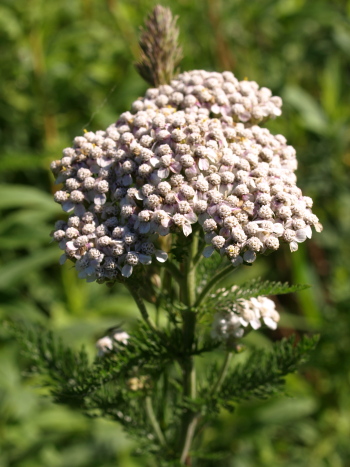
Yarrow

Common Name: Common Yarrow

Scientific Name: Achillea millefolium

Habitat & Range: dry, sunny fields, prairies, and woods

Bloom Time: summer

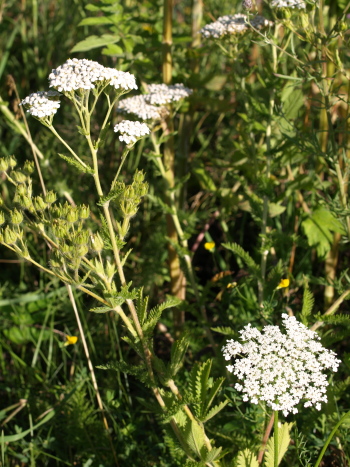
About: Another white, flat-topped flower (which is far less insidious and far more useful than Water Hemlock) you will find blooming this time of year is Common Yarrow. If you garden with perennials, you probably know there are many lovely cultivars of Yarrow to be found at your local nursery. Common Yarrow is a bit less showy, but a very useful plant that has been used medicinally for perhaps millenia to slow or stop the flow of blood from wounds (including by the legendary Achilles during the Trojan wars–hence the first part of its scientific name). It is a good companion plant in your garden because it attracts beneficial insects such as ladybugs and predatory wasps. Young leaves can be dried and used as an herb or cooked and eaten as a green. You can find many more uses and recipes in herbals.

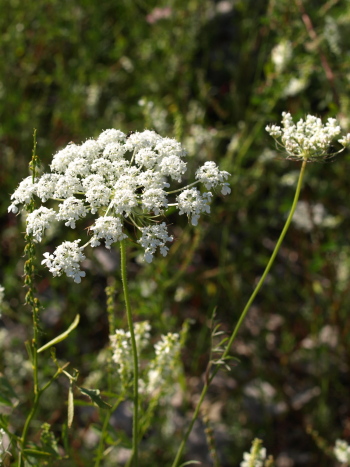
Here it is growing alongside lookalike Queen Anne’s Lace:

OLYMPUS DIGITAL CAMERA

Yarrow is upper left and Queen Anne’s Lace is lower right.

Reference: Wildflowers of Michigan by Stan Tekiela; Adventure Publications, 2000 (also Wikipedia)

Wildflower Wednesday: Water Hemlock

waterhemlock

Common Name: Water Hemlock

Scientific Name: Cicuta maculata

Habitat & Range: wet, sunny meadows, ditches, my garden

Bloom Time: summer and fall

About: Last week I mentioned that Queen Anne’s Lace was in the carrot family and the root was edible (as a coffee substitute). Water Hemlock is also in the carrot family. It looks very much like Queen Anne’s Lace and like Cow Parsnip (also edible). The taproots even smell like carrots. But DO NOT CONSUME any part of this plant in any fashion as it is Michigan’s most poisonous plant. Just a small amount will cause convulsions and then death. If you have children or pets and you see this in your yard, eradicate it. Pull plants up by the root and throw away. Don’t add them to your compost pile (I’m not sure anything bad would come of it, but better to be safe than sorry).

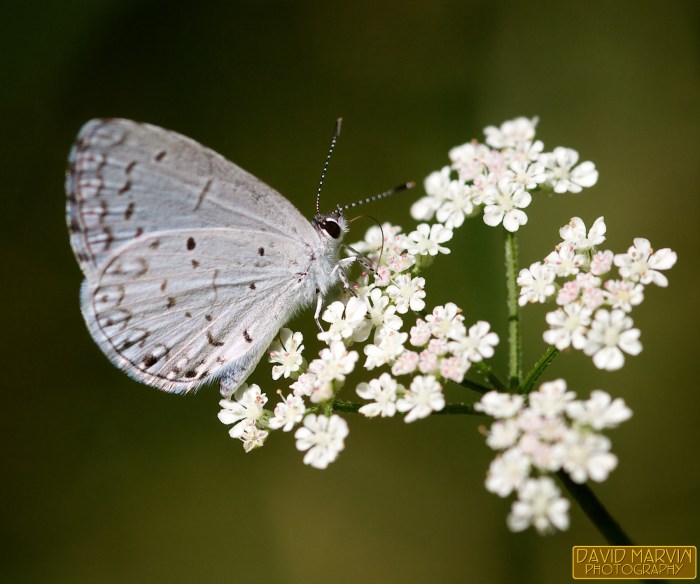
When we moved to our house, which has several wet spots, I saw quite a bit of this plant but thought I had successfully removed it. When we came home from two weeks’ vacation earlier this month, I found a couple lurking in my vegetable garden and near the driveway. Weeds always seem to find a way. I pulled them up before I thought about taking photos, so I borrowed a photo from my friend and butterfly/dragonfly photographer extraordinaire David Marvin.

I’m also going to direct you to this website for many detailed pictures of the plant so you know what’s what when you think you’ve encountered this plant. The telltale sign is the leaf, which has veins that end in the V of the serrated leaves rather than at the tips.

Reference: Wildflowers of Michigan by Stan Tekiela; Adventure Publications, 2000

Wildflower Wednesday: Queen Anne’s Lace

Queen Anne's Lace

Common Name: Queen Anne’s Lace

Scientific Name: Daucus carota

Habitat & Range: dry, sunny meadows and roadsides statewide

Bloom Time: summer and fall

About: So many of our wildflowers are non-native European garden plants that have escaped, and this is one of them. A member of the carrot family (and thus a host plant for black swallowtail butterflies) Queen Anne’s Lace is a common and well-known plant. I recall hearing the story behind the little cluster of dark red flowers in the center as a child: that Queen Anne (whoever that was, I was not sure) was making lace and pricked her finger with the needle and a drop of her blood got on it. But now I’m fairly sure handmade lace is made with a tiny crochet hook (right?) so I’m thinking Queen Anne must have had to work pretty hard to draw that drop of blood. At any rate, her namesake plant is now considered an invasive, though I’ve not heard of any plans to rid the state of it.

The root of Queen Anne’s Lace can apparently be dug, dried, ground, and used as a coffee substitute. But beware that in the family of flat-topped flowers (which we shall explore in the coming weeks) there are many lookalikes–and some of them are deadly. So hold off on making that “coffee” until you really know what’s what. Next week: water hemlock.

Reference: Wildflowers of Michigan by Stan Tekiela; Adventure Publications, 2000

queenanne4
Here’s what’s become of Queen Anne’s Lace in the fall.

How to Find the Best Beaches in Michigan’s U.P.

Mosquito Beach
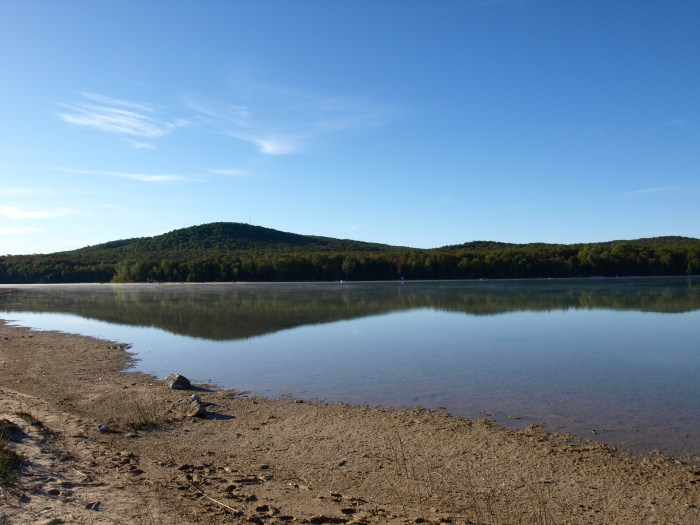
One of my favorite places in the world: Mosquito Beach.

I don’t typically highlight websites on this blog, but in preparing for my upcoming hiking trip to Grand Sable Dunes and other parts of the east side of Pictured Rocks National Lakeshore (and also in thinking about August’s short story) I happened upon this excellent website: Some Yooper Beach.

For the uninitiated, Michigan’s Upper Peninsula is locally referred to as the U.P. (pronounced Yoo Pee, not “up”) and those who live there are called Yoopers. This particular Yooper has done the world a great service by visiting TONS of U.P. beaches and then describing them and sharing photos of them on his website. If you have ever thought of visiting Lake Superior, spend some time on this site first to see which part of the 2,726 miles of shoreline (nearly 1,000 of which are in Michigan) you would most like to visit.

Mosquito Beach
We spent more time at Mosquito Beach than any other place on the trail.

Another handy website is the Lake Superior ShoreViewer. What it lacks in interesting commentary, it makes up for in comprehensive photos of what appears to be the entire Michigan shoreline. Though it would be super nice if you could zoom in on the photos (which you can’t).

I’ve added both of these sites to my page of Michigan Links. If you didn’t know about that part of this site, why don’t you go check it out now? I’m sure you have tons of time to waste, right?

Beach at Coves
The beach near Coves campsite.

Wildflower Wednesday: Fringed Gentian

Fringed Gentian

Common Name: Fringed Gentian

Scientific Name: Gentianopsis crinita

Habitat & Range: wet prairies & meadows, along streams and lakes

Bloom Time: late summer & fall

About: I see fringed gentian regularly up at Camp Lake Louise, but I only have pictures of it from odd years because…it’s a biennial! It takes two years to bloom and, like most wildflowers, should not be picked or dug up. Since 2013 is an odd year, I was on the lookout for them on our trip this year, but it’s been a cool summer and the late summer wildflowers were not in bloom yet when we were up there.

In addition, like many other wildflowers, it depends on a mycorrhizal relationship. In other words, it can only grow where certain bacteria or fungi are present in the soil, so if you decide you are the special exception and you’ll just go ahead and take that plant home thank you very much, it won’t grow in your yard anyway, so please leave it be and bring home some nice photos instead.
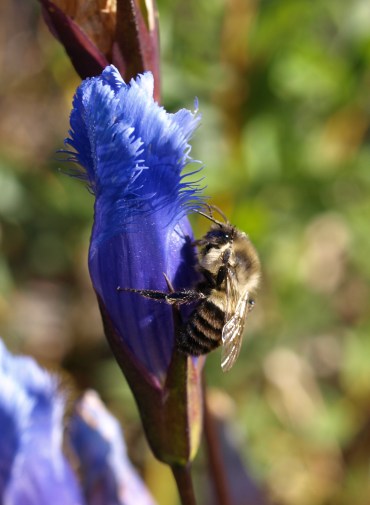
Fringed Gentian

The fringed gentian has been the subject of some poetry over the years, including

Emily Dickinson

God made a little gentian;
It tried to be a rose
And failed, and all the summer laughed.
But just before the snows
There came a purple creature
That ravished all the hill;
And summer hid her forehead,
And mockery was still.
The frosts were her condition;
The Tyrian would not come
Until the North evoked it.
“Creator! shall I bloom?”

William Cullen Bryant

Thou blossom bright with autumn dew,
And colored with the heaven’s own blue,
That openest when the quiet light
Succeeds the keen and frosty night.

Thou comest not when violets lean
O’er wandering brooks and springs unseen,
Or columbines, in purple dressed,
Nod o’er the ground-bird’s hidden nest.

Thou waitest late and com’st alone,
When woods are bare and birds are flown,
And frosts and shortening days portend
The aged year is near his end.

Then doth thy sweet and quiet eye
Look through its fringes to the sky,
Blue–blue–as if that sky let fall
A flower from its cerulean wall.

I would that thus, when I shall see
The hour of death draw near to me,
Hope, blossoming within my heart,
May look to heaven as I depart.

and Robert Frost 

I felt the chill of the meadow underfoot,
But the sun overhead;
And snatches of verse and song of scenes like this
I sung or said.

I skirted the margin alders for miles and miles
In a sweeping line.
The day was the day by every flower that blooms,
But I saw no sign.

Yet further I went to be before the scythe,
For the grass was high;
Till I saw the path where the slender fox had come
And gone panting by.

Then at last and following him I found–
In the very hour
When the color flushed to the petals it must have been–
The far-sought flower.

There stood the purple spires with no breath of air
Nor headlong bee
To disturbe their perfect poise the livelong day
‘Neath the alder tree.

I only knelt and putting the boughs aside
Looked, or at most
Counted them all to the buds in the copse’s depth
That were pale as a ghost.

Then I arose and silently wandered home,
And I for one
Said that the fall might come and whirl of leaves,
For summer was done.

Fringed Gentian

Reference: Wildflowers of Michigan by Stan Tekiela; Adventure Publications, 2000
Wildflower Wednesday: Columbine

Columbine


Common Name: Columbine

Scientific Name: Aquilegia canadensis

Habitat & Range: dry, open woodland in partial shade throughout the state

Bloom Time: spring further south & summer further north

About: One of Michigan’s more exotic looking wildflowers, the columbine is a favorite of our Ruby-Throated hummingbirds and butterflies. The photo you see above is of a true Aquilegia canadensis, but you’ll find other colors around, especially closer to towns where cultivated columbines have escaped and seeded. Columbines cross-pollinate and you can get some really pretty hybrid colors. Seeds may be collected from these wildflowers if you want to try them in your garden, but please leave the plants themselves alone. Also, these can nearly always be found at native plant sales. My heavy clay soil has not been very hospitable to them, but if you have sandier soil, give them a try. During hot summers a columbine may die back, but it will likely return the next spring.

Reference: Wildflowers of Michigan by Stan Tekiela; Adventure Publications, 2000
Sometimes, What You Seek Finds You

For most of my 33 years on the planet, as soon as I learned of the existence of Michigan’s state stone, the Petoskey stone, I have been searching for one. You can buy them all over up north in stores, pre-polished and sometimes cut into the shape of the state or a bear or some such thing. But I wanted to find one. And so, every trip I’ve taken up north to areas that potentially have Petoskey stones, I have walked, hunched, eyes peeled in the hopes that I might find one. Just one. That’s all I would need to be satisfied.

The Petoskey stone can only be found in certain parts of the state because it’s not just any rock. It’s a fossil. Fossilized coral from the long ago days when Michigan was beneath a sea. Now, any visit to just about any natural lake in the state can yield marine fossils. I have scads of them. But Petoskey stones are one particular type of coral and are found, unsurprisingly, in the Petoskey, Michigan, area.

petoskeystonemap
Devonian fossils like the Petoskey stone can be found in the blue regions.

In their rough state they look like pockmarked gray rocks, unremarkable and, compared to the lovely igneous rocks you can find in all colors, pretty forgettable. But shined up they reveal their true beauty.

As I said, I have never found one of these myself. But suddenly this week at Camp Lake Louise (an area to which Petoskey stones are not indigenous) six—yes, six—of these stones found me. (This is the spot I’d insert a photo, but I forgot my camera cord at home and my laptop refuses to read my xD card. Curses! I’ll share them with you at a later date.)

The funny thing is, they’ve been right under my feet the whole time. I’ve been up here probably fifteen times, once for an entire summer, and have walked over these rocks every time I’ve been here. And for the past five years I’ve stayed in a cabin mere paces from where I found the stones. In fact, two of them I found right up against and under the deck.

How did they get here? The ninety-year-old craft shop guru Wilma tells me that some time ago when they were doing some sort of construction project they brought in fill from another area of the state. After that, people started finding Petoskey stones a lot. My stones have apparently been working their way to the surface for a while.

It’s funny how you can look for something for so long you almost feel that you were destined never to find it. And then suddenly, without warning and without much effort on your part beyond keeping your eyes open, you can be overwhelmed with success.

And now I must get back to work here at camp, feeling the breeze off the lake, listening to loons, watching the bald eagles fish, and scanning the ground for treasures.

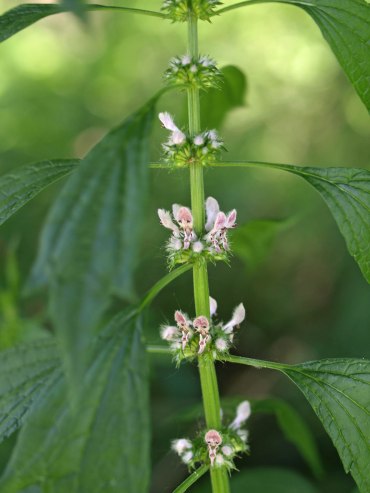
Wildflower Wednesday: Motherwort

Motherwort

Common Name: Motherwort

Scientific Name: Leonurus cardiaca

Habitat & Range: fields, edges of woodland, possibly your yard

Bloom Time: summer

About: Remember my explanation of the “wort” in plant names? Well, the common name of this plant suggests that either you use it when your mother is coming to visit (perhaps to calm your nerves?) or it looks like a mother. Or, more probably, it was used to treat some sort of menstrual disorder and/or aid in labor. The observant among you may have noted that the scientific name suggests that the plant may be used to treat heart ailments. The very observant might notice that there are also hints toward lions (LEOnurus) and another common name for this plant is Lion’s Tail (I’m thinking that is due to the shape of the leaves).

Motherwort was introduced from central Asia as a medicinal plant, so it is not native. However, like many Asian introductions to our state (carp, emerald ash borers, etc.) it is widespread, though thankfully not so destructive as some others. It shows up in overgrown back yards where some previous resident may have had an herb garden. But, as with all herbal remedy plants, do your research and be very careful when using them. Sometimes a plant is safe in a particular form or in a diluted amount but dangerous and even deadly in other forms and amounts. Be especially careful with herbs during pregnancy. Sometimes they are purported to help a pregnant woman’s health but actually they can cause cramping and even contractions. So never go by just one source (especially not an Internet source or an old herbal you found in a used bookstore) but check multiple modern reference books for the best information.