October Is Almost Half Over–Don’t Miss It

OLYMPUS DIGITAL CAMERA

Along the drive to my son’s school is a block of city land devoted to nature. Surrounded on four sides by homes, a highway, and a golf course, it is nevertheless a patch of peaceful ground. This little enclave of trees and cattails and wildflowers is the haunt of ducks, herons, songbirds, rabbits, muskrats, turtles, and frogs, as well as senior citizens out on walks and health nuts getting in a run. It is lovely much of the year, but like all wooded areas in temperate zones, never so lovely as in fall.

OLYMPUS DIGITAL CAMERA

During our frenetic and emotionally taxing week last week, I stopped for twenty minutes one morning after dropping the boy off at school to take some pictures and breathe the cool October air. I took the photos you see in this post of Great White and Blue Herons, colorful sumac leaves, mist dancing above the water, and reflections of trees in the ponds.

OLYMPUS DIGITAL CAMERA

When I picked my son up that afternoon, I convinced him that visiting the ducks at the park would be far preferable to playing a video game or watching a TV show. We had a grand time greeting the ducks we knew (like Tucky, who is any female Mallard we encounter anywhere in the city) and naming those we were meeting for the first time (Caramel, Buttercup, Oreo, Splashy, Ducky, Woody, Shaky, etc.). We saw two muskrats and chipmunks with cheeks stuffed full of seeds.

OLYMPUS DIGITAL CAMERA

These two stops at the park took up less than an hour of my day. But that hour did so much good to my spirit. I saw so many different species of plants and animals living in such a small space. A compact and yet complex ecosystem.

OLYMPUS DIGITAL CAMERA

So much is packed into our lives. So many people, activities, responsibilities, diversions–all vying for attention. But in this little park nothing vied for attention. Everything waited quietly to be noticed.

OLYMPUS DIGITAL CAMERA

The silent rabbit I saw retreating ahead of me on the path did not need to be checked off my to-do list. Berries of every hue waited patiently on the bushes for me to note their presence or to pass them by without a glance. And while it’s fun to know the species of the trees or the birds or the flowers, it’s not necessary in order to enjoy looking at them.

OLYMPUS DIGITAL CAMERA

Surely there were creatures attempting to escape my notice entirely, like the cautious wading birds or whatever creature ducked underwater at my approach and created ringlets of tiny ripples retreating out into the pond.

OLYMPUS DIGITAL CAMERA

I try to make it a practice to notice nature. But when life gets so terribly busy it is easy to forget that there is a world out there that is unconcerned with deadlines or what happens on the next episode of insert-show-you-obsessively-watch. A bird is only concerned with eating. A plant is not concerned about anything at all! And while I wouldn’t want to be a heron or a maple tree, no matter how carefree their existence might be, I don’t want to miss what they have to teach me about patience, silence, and stillness.

OLYMPUS DIGITAL CAMERA

I hope you take the time for a little stroll in the woods or along a shore or in a nature center this week. The leaves are falling and this season will not last. Your project will be there tomorrow. Go take a walk.
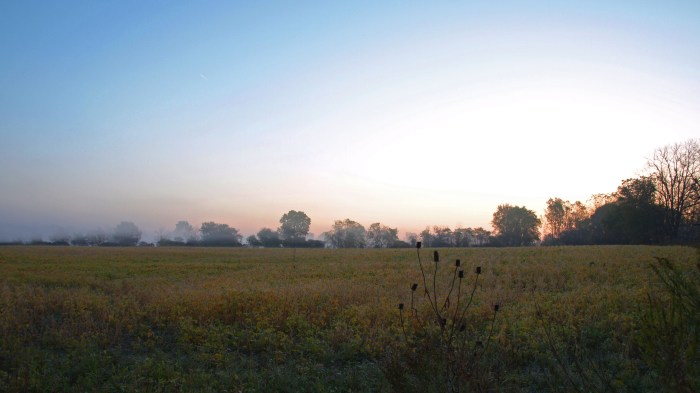
October Morning Mist

OLYMPUS DIGITAL CAMERA

OCTOBER by Robert Frost

O hushed October morning mild,
Thy leaves have ripened to the fall;
Tomorrow’s wind, if it be wild,
Should waste them all.
The crows above the forest call;
Tomorrow they may form and go.
O hushed October morning mild,
Begin the hours of this day slow.
Make the day seem to us less brief.
Hearts not averse to being beguiled,
Beguile us in the way you know.
Release one leaf at break of day;
At noon release another leaf;
One from our trees, one far away.
Retard the sun with gentle mist;
Enchant the land with amethyst.
Slow, slow!
For the grapes’ sake, if they were all,
Whose leaves already are burnt with frost,
Whose clustered fruit must else be lost—
For the grapes’ sake along the wall.

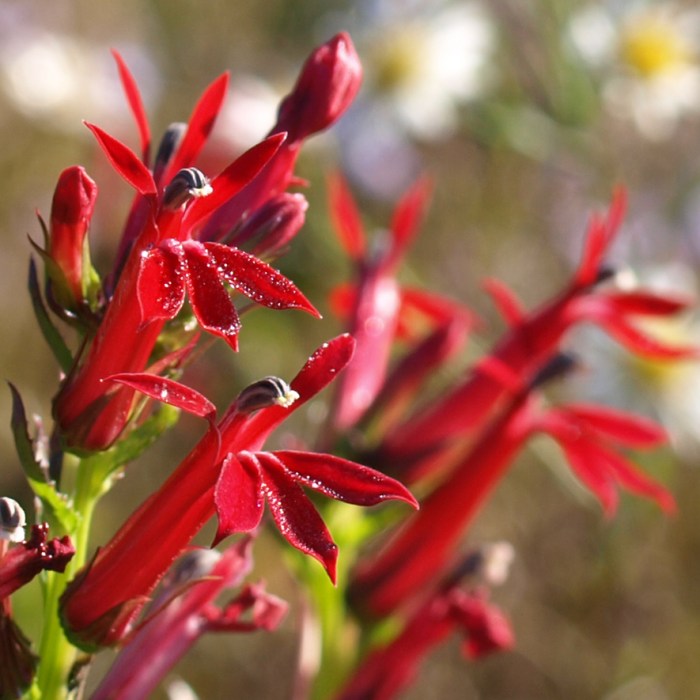
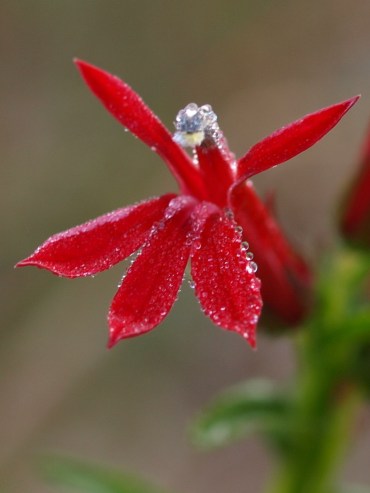
Wildflower Wednesday: Cardinal Flower

Cardinal Flower

Common Name: Cardinal Flower

Scientific Name: Lobelia cardinalis

Habitat & Range: wet, shady streams and wetlands

Bloom Time: summer and fall

About: Not too many wildflowers in Michigan are this striking red. Not easy to grow in a garden (unless you have a pretty good pond on your property) the Cardinal Flower needs wet roots and a bit of sunlight. You can find it at a really well-stocked nursery or a native plant sale (this is another I tried unsuccessfully in my garden) but NEVER dig from the wild. Cardinal Flowers can only be pollinated by hummingbirds and thus don’t reproduce well. If you already have them established, lucky you! Otherwise, just take some nice pictures. Mine are from the shores of Thumb Lake at Camp Lake Louise. Like the bird, the plant gets its common name from the robes worn by Catholic cardinals.

OLYMPUS DIGITAL CAMERA

Reference: Wildflowers of Michigan by Stan Tekiela; Adventure Publications, 2000

A Short Hiatus as We Tend to Other Matters

Besides my regularly scheduled Wildflower Wednesday blog post, I may be conspicuously absent from the blog this week. Over the weekend our church lost three lovely older ladies to death after a very short time for all of them in hospice. In case you had never gathered from previous posts, my husband is a pastor, and so our household will be very busy ministering to grieving family and friends (and grieving ourselves) in addition to all the rest that our busy lives entail.

I hope if you are a person of faith that you will say a prayer for us, especially my husband, Zachary. The longer we serve at our church the more closely we know those whom we lose to the grave and the more deeply we feel the void they leave behind in our church and in our hearts. Our one comfort is that Jesus’ resurrection guarantees our own so that not only will we live with Him but we will be able to see, embrace, and love all of those believers who have gone on before us. And so we do not grieve as those who have no hope, but as those who are secure in the Savior’s hands.

I’ll see you next week.

F. Scott Fitzgerald on Originality and Style

Fitzgerald“Nobody ever became a writer just by wanting to be one. If you have anything to say, anything you feel nobody has ever said before, you have got to feel it so desperately that you will find some way to say it that nobody has ever found before, so that the thing you have to say and the way of saying it blend as one matter—as indissolubly as if they were conceived together.”

~F. Scott Fitzgerald

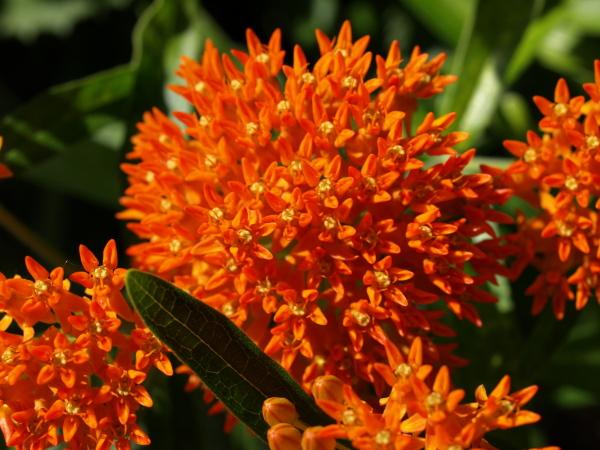
Wildflower Wednesday: Butterfly Weed

butterflyweed1

Common Name: Butterfly Weed

Scientific Name: Asclepias tuberosa

Habitat & Range: dry soil, full sun, prairies and meadows

Bloom Time: summer

About: How about some more flowers that will attract butterflies and other pollinators? Butterfly Weed is a compact, lower growing perennial wildflower that can be purchased at a good nursery or easily seeded. It is better for attracting butterflies to smaller yards than big, sprawling plants like Milkweed or Joe-pye Weed (though it is a milkweed and thus still host to Monarchs and also to Gray Hairstreaks). And it’s orange, not all that common in wildflowers, which tend toward begin white, yellow, or purplish.

I have a specimen in my garden (originally purchased at, you guessed it, a native plant sale) that has been slowly growing in circumference for years. And I occasionally find volunteers pop up in other parts of the garden, which can easily be pulled or replanted elsewhere (if you catch them early; the long taproot this plant develops makes transplanting difficult once a plant is established). It is great in full sun and dry soil, so you can position in some of the most harsh spots in your garden, along with your Sedum and other tough plants. It can be found growing wild throughout the Lower Peninsula.

Here’s some on Mackinac Island:

OLYMPUS DIGITAL CAMERA

Reference: Wildflowers of Michigan by Stan Tekiela; Adventure Publications, 2000

On Garrulous Chipmunks, Belligerent Yellow Jackets, and Other Glories of Fall

japmaple02Somehow, it is October. This has really taken me by surprise. Most years, in September, I start getting out to the nature center or on the River Trail to take photos of the early hints of fall color. I get out in my yard and start trimming back spent perennials and vegetable plants. I pull out my warm clothes and closed-toe shoes.

But this September, one of the nicest I can remember weather-wise, was so very, very busy. I don’t quite know why. Perhaps it has to do with our big schedule changes at home with our son in school every day, karate and church stuff three nights a week, Sunday school preparation on Saturdays, research into my next book most nights…the list just seems to go on. Whatever the reason, I didn’t “feel” September this year. I missed it, somehow.

And so it’s October. The chipmunks are constantly chirping, for what reason I cannot tell. We’ve started a quarterly relationship with Terminix to rid our home of the yellow jackets we thought we could trust (who then perniciously invaded the sunroom) and ants and other such things. The bergamont and peonies are coming down with a serious case of powdery mildew. And any remaining tomatoes out there have been thoroughly taste-tested by squirrels, raccoons, and tiny black worms. The honeymoon’s officially over with this year’s garden and it’s time to do some pretty ruthless chopping and bagging.

Our attention is lifted from ground level as we start to notice the trees flirting with colors that have always been there beneath the chlorophyllic green. We buy the first jugs of apple cider. We start contemplating a nice color drive Up North. We remember to bring our camera with us everywhere just in case the mist and the sun should kiss in the morning over drifts of red sumac leaves. (Yes, some of us still use an actual camera rather than a phone.)

And we hope that we won’t miss October. Because this, the most beautiful of months, only comes once a year.

New Release: The Beginning and the End

My September story is now available for Kindle and Kindle apps! Click here to buy.

OLYMPUS DIGITAL CAMERA

I have to say this month has been an odd one as far as short story creation is concerned. I started this month’s story with this cover photo and title:

OLYMPUS DIGITAL CAMERA

But as I wrote the story, the title changed, and the photo had to change too. I had intended the story to be more about the house/inn but it became more about how relationships begin and end. To figure out the significance of the dandelion on the cover, you’ll have to read the story. Also got to have a little fun with the type this time around.

I’m really looking forward to writing my nonfiction book next year on how this year’s experiment worked and how you can make writing more intentional. September was a perfect example of initial inspiration having served its purpose and then needing to be discarded for the good of the story. Too fun.

Only three more short stories to go!

LastThree

Overcoming the Fear of Inadequacy

This is a picture of my son.

CalvinSelfPortraitMarch2013Age4

It is a self portrait made back in March when he was still four years old, sent home in his personal file when he left his daycare/preschool and started kindergarten. Being four, this is as skilled as his self-portrait could be, even though I know he really sees himself more like this:

Do you ever feel like your talent may not live up to your own expectations?

Does that fear keep you from trying something great?

In almost any creative endeavor, we have an idea of what we want the end result of our efforts to be. The knowledge that our labors–our writing or painting or sculpting or songwriting or drawing in crayon–may never quite live up to the perfect standards we have in our heads can keep us from trying. One can feel paralyzed by potential.

But one must still write. One must still create.

My son may not be a real ninja turtle, but he is taking karate lessons.

OLYMPUS DIGITAL CAMERA

If you don’t try, you can’t fail. But if you don’t try, you can’t succeed either.

You’ve got to start somewhere.

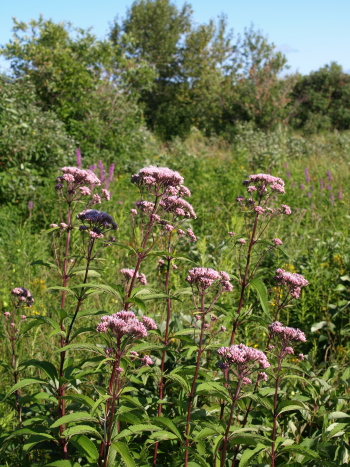
Wildflower Wednesday: Joe-pye Weed

Joe-pye weed

Common Name: Joe-pye Weed

Scientific Name: variously Eupatorium maculatum and Eutrochium maculatum (depending on the source)

Habitat & Range: wet, full sun meadows and along streams and lakes

Bloom Time: summer

About: A tall perennial you can get at most nurseries or native plant sales, this may look like a milkweed, but it is in fact part of the aster family. If you have a pond on your property, this is a perfect plant to edge it. It’s tall (some varieties can reach 10 feet!) so use it as a backdrop to smaller plants in your native or cottage garden. Even though it likes moist soil, its extensive root system means it will tolerate drought. It’s not too picky. Other pluses: it attracts butterflies and deer don’t like to eat it.

Reference: Wildflowers of Michigan by Stan Tekiela; Adventure Publications, 2000

(also Better Homes & Gardens online plant encyclopedia)