The Past, the Future, and This Unending Winter

March 16, 2013, Fenner Nature CenterMichigan, like quite a large swath of the country, is in the midst of a depressing cold snap the likes of which puts me in mind of Laura Ingalls Wilder’s The Long Winter. We haven’t started twisting straw into kindling or burning our furniture yet, but one can’t help but feel that everyone is teetering on the edge of that kind of desperation lately.

Last year the temperatures in mid-March were a full 50 degrees higher then they have been during the past week. This was not necessarily good, as it caused massive fruit crop failures when temps dipped below freezing again (for example, Michigan normally produces about 96 million tons of apples a year while in 2012 we only managed 2 million tons). But still, I don’t think I’m speaking out of turn when I say that it would be nice to have temps in the 40s rather than the 20s at this point in the year.

Being stuck in this winter is like being stuck in a story. You get to a certain point where you feel frozen. You can’t push forward. You can’t go back. You’re just…there. Waiting for the thaw in your brain so you can get on with it already.

That’s how I feel right now. Frozen in time. Tired of what has come before. Waiting to see where things will go in the future. Ready to move on. But stuck frozen in place.

How do you hasten spring? How do you thaw the fertile soil of your creative mind? It seems clear to me that we cannot rush the changing of the seasons, as much as we might want to. There are plenty of tips and tricks to get beyond blocks, but sometimes maybe we just have to wait it out, trusting that the thaw will come, the waters will flow, the flowers will bloom, and the story will move on to the next chapter.

Overcriticizing Your Own Work (or How NOT to Take a Compliment)

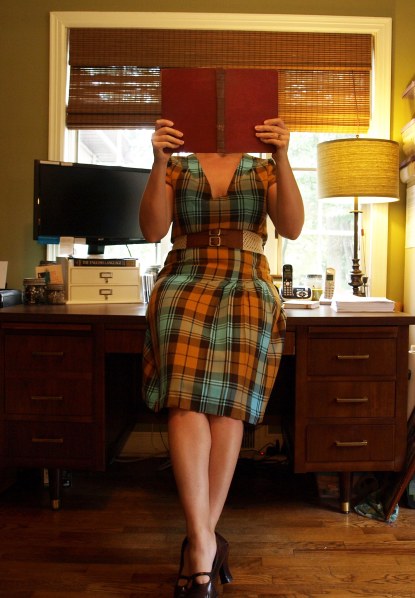
OLYMPUS DIGITAL CAMERAOn Sunday I wore this dress for the first time. I made it back in early September (if you found this blog through the Sew Weekly, you may have seen it before).

Normally I’m someone who dives in, wings it, fixes along the way if necessary, and comes out of the creation process with something I like. Something that fits. Something that works.

Not so with this dress. I thought I’d be smart and really measure and really fit the pattern to my body, and so I ended up thinking I needed to lengthen the bodice (that’s the top part of the dress, for you non-seamstresses out there). But it turns out I must have done that all wrong. And I neglected to check the neckline while doing my alterations. So I ended up with something way too low-cut for comfort and bunchy around the torso to boot.

It went straight into the closet and I decided I would take the time to fix it later. Yeah, right.

Then Sunday morning I decided to finally wear it. I’ll wear it, I reasoned, so I can really get a feel for what needs to change. I put a light turquoise tank underneath to deal with the neckline problem and wore it to church.

I got a lot of compliments on it. No one noticed the flaws (except perhaps my close fellow seamstress friend who may have been wondering about the bizarre bodice issues). People loved the fabric (which I also adore and which is one of the reasons the fit issues were such a huge disappointment to me). They loved the pleats. They loved the whole package.

But as I received their kind comments I quickly told them about all the flaws I needed to address. Not being seamstresses, they all adopted a somewhat glazed over look in their eyes and were probably thinking, “Geez, Erin, I was just trying to give you a compliment.”

Not surprisingly, this whole experience got me to thinking about writing, editing, and sharing our work with others…

Lesson 1: We’re all our own worst critics. Well, unless we’re deluded. We see the flaws in our work that others do not. What we need to ask ourselves is whether we can be satisfied that others see beauty when we ourselves see something that’s almost-there-but-not-quite-yet.

Lesson 2: If you’re not happy with it, go ahead and work to make it exactly what you wanted. If it will continue to eat at you and keep you from confidently showing your work to the world, keep making it better. Go ahead. Indulge yourself in all those little edits. However, you may, like me, discover that you constructed your creation so well and so precisely that to fix it you have to do a lot of work and everything you alter will mean some other part needs to be altered as well. (This is why I like making clothes but not altering them.)

Lesson 3: At some point, you really just need to let go and let the thing be what it is. Sometimes the more we work on something the worse it really gets. I’ve worked a piece of clothing to death. I’ve probably worked over my first as-yet-unpublished novel almost to death. Sometimes you just have to call it quits and move on to something new.

Lesson 4: Don’t point out the flaws that have already gone unnoticed. It’s not humility. It’s false humility. It’s fishing for the other person’s comfort and reassurance (and more compliments). It’s giving you a chance to talk about yourself more. Just gracefully say thank you and move on to another subject, perhaps returning the compliment to them somehow.

Now then, where’s my seam ripper?

Anticipation, Distraction, and Writing It All Out

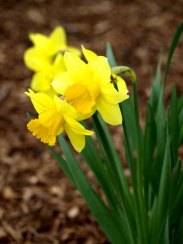
Waiting for DaffodilsMy distracted mind has not been on writing lately. It’s been on spring cleaning. It’s been on my son’s impending move from preschool to elementary school. It’s been on things I want very much to see clearly (and soon)–on the snow melting, on the sight of green leaves and yellow daffodils, on what the future may bring. It’s been on very physical things. No room in my brain right now for the mental work of writing.

Planning. Expectation. Preparation. Yearning. Possibilities. A desire I didn’t realize until it was spoken aloud. But that’s how writing works, too. Sometimes you don’t realize what you want to write about until you start writing about something else. If you’re not careful, you can write yourself into things you would never have expected.

Are you stumped about what to write about next? Don’t know which way to turn on the road of your life? Can’t see as far into the future as you would like?

Just write. Write yourself into a compelling story. Write yourself into a plan for dealing with what’s bugging you. Write out your dreams. Write the future you want. You just might get to know yourself better. You just might discover you have much more to say than you realized. You just might be able to re-distract your mind until the thing you anticipate has finally happened.

You Owe Yourself a Writing Vacation

OLYMPUS DIGITAL CAMERAI don’t know when the term “staycation” was coined, but since becoming a homeowner in the mid-2000s I have taken a good number of them, partly because I like my house and I like working to make it feel ever more like my ideal home, and partly because, having a house and family to take care of, we have no money for a “real” vacation.

Over the past few years, my husband and I have taken a couple staycations during which we did no painting, weeding, laundry, or dishes, but instead planted our butts on the couch, steadily fed the fireplace logs, and wrote. If you do this for a week and don’t allow yourself distractions (make sure your kids are in school) you can get an astonishing number of words out of your head and into your story.

This past weekend we did one better. We left everything–child, pets, chores, and, most importantly, any possibility of a wifi connection–and spent three days writing at a friend’s cottage on Gun Lake. We fed the fire. We made some simple meals. We did spend an hour or so at the casino one night (largely because we wanted ice cream and there’s a Cold Stone Creamery in there). We spent about ten minutes trying unsuccessfully to catch a bat that was flying around the living room one night (after it was clear that we wouldn’t catch him, we named him Briscoe and left him alone). Other than that, we were pretty much planted in two comfortable chairs a few feet from the fireplace with laptops open and fingers tapping away.

I started a short story Friday afternoon, finished it Saturday, had my husband read it and give feedback Saturday night, and had it ready to convert for Kindle on Sunday morning. During that time I also read most of the Gospel of Mark, and all of Luke and John. I also had plenty of time to stare mindlessly out the window at the frozen and snow covered lake. And here’s the thing: I didn’t miss anything.

When we returned to a place that had wifi and I checked my emails and looked at Facebook, I found that, though the world had gone on without me for a few days, it hadn’t gone very far. My retreat made a difference in the scheme of my writing life and my husband’s; we got some work done, we allowed ourselves some space to breathe and relax and be creative, we enjoyed each other’s company without needing to interrupt our thoughts to rationalize to our son our assertion that he had watched enough Ironman: Armored Adventures for one day. But our retreat didn’t stop the world from getting on with things (and things that, frankly, didn’t concern us in the least–like the Oscars).

If you have a day job and writing is a luxury, you need to take a weekend or a week here and there and take a writing vacation. Whether you stay at home (and can keep yourself from wasting time with keeping the place clean) or just get a hotel room in your own town or have a generous friend with a house on a lake and no Internet, you need to make the time. No one can take the time for you. No one cares about your writing in the way you can. And if you don’t make time for it, it won’t happen.

Now then, I have one more day I’ve taken off of work and it’s starting to get away from me. There are paint cans calling me down in the main floor bathroom and, since I’ve finished my story for next month, I think I will go answer their call.

As for you, get out your calendar, pick a day or two or ten, and write “Writing Vacation” there. Write it in pen.

A Symphony to Write By

This is the soundtrack to my upcoming story for March, This Elegant Ruin.

I’ll be writing the bulk of it this weekend as my husband and I get away to a friend’s cottage. I imagine we’ll be huddled by the fireplace and the wood stove, happily typing away with no child and no pets and no responsibilities. A nice little writing vacation, something I highly encourage you to take if you are searching for concentrated time to write.

Thoughts on Submission(s)

We all run in various circles. I don’t mean that in the sense of having no direction, just a dog chasing its tail and not getting anywhere. I mean it more in the sense of social and professional circles.

In the two main circles in which I find myself running about, the word submission has two distinct meanings.

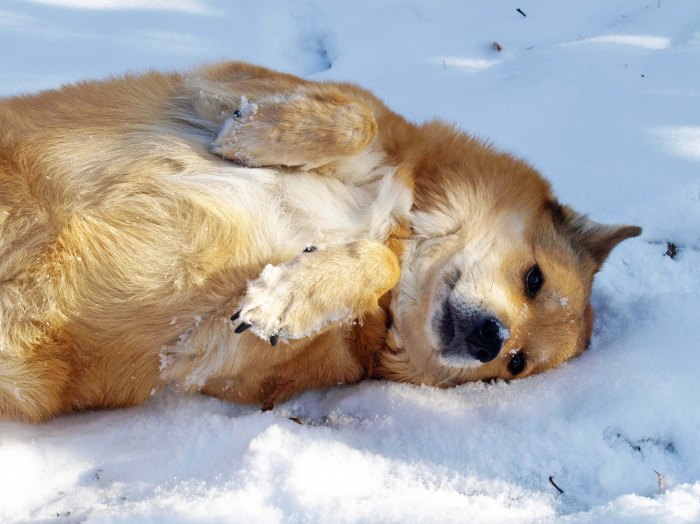
This is what submission looks like for a dog. We humans shy away from this sort of vulnerability.
This is what submission looks like for a dog. We humans generally avoid this sort of vulnerability at all cost.

In the circle labeled Writing, submission is a noun (a story or a poem sent to some contest or publication) or a process (the act of sending that story or poem to that contest or publication).

In the circle labeled Faith, submission is always a verb (us submitting to God, husbands and wives submitting to each other, us submitting our plans to God’s will).

In practice, these can feel like the same thing for several reasons.

1. It’s not easy. Submitting a story, querying an agent, sending your tender literary child out into the world–it’s hard. Taking the first step in handing control of your work over to someone else and risking their rejection is difficult in the same way it is hard to trust someone else with control of your life and happiness. It’s kind of scary at first. Submission of any kind requires courage.

2. It’s a long process. Waiting is the name of the game if you are submitting stories to magazines or entering contests or sending out queries. It will usually take months to receive a response and in the meantime you can feel like you’re in a kind of literary limbo. When you hand your plans over to God you can feel that his timing and yours do not always (usually) match up one to one. It’s going to take longer than you want it to. Submission of any kind requires patience.

3. You have to keep doing it, over and over. Submit, get rejected, repeat. That’s the process you need to follow until your work matures, hits a nerve, happens to be timed just right. You can’t give up. Similarly, submitting to God is not a one-time thing–it’s an ongoing process. You have to do it daily. You’re never done submitting. Submission of any kind requires persistence.

4. Eventually, it pays off. You can’t publish something if you don’t submit it, and if you are a good writer who is consistently trying to improve your craft, eventually you will get published. In the same way, submitting to God or to a spouse can seem at first as if you’re getting the short end of the stick–you lose the control over your daily life, you turn over the fulfillment of your needs to someone else. What if they get it wrong? What if they neglect you? But the reality is, God is better at fulfilling your needs than you are, and a loving spouse is as well. Submission of any kind requires trust.

Courage, patience, persistence, trust. Do you have those qualities? Which one do you do best? Which is hardest for you right now? If you’ve shied away from submitting your writing and sharing it with the world, what is holding you back?

Don’t let fear of rejection keep you from submitting. Everyone gets rejected. But if you never submit, never turn anything over out of fear that once you do everything is beyond your control, you can never be the writer or person you were meant to be. If you’ve been given the gift of being able to write well, that gift was given for a reason. Use it. Share it. Submit it to God. And for goodness’ sake, submit it for publication!

So, What’s Your Point?

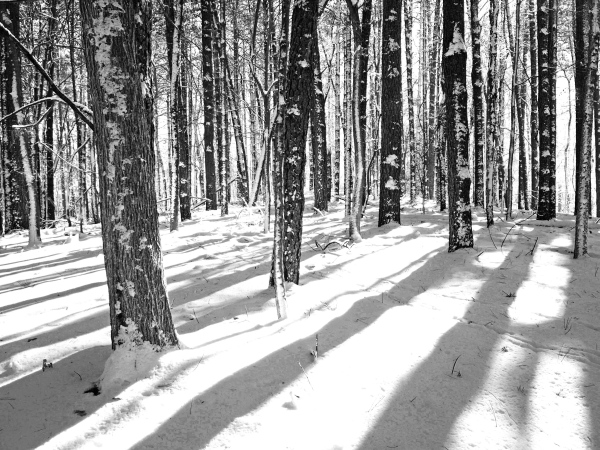
Snowy Forest

My dreams are rarely guided by what we might call a plot. Nothing actually happens in them. They are scenes that flow nonsensically one into the next and go NOWHERE.

My husband can attest to this. The poor man is often subjected to partial recounts of my dreams–partial because at some point he simply walks away because he knows this is going nowhere and yet will not end. He even used my “method” of dreaming in a sermon to illustrate the difference between reading Scripture as a bunch of boring, unrelated stories (“and then this happened and then this happened and then this happened”) and reading it as God’s very well plotted and intentional story (which he generously compared to my more deliberate method of writing) in which we find purpose and meaning. In case this interests you, you can listen to it here. It also contains a fascinating tidbit on the real St. Nicholas, who was apparently a bit of a hothead and prone to decking heretics. True story.

Now, I’ve been busily working on February’s short story, The Door, which I have deliberately made a bit dreamlike. Last week I realized that this was becoming a problem. It was becoming much too much like one of my actual dreams–rambling and random and pointless.

So I stopped writing. And I started plotting. I thought about this story in the shower. I thought about it in bed. I thought about it in the car. I thought about it but did not write down anything I thought of. I just allowed myself to think it through, to think myself into a plot, a purpose, a point.

While turning back toward home on an ill-fated trip through white-out conditions to my office today (Lake Effect Snow = 1, Erin = 0), everything fell into place like fat snowflakes aiming directly for their spot on the ground (rather than swirling madly around my car). I got home safely, put a space heater at my feet, and got back to work with the lovely feeling in the back of my mind that I now know where this story is going.

Dreams are okay. Their very weirdness is interesting. But interesting is not really enough for a story. Writers, we owe our readers a bit more than a rambling but interesting story. We at least owe them a compelling plot or, as is often the case in shorter fiction, a point.

How can you take those intriguing but (admit it) pointless scenes and weave them into a larger tapestry to make them an essential part of your plot? How can you give your readers a clear (though pleasantly winding) path through your forest of very lovely, very interesting trees?

When Youthful Illusions Fade, You Can Really Get to Work

You. Are. Awesome.Creative people, when you were young did you imagine yourself being “discovered” at some point? Be honest. When you were a child singing slightly off-key in your room, wasn’t there some part of you that was sure that somehow in your dinky Midwestern town, as you were one day following your mother back out to the car with a cart full of groceries, singing quietly to yourself, that a random Nashville bigwig would overhear your angelic voice and sign you on the spot?

No? That was just me then?

Surely when the pencil drawing you made in seventh grade art class was selected to go on some foam board display in the hallway you imagined that during the next parent/teacher conferences a famous art critic would wander past the cafeteria and stumble upon your flawless execution of a winged horse, track you down in a mad rush of inquiry, and whisk you away to some fine art institution in New York where you would blossom into the absolute toast of the cutting edge art scene.

Am I getting closer?

How about this. Despite the keen awareness in college that you were perhaps not quite as remarkable as you were lead to believe in your small hometown, that you were surrounded by many talented people and could even enjoy being part of this community of young visionaries, there was still a place in your psyche that was reserved for illusions of grandeur, that believed that your creative writing teacher would read your complex and sophisticated short story about losing your best friend and immediately pass it on (with gracious apologies to you for not asking first) to her friend at The New Yorker and you would assume your natural and rightful position as the brightest young literary star to come from your town in…ever.

Admit it. That was you. Some small part of you, anyway.

If it was not you, it was certainly me at various times of my young life. Even in my twenties I felt sure (well, perhaps not quite as sure as I had been in my teens) that the promise that teachers and parents saw in me would simply materialize into worldly success on a grand scale with little effort on my part (and that it would be nothing less than I deserved).

Considering this, you may think turning thirty a few years ago would have sent me into a shame spiral at having not accomplished artistic feats that would last through the ages and get me interviewed on NPR. Actually it felt really, really good. Rather than be despondent that I would never be considered a young prodigy admired the world over for my natural talent and easy charisma, I felt a lightening of spirit as the pressure to live up to the expectations I had placed upon myself was lifted from my shoulders. It was not until the silly desire for admiration was gone that I began to write anything worth reading.

Why do I write today? To exercise my gifts, to enjoy the process of creation, and to share in the exchange of ideas that is one of the many things that distinguishes us from the rest of creation. I love to read and I think when you love to partake in an activity you naturally want to contribute. My experiment of writing and publishing a short story each month of this year is part of a determined effort to contribute.

Why do you write?

Helpful Books on Writing and Writers

I’m putting together a list of helpful, funny, and inspirational writing books as part of a workshop handout and I thought it might be helpful to the blogosphere at large to list and link to them here. You may want to bookmark this page refer back to it when you’re running dry.

I’ve grouped them very generally, because there is inspiration within books on the craft, and there is certainly instruction and advice to be had from the more narrative ones, so I encourage you to check them all out at some point. And if I’ve missed your favorite, add it to the comments.

BOOKS TO MAKE YOU A BETTER WRITER

The First Five Pages by Noah Lukeman

The Plot Thickens by Noah Lukeman

The Art of Fiction by John Gardner

On Writing by Stephen King

Eats, Shoots & Leaves by Lynne Truss

Spunk & Bite by Arthur Plotnik

77 Reasons Why Your Book Was Rejected by Mike Nappa

How Not to Write a Novel by Howard Mittelmark and Sandra Newman


BookQuote01

BOOKS OF WRITING PROMPTS AND EXERCISES

The Pocket Muse by Monica Wood

The Pocket Muse 2 by Monica Wood

Writing without the Muse by Beth Joselow

Write: 10 Days to Overcoming Writer’s Block. Period. by Karen E. Peterson


BOOKS TO INSPIRE YOU & REMIND YOU WHY YOU WRITE

If You Want to Write by Brenda Ueland

Writers on Writing: Collected Essays from the New York Times

Writers on Writing, vol. 2: More Collected Essays from the New York Times

The Writing Life by Annie Dillard

Bird by Bird by Anne Lamott


So did I miss any big ones? Please share them with us!

Easy Come, Easy Go

You know that random writing opportunity that fell out of the sky last week? Well, as things often turn out in the freelance world, it kept falling right past me and the earth swallowed it up. A part of me is disappointed about the loss of potential experience and money. Another part of me is relieved at the sight of all those Saturdays that would have been spent traveling to interviews and all of those evenings that would have been spent writing someone else’s story going suddenly, gloriously blank.

Glad I used pencil.