The Deadly Act of Revision

The Butterfly EffectDuring the past week I took the plunge and switched a novel-length manuscript from 3rd person limited omniscient over to a 1st person point of view. I knew I needed to do it, but I wasn’t looking forward to it because it meant a lot of changes.

A change in narrator means not only a change in personal pronouns but (in this case) subtle changes in voice, phrasing, and vocabulary. It can change the way you describe a scene. It can change the values you place on various elements of the story. It can change the past and it can change the future. It can change everything.

It can mean throwing out a significant amount of good writing. But as painful as this whole process can be, it is also a great teacher. And I shall not presume my learning days are done just because I’m long out of college. (Oh my, it has been twelve years.)

You know the butterfly effect? One tiny event in one spot causes untold numbers of events that would not have happened, or would have happened differently, had it not been for that one tiny event half a world away? That’s the kind of thing that happens when you replace the word “she” with “I” in a novel.

Big revisions are not for the faint of heart. You lace up your boots (or, for those of you write historical romances, your corset), take a blind leap into the fray, and hope that with persistence and intelligence you will come out on top. And a little luck probably doesn’t hurt either.

In the meantime I am also writing and taking notes on a new series, coming up with story arcs and subplots and characters. Lots of planning, planning, planning. Very different in process and in tone from my first finished novel, but it is something I started thinking about doing a decade ago and now I’m finally ready to start bringing it into reality. I love brainstorming and throwing a ton of ideas out there, ready to be plucked later. It has me excited and feeling rather happy. Which is a nice relief when the revisions of earlier pieces gets tedious.

What are you working on?

Dogs, Quilts, Graphic Design, and the Beauty of a Barter Economy

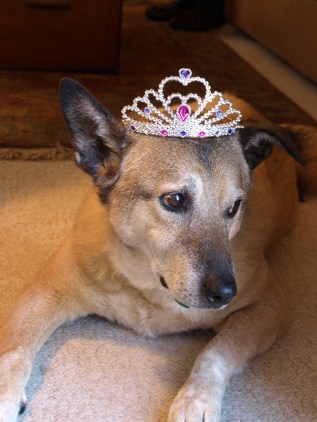
Each March my sister and her family go to Florida. Each March we watch her now geriatric dog, Max, while they are away.

Princess Max

Each July, my family goes to camp in Northern Michigan. Each July my sister watches our dog, Sasha, dig a giant hole in her backyard and sit in it.

Sasha Digs

You scratch my back, I’ll scratch yours.

Exchanging services is a very old way to get something you need without having to fork over money. All it takes is your time and sometimes your talent.

Earlier this winter a colleague in the art department needed someone to turn a bunch of biking and running t-shirts into a quilt. I happen to sew a lot and I’ve made a t-shirt quilt for someone else before, so I volunteered. But any time I’ve sewn for someone else, there is the awkward question of “how much is this going to cost?”

Rather than send my coworker an invoice for something I knew would be fairly simple and for which I would probably only spend $5-10 on materials (since she was giving me a bag full of all the fabric I would need) I asked if perhaps she would use one of her talents for me in exchange.

So Heather will at some point be designing a book cover for me. My initial thought was that it would be the cover for my novel, which I intend to self publish later this year. But I’m also considering whether I might rather have her do the cover for the collection of short stories I will have in 2014. But we’ll work it out.

What talent do you have to offer? What needs do you have to be filled? Find a few people you can help out who can help you out in return. Develop a pool of talented people who can all mutually benefit from each other’s skills and passions.

Are you a good editor? See if you can offer your services free to an influential website in exchange for free advertising space on their page.

Do you know an editor who doesn’t have time to clean her house? Offer your services in exchange for proofing the work you want to publish.

Do you have a friend with connections? How can you help that friend in exchange for some introductions?

Need a better website design? Can you offer your techie friend free fresh baked goods for a year?

Want some professional looking headshots? That friend of yours with the amazing camera and Photoshop skills probably needs something too. Could you supply that need?

Writing and publishing take a lot of time and effort. But amazingly, in this day and age, they may not take as much money as you think.

FIRST WARNING: In this barter economy, you must have something to give. I have known a person or two who only calls or emails me when he needs something and has never offered anything in return. Don’t be that guy. Even if you’re just asking for advice about an aspect of publishing or website design or whatever, you should at least offer something in return, or just show up with a gift that says you appreciate the time your friend has taken to help you.

SECOND WARNING: Don’t let this exchange of services make you start thinking of the people in your life purely in terms of what they can do for you. People can smell this kind of thought process a mile away and you’ll find yourself losing friends instead of gaining help.

Share and share alike and we all benefit.

Overcriticizing Your Own Work (or How NOT to Take a Compliment)

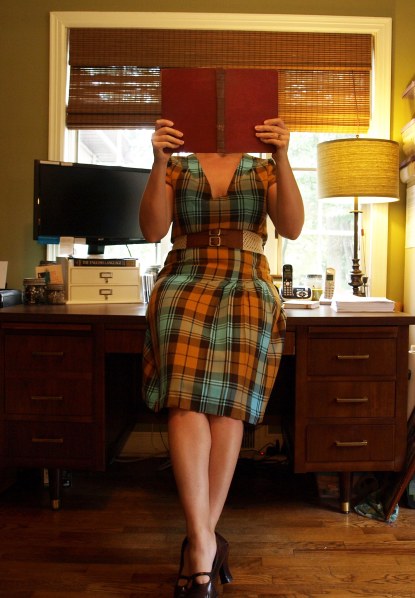
OLYMPUS DIGITAL CAMERAOn Sunday I wore this dress for the first time. I made it back in early September (if you found this blog through the Sew Weekly, you may have seen it before).

Normally I’m someone who dives in, wings it, fixes along the way if necessary, and comes out of the creation process with something I like. Something that fits. Something that works.

Not so with this dress. I thought I’d be smart and really measure and really fit the pattern to my body, and so I ended up thinking I needed to lengthen the bodice (that’s the top part of the dress, for you non-seamstresses out there). But it turns out I must have done that all wrong. And I neglected to check the neckline while doing my alterations. So I ended up with something way too low-cut for comfort and bunchy around the torso to boot.

It went straight into the closet and I decided I would take the time to fix it later. Yeah, right.

Then Sunday morning I decided to finally wear it. I’ll wear it, I reasoned, so I can really get a feel for what needs to change. I put a light turquoise tank underneath to deal with the neckline problem and wore it to church.

I got a lot of compliments on it. No one noticed the flaws (except perhaps my close fellow seamstress friend who may have been wondering about the bizarre bodice issues). People loved the fabric (which I also adore and which is one of the reasons the fit issues were such a huge disappointment to me). They loved the pleats. They loved the whole package.

But as I received their kind comments I quickly told them about all the flaws I needed to address. Not being seamstresses, they all adopted a somewhat glazed over look in their eyes and were probably thinking, “Geez, Erin, I was just trying to give you a compliment.”

Not surprisingly, this whole experience got me to thinking about writing, editing, and sharing our work with others…

Lesson 1: We’re all our own worst critics. Well, unless we’re deluded. We see the flaws in our work that others do not. What we need to ask ourselves is whether we can be satisfied that others see beauty when we ourselves see something that’s almost-there-but-not-quite-yet.

Lesson 2: If you’re not happy with it, go ahead and work to make it exactly what you wanted. If it will continue to eat at you and keep you from confidently showing your work to the world, keep making it better. Go ahead. Indulge yourself in all those little edits. However, you may, like me, discover that you constructed your creation so well and so precisely that to fix it you have to do a lot of work and everything you alter will mean some other part needs to be altered as well. (This is why I like making clothes but not altering them.)

Lesson 3: At some point, you really just need to let go and let the thing be what it is. Sometimes the more we work on something the worse it really gets. I’ve worked a piece of clothing to death. I’ve probably worked over my first as-yet-unpublished novel almost to death. Sometimes you just have to call it quits and move on to something new.

Lesson 4: Don’t point out the flaws that have already gone unnoticed. It’s not humility. It’s false humility. It’s fishing for the other person’s comfort and reassurance (and more compliments). It’s giving you a chance to talk about yourself more. Just gracefully say thank you and move on to another subject, perhaps returning the compliment to them somehow.

Now then, where’s my seam ripper?

Banishing Clutter and Getting Your Literary World in Order

32/40 bags in 40 daysToday I took a huge load of junk I don’t need to Goodwill. I filled my Explorer to the gills and then passed it all off on an unsuspecting lone worker who is on the front lines of the redistribution of stuff in this community. Every time I handed him yet more bags of stuff (32 in all on this trip) I could see his resolve strengthen a little bit. He would sort through my castaways if it was the last thing he ever did.

Other loads I’ve dealt with today: two of dishes, three of laundry, one of trash. And I have to tell you that it feels so good to walk out into the warm, sunny day (we actually hit the mid-40s in mid-Michigan today!) carrying out the stuff I don’t need.

It’s like editing. (You knew that was coming, didn’t you?) You go through your manuscript or article or story and find the useless stuff, the stuff that doesn’t help anyone, the stuff that you thought you’d use but that instead just ended up as unsightly clutter that distracts you from the real focal point.

What parts of your latest creation could use a good spring cleaning? Trust me, you’ll like your story better once you can get yourself to part with the unnecessary clutter.

A Writing Tool You May Not Be Using (Yet). Hint: It Involves Robots.

It can be difficult to find the weaknesses or errors in one’s own writing. We read over missing words because our brains know they should be there. We write mind-bogglingly long sentences, those great structures built of words, nesting clause within clause within clause, little knowing how someone who is coming at it fresh, who hasn’t seen the blueprint, will work it all out and tease the correct meaning from our tangled strings of nouns, verbs, and adjectives. One important way to get feedback is to pass our work along to willing readers who will be encouraging and yet honest, and who also hopefully know a thing or two about plotting, pacing, and prepositional phrases.

But before passing your tender, raw writing on to another human being, perhaps you should be trying robots first.

One of the best ways to really hear your writing for what it is is to make use of the increasingly sophisticated text-to-speech capabilities of your word processor, your e-reader, or various programs you can download. My preferred method is something called NaturalReader. You can download a free version here, but I recommend buying a few voices (I use Crystal) that sound less like robots and more like…um, let’s say cyborgs. Simply cut and paste any text into the program and you can listen to it, either via your computer speakers or converted to an mp3 file that you can listen to on your iPod.

I probably listen to close to a hundred book-length manuscripts using this software every year for work. I do my work reading this way for convenience and as a time-saver. Listening to a manuscript rather than reading from a page, I hear things that I wouldn’t necessarily always notice (which I might then decide to pass on to the editor if it becomes too distracting). Irritating repetition of a word, phrase, or way of describing something (such as “Her heart fell along with her valise”), sometimes a mere paragraph away.  Missing helping verbs or spots where an author changed the sentence structure at some point but missed the removal of a now superfluous word. Overuse of a description, as though the author had forgotten that the “lawman” had already been described as “blonde” many, many times in the book (as though the color of his hair somehow had anything to do with his professional competency).

And everything I pick up in others’ manuscripts I can pick up in my own using the same technology. Hearing your work read aloud, even by a slightly robotic voice, brings into sharp relief those little mistakes and irritations that you want to fix before you send your work away to another human being. It makes you notice when you need another paragraph of transition. It shows you that you forgot an article or changed tense or forgot to pluralize something. It shows you misspellings you already read over ten times without noticing.

If this tool isn’t in your toolbox yet, I strongly encourage you to add it. It’s free or cheap, it can save you small embarrassments, and it can make you a more efficient self-editor.

Plus, there’s just something about hearing a robot read your story that is bizarrely satisfying.

The Editing Secret You Know (But Are Trying to Forget)

Balancing the Baby

The observant among you will have noticed something rather off about the photo above. The rest of you are wondering why I would post a boring photo of my fireplace. If you are in the second lot, look again. See it now?

That baby should not be there. And really, it’s a pretty poor Photoshop job anyway, so you may be suspecting that the weeks-old baby on the mantel is not in actuality sitting up there under his own power. Two photos taken, one with my husband on either side, holding up our infant son several years ago, knit together quickly to make it appear that the boy just jumped up there on his own and was casually relaxing. In hindsight, we should have used a tripod.

I post this photo to illustrate a writing truth that you have probably already heard, but of which we all need to be reminded now and then. Sometimes you write a scene, a chapter, or an entire book and place a baby somewhere it doesn’t belong. A turn of phrase you are particularly proud of that really doesn’t fit the tone of the rest of your work, a supporting character you love but can’t justify because he doesn’t move the story along, a bit of melodramatic indulgence in place of hardworking, compelling storytelling.

These are the babies on your mantel. They don’t belong there. You need to remove them. And you know it (usually). If your babies blend in too much, perhaps a reader with keener eyes can help you identify them.

You don’t have to toss your babies out in the cold and forget about them. You just can’t leave them up on the mantel. It’s distracting. Tuck them away in their cribs until you find a better place for them in another work. Keep that turn of phrase, that great character, that bit of melodrama in your notebook; they may all someday turn into new stories where they fit perfectly.

Perception Is Reality . . . Well, Almost

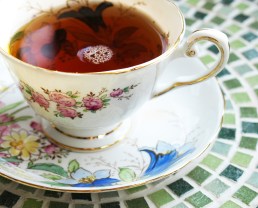
Tea“This smells like an old timey poultice that has just been removed from a wound.”

This is what my husband said as he walked into the living room with a mug of Sleepytime tea.

“It’s chamomile. It’s supposed to smell like apples,” I countered as I drew near to sniff the offending liquid. It smelled exactly how it was supposed to smell. Like yummy, soothing herbal tea.

My husband is not a tea drinker, and is especially not an herbal tea drinker (why bother if there’s no caffeine?) but he was going to muscle that poultice tea down anyway. The night before he had not slept at all. Not one blessed minute. So this night he was doing everything he possibly could, piling on all the useless advice he’d heard over the past five years, in a desperate attempt to trick his mind into shutting down for the night. Magnesium, valerian root, sleeping pill, sleepytime tea, and a few other things I don’t recall now. As he rattled of the ingredients to his sleep-inducing cocktail, I remarked that he was probably the world’s foremost connoisseur of insomnia cures. Much good that did, though, as whether they worked or not seemed to be a bit of a crap shoot.

He did sleep that night. But insomnia is not really what this post is about. It’s about perception. Specifically, perception of writing. Your writing, perhaps.

I thought the tea smelled fine. My husband thought it smelled like it had just been extracted from the germ-infested seeping wound of some filthy Dark Age peasant. I like tea. My husband does not.

In writing, as well as any other field that seeks to involve other people’s senses, desires, prejudices, and emotions (think advertising, movies, music, just about any media you can imagine) a stark black and white sense of reality does not matter, and many would argue it cannot be determined anyway. What matters is how people perceive what you’ve created.

In other words, if I write something I think is unique but others think is commonplace, it is commonplace. If I write something I think is edge-of-your-seat but readers put it down because they don’t feel the drive to keep reading, it is not edge-of-your-seat. If I write something I believe takes on deep issues but the reader dismisses as shallow and sophomoric, it is not as deep as I think it is.

Ouch. Criticism reveals our writing’s most persistent flaws. It’s hard to take at times, just as it was hard for my husband to swallow that tea. But criticism, even the mean and spiteful criticism, can strengthen our writing if we apply it correctly. Even a tirade can be turned into constructive criticism if we read it with the right spirit and thick enough skin.

But here’s the kicker. You are a writer. You are an artist. And even if people do not receive your work as you hoped they would, you have a message and a vision. While properly applying criticism to our writing does produce better writing, there is such a thing as too much compromise, when your writing and your story become someone else’s because you are trying to please too many people.

If you are confident that an element of your writing is right for your story, that it serves your story in a way that it would not if you changed it (perhaps the way a character acts or your point of view or the style in which it is written) then leave it alone. Sometimes people criticize things because they are not exactly like everything else they’ve read. Sometimes they criticize because they had a really crappy day and they need to lash out at someone. Sometimes they criticize because they are trolls. Be courageous. Be willing to be different. But only after you have truly and honestly considered your reader’s opinion and have a good reason for disregarding it (and there are many legitimate reasons to reject other’s opinions).

When I initially gave my novel manuscript to a few friends and colleagues to get feedback, there were a couple things that everyone said I did really well. And there were a couple of things that were distracting flaws. I had to choose how much of those perceived flaws I was going to change. If only one reader mentioned it, I might leave it as is. But if almost everyone mentioned it, I knew I needed to think hard about how to address it. And then I had to decide if I had really addressed it adequately once I did make changes. (I’m still not sure.) But I also had to decide if I was willing to sacrifice something I felt was necessary to retain the style of the storytelling.

Perception is reality for the reader. You can control the reader’s perception up to a point, but you cannot change the lens through which they read. So do your part to make things understandable. Do your part to create and mold the perception. But accept the fact that another reader may see your work differently, may catch your vision in a way the first reader didn’t. Maybe every single reader isn’t really the right audience for you. Maybe you’re happy with a smaller audience that truly understands and appreciates your writing for what it is because you are all looking at it through similar lenses.

I’m the tea drinker in our family. My husband will never like tea, no matter how many different kinds are out there, no matter how much sugar, no matter how it’s dressed up. He is not the “audience” for tea. And tea growers don’t grow for him. They grow for me.

Who is your audience? Your real audience. Write for them.

If Writing Is Packing Your Bags, Editing Is Taking the Trip

I love writing. I enjoy the actual process of putting thoughts down in words on a page/screen, and especially that mysterious reverse aspect of writing–when the act of writing actually drives your thoughts. It is fascinating to be part of the interchange between process and product, the fluid state where you aren’t sure who is in charge of the story that is taking shape.

But even more than writing, I have to admit, I love editing. Writing can never achieve on its own what writing and editing achieve together. Writing is only the very first part of the journey. You might compare it to a hiking trip. It’s packing your pack and reserving campsites and planning how far you will hike each day. It’s making sure you have everything you need, gathering the essentials of your story–characters, setting, plot, etc. But just like a hiking trip, you don’t want to stop with the prep work. You want to actually go on the journey. You know it will be hard work, but that it will all be worth it in the end.

I’m not talking about overarching revision, though that is often important, especially when you push yourself to write at a quick pace as so many of us are doing for NaNoWriMo. And I’m not talking about proofing, that necessary nitpicking that gives you a clean manuscript.

I’m talking about  looking at individual words and judging their merit. Are they hardworking or lazy? Are they unique or commonplace? Do they truly mean what you want them to mean? Is there a better one, a more complete one, a more interesting one that could be substituted to bring your writing to the next level? This is like looking down at the forest floor on a hike, noticing the individual plants and flowers and mosses, spotting the snake slithering away or the butterfly sipping nectar. It’s paying attention to the little things, because the little things are what make up the whole of the experience of the trip and they are important. If your readers are tripping over the roots or rocks that are poorly chosen words, this is your chance to  level the path.

I’m talking about looking at individual sentences with that same critical eye and asking yourself if that sentence is truly the best it can be. Does it say something important? Does it say something true? Does it say something necessary? Is it essential? Does it move the reader forward? This is like looking at everything around you at eye-level. This is seeing the path ahead, seeing the deer tip-toeing among the trees, seeing the play of sunlight and shadow on the water. This widens your scope from individual words and takes into account the somewhat larger landscape of your story. If your readers have come to a river with no bridge in sight, this is your chance to build one for them so they don’t have to slog through the mire of unclear sentences.

I’m talking about examining a paragraph and then a chapter and applying the same criteria to it. Is it unique, necessary, dynamic, clear, interesting, and compelling? These are the breaks in the trees that allow you to experience the bigger picture. They are the overlooks, the vistas, that you miss if you are too focused on the ground. These are the points at which you (and your reader) can get a glimpse of what is coming ahead in your story.

So, writers, if your bags are packed (you’ve written your story) it’s time to enjoy the editing journey. The lovely thing about editing is that this is your chance to reshape your literary landscape, to remove obstacles that trip readers up, to improve the scenery and make the path clear. And, just like a hiking trip, you can start from the beginning again, make the same hike, and notice new things every time, so you’ll want to plan multiple trips through your story.

My own penchant for editing has thrown me way off my NaNoWriMo schedule and I’m quite behind now. I took a break to finish an edit on an earlier work (possibly my 20th time doing that hike) before sending it off to a literary agent. I also succumbed to the temptation to go back in my current manuscript for NaNoWriMo and do some revising and editing. But, in my defense, in the early stages of writing a novel, sometimes that really does have to be done or else you will find yourself lost in the wilderness days later having taken a wrong turn way back in chapter 3. Better, I think, to retrace your steps now, consider your options more carefully, and take the right path. After all, blazing new trails is hard work and if you’re going to do it you want to end up in the right place. Or, to put it in terms of our packing metaphor, I don’t want to get too far into my hiking trip and find that I neglected to pack my water purifier or my tent.

Not sure where to start on your editing hike? One of the best books I’ve read lately on the subject is The First Five Pages by Noah Lukeman. It’s a veritable field guide to editing success. If you take his advice seriously and apply it to your manuscript, you will end up with a far better product than you started with.

Enjoy the trip!