
Click to see it bigger. It’s better bigger.
Click to see it bigger. It’s better bigger.
On this day twenty-five years ago I was ten years old and getting breakfast at a friend’s house after a sleepover when there was the distant sound of a large boom and a shiver under our feet. I thought it must have been a small earthquake. I didn’t know it then, but a gas tanker on the Saginaw River had just exploded.

Plan A was to let the fire burn itself out, so the inferno raged for 36 hours before authorities decided that they needed to try Plan B and actually fight the fire. For days after, I could see a plume of black smoke that faded slowly to gray. Even after crews thought the fire was out, it reignited and had to be suppressed again.
It was one of those things you remember because it seems so otherworldly. Explosions happen in movies, not real life. Miraculously, only one life was lost, an Iowa sailor who drowned while swimming away from the blast.
For an excellent article about the Jupiter explosion, click here. For more images, visit the Saginaw River Images blog.
Yes, the days are hot and humid of late. But the mornings are like this.
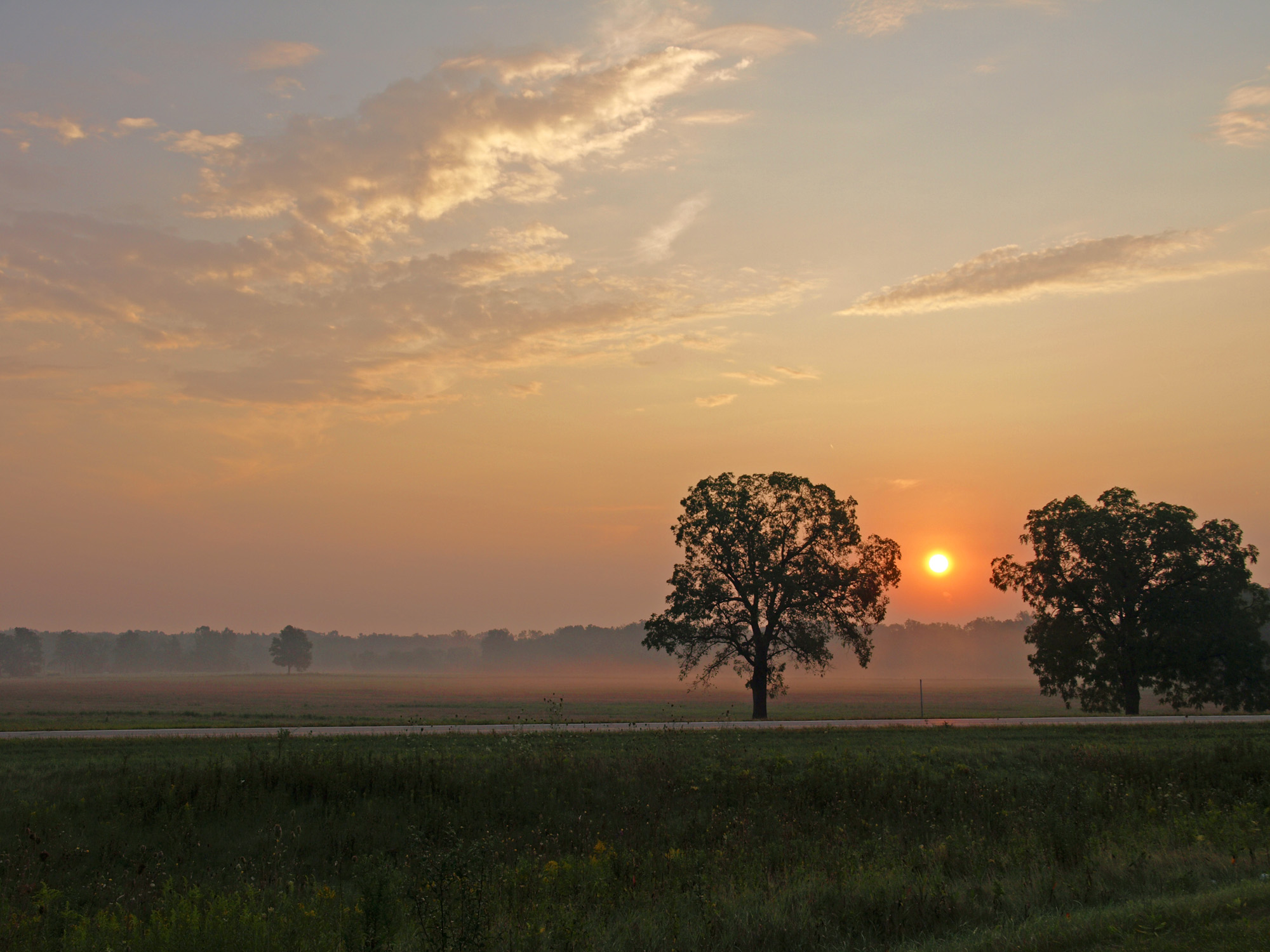
Worth it.
Sunday afternoon I took in the last bits of June at Fenner Nature Center’s restored native grassland area. I strolled among innumerable flowers, bees, butterflies, dragonflies, and a few mosquitoes (They’re finally here. Hooray.) and listened to birds trilling and wings buzzing. It was the perfect summer day — the one we remember from childhood — with blue skies and time stretched out in all directions.


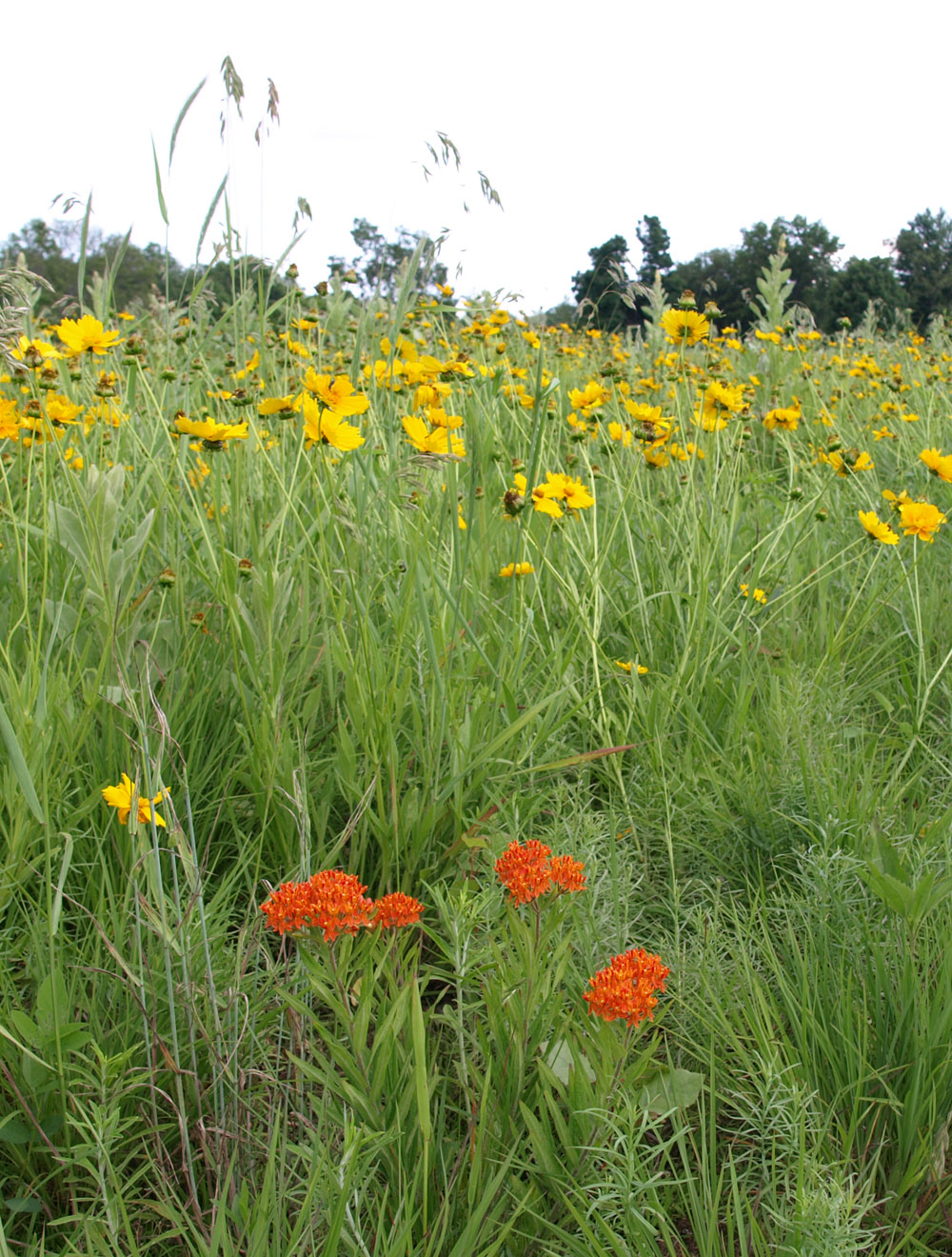

About halfway through the afternoon I was joined by a friend who seemed content with my company for a while.
We eventually went our separate ways, I to the pond to look for frogs and turtles, she to another patch of grass.
It was a lovely time away from people and the Internet, though I was disappointed that I could still hear traffic and some kids screaming in a nearby backyard. It has me looking forward to quiet July mornings on Lake Louise before the campers drag themselves out of bed and hiking through Pigeon River Country State Forest in October with my sister.
I asked my husband if he ever feels the pull to be completely away from people and all people-related things. He never has that he can recall. If I don’t get that kind of alone time in the natural world, I start getting anxious. We are both reluctant suburbanites. He would prefer to live in a high rise in New York or Chicago or Boston. I’d prefer to live in a log cabin on a remote island off the shore of Lake Superior. The day after I shot these pictures, he and our son spent an impromptu day in downtown Detroit, riding the People Mover and checking out the skyscrapers.
When I think about it, this is practically the only difference between us anymore. We’ll have been together 20 years this October (since I was fifteen), and in that time we’ve grown up and into one another so that we really are one, as we should be. Our culture so prizes individuality that I think this notion is rather quaint these days. But when it works, there’s nothing better.


At Fenner Nature Center on Sunday I observed a chickadee couple hollowing out a stump to nest in. I think chickadees are my favorite small birds. It took me a while of slowly creeping near to get close enough for a good photo. Then a jogger ran by and off the chickadees flew. I stayed in my spot for another few minutes, and they did come back.
The key to photographing skittish wildlife is always patience. Stay there, stay still, and they will eventually come near. It will always feel like it takes longer than it should, and because we’re programmed by everything in life not to wait silently you will want to give up, get up, and get on with it. Don’t. You have to force yourself to be still and be ready — that means you have your camera trained on the spot you believe the animal will appear, you have it focused, your eye is at the viewfinder, and your finger is on the shutter button. You can’t move your head or the camera or your hand after the animal has appeared, because that movement will frighten them. You have to be ready and you have to wait.
I guess one other helpful attribute is the ability to notice. I almost missed seeing this deer and her companion across the little pond where I was hoping to get a better look at the frogs I kept hearing.

One thing’s for sure: you will always miss moments like this if you never look away from that infernal smartphone. Life is out there. Go look for it.
Phew! What a week and what a weekend. By the grace of God, the prayers of many, and the workings of modern medicine, I was able to function on Friday and Saturday for Write on the Red Cedar. I also managed to get quite caught up today at work, despite almost a week of painful delirium where I think I may have answered a dozen emails, all with a mere sentence if possible. And now I am almost at 100% again.
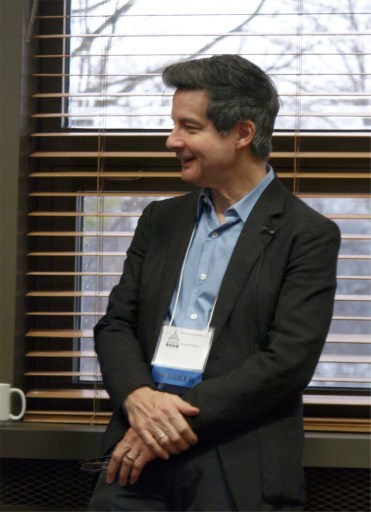 One of the highlights of my weekend was driving Donald Maass from the airport to the Kellogg Hotel and Conference Center, chatting about my writing. Don gave a fantastic, uplifting keynote address Saturday morning before launching into two hours of instruction on Writing 21st Century Fiction. As insightful and winsome as he is in writing, he is even more so in person. I was lucky enough to sit by him at lunch while our table shared stories of family, publishing, MSU shenanigans, and Michigan’s natural beauty.
After lunch, Zach and I answered questions about traditional publishing at a “roundtable” discussion, which I think was helpful and enlightening for the participants. Then I presented a workshop I’ve done at the Breathe Christian Writers Conference called Finding Your Writing Rhythm. I felt a little rushed with only 45 minutes, but I got some good feedback from attendees and, best of all, my voice held out.
Next I attended a great workshop on character led by author Kristina Riggle. She had some wonderful insights about how to create characters that walk off the page and feel like real people.
After a quick agent/author panel, I tried my first real solid food in nearly a week and managed not to choke (huzzah). Then I settled in for four hours of Writing the Break-Out Novel with Donald Maass. Wow. Writers, if you ever, ever have a chance to sit under this man’s teaching, you need to do it. Don is engaging and funny and challenges you–commands you, even, but in the nicest of ways–to think differently about your writing, to forego the easy solution for the creative solution, to raise every aspect of your craft to the next level, to take control of your fiction and thereby take control of your reader’s emotions in order to create fiction that moves and sticks with people.
I have a notebook full of ideas that Don drew out from me through his probing questions and exercises. I’m excited to get back into my first draft of I Hold the Wind and to get The Bone Garden back out to make even more improvements.
But I think the most important thing that Don said, for me at least, was this (I’m paraphrasing): You have the time. No novel is so timely that it can’t wait a few more months or a year or more for the author to make it better, to make it as good as it can possibly be. Don’t be in such a hurry. I’m going to try to take that to heart this year and truly enjoy every minute of the process of writing rather that always wishing for the next step to be here.
There is time. There is always time.
Last week I shared the story of a shooting near our house. If you haven’t read that post, hop on back and read it first, then move on to this one.
When the dust settles after a tragedy in which the human will was involved–as opposed to a natural disaster–the very first question we ask ourselves is Why? What drove the villains of innumerable wars and genocides and school shootings and kidnappings and murders to commit such heinous acts? We want a reason, even if it’s an inadequate one, for the crime. And when we don’t get it, it makes the tragedy more frightening. Whatever the reason, it is so much easier to process and understand if it isn’t random.
When it comes to storytelling, motivation is key to understanding characters, accepting the plot, and fully immersing ourselves in the story. If there’s no clear reason for an action, the reader will be continually on the lookout for it. Now, if we want to make unclear motivation part of the tension for a while, that’s fine. But if we never manage to explain to a reader why a character, say, betrays his brother or cries when he sees a field of ripe wheat or sabotages his best friend, we’re betraying their trust in us as storytellers.
In high school I was in a number of plays and musicals, and beyond the very obvious difference of one having musical numbers and one not, I noticed a very pronounced difference in stage direction. In a play, if I stood up and walked to another spot in the “room” for no apparent reason, the director would call me on it. I needed to have a reason to change my position beyond me just feeling like the audience would be bored if I sat the whole time I was delivering these lines. In fact, it was so ingrained in me that it has affected my enjoyment of other productions! A common problem when memorizing lines and movements for a play is to answer the question What’s my motivation? because, of course, as an actor you are given lines and stage direction in a non-organic matter. To you, they did not arise naturally. Someone else wrote them out and you have been tasked with performing.
In contrast, the director of the musicals needed little reason for movement beyond the need to get people into the proper spots to start the next dance number. If you’re manipulating events in your manuscript just so you can get to the next scene that you planned, step back a moment and examine each character’s motivation. Would someone really act that way, say that line? Why? What would drive them to do that?
Using my example of the recent deadly shooting from the post on tension, after the shooter was taken into custody our questions changed from Who? and Where? to Why? Why the pharmacist? Was the shooter attempting to steal drugs? Was he under the influence of drugs? Why his neighbor? Had they been at odds?
The day after the shooting I was attempting to organize my desk (because deeper thought eluded me, preoccupied as I was with the events of the day before). This process involved going through a stack of items to be read and filed, including several issues of The New Yorker. I was flipping through them for articles and stories and comics I wanted to rip out and keep when I ran across an article about Adam Lanza’s father. I didn’t want to read about Sandy Hook, especially after the experience of my son’s school being on lockdown. But for some reason I began to read anyway. The article essentially attempted to explain what created a killer and a scenario like Sandy Hook. It talked about Adam Lanza’s childhood and teen years, his slow descent into a mental prison, the enabling actions of his mother, the frustration and despair of his father, everything, it seemed, except personal motivation. And that’s because that’s all we’re left with when a mass murderer kills himself and leaves no explanation. We’re left to grasp at wisps of clues and will never know the full truth.
But as writers, we must know why our characters are behaving the way they are, doing the things they’re doing, saying the things they’re saying. Read through each scene of your work in progress. Are the motivations of your characters clear? You don’t have to tell the reader outright why someone did something. You just have to make it easy enough for them to figure out on their own.
In my current manuscript, I wasn’t happy with one aspect of the ending. A young character committed a heinous act because I needed another character to suffer the consequences of their actions. The only problem was, I didn’t give this young character enough motivation. I tried adding a bit here and there, but what he did was so awful, my sprinklings of motivation were not enough, and I knew it. Rather than change the ending so that my other character didn’t suffer the consequences of her actions, I simply switched the young man’s target and made the consequences to the other character accidental. Problem solved.
Not everything needs an explanation of course. You don’t need to tell us why your protagonist rescued a dog from a shelter. It’s a pretty common thing humans do because most people like pets. However, you might have a reason for your protagonist choosing a large and imposing dog rather than a little yippy one. Or choosing a dog rather than a cat. That may factor into the plot or it may simply tell a reader something about the character that’s important.
Remember, if your character moves stage left, there had better be a reason for it or the spell you are trying to cast will be broken. Your audience will remember that they’re reading a book. And that’s exactly what we don’t want them to do.
Look friends, winter’s over, the trees are leafing out, the flowers are blooming, and Michigan’s cities and coastlines are calling. If you live here, you already know how amazing it is. If you don’t, take a couple minutes and watch this:
And then head on over to my page of Michigan links and start clicking and planning a vacation here.
Michigan is more than Detroit (although, Detroit’s pretty freaking amazing, even for a city in crisis) and it has something for everyone. Here are some of the beautiful places I like to frequent.
Don’t forget to pack your sunscreen, bike, hiking shoes, ATV, fishing pole, camera, nature guides, water skis, appetite, and penchant for fun and relaxation.
As I was headed to the post office late Monday morning in the pouring rain, I couldn’t help but notice half a dozen police cars and twice as many police officers in an otherwise empty parking lot in front of Rite Aid. Yellow police line tape cordoned off both the parking lot and the building, which is situated uncomfortably close to my house. Uncomfortably, because of what had happened there to necessitate the police presence.
I got to the post office in East Lansing and called my husband for a phone number I’d forgotten to write down and mentioned the strange situation at the Rite Aid. As we do nowadays, he proceeded to look up what information could be gleaned from online sources. Very little, as it turns out. A pharmacist, a kind man who had filled prescriptions for our family, had been shot in the face 30 or 40 minutes earlier and died. The shooter fled on foot into a residence on a nearby street, a street we used to use daily when our son was younger as we took him to daycare. There the shooter had apparently shot someone else just fifteen minutes later. Several schools were on lockdown. But my son’s school, closer in distance to the now supposed location of the shooter then the other schools listed, was not on the list. A call to the school went unanswered.
I finished my business at the post office, ran through the downpour to my car, and headed for his school. Thankfully when I got up to the front door, the building was locked. The principal let me in, I quickly made sure they knew what was going on, and then I left.
In the tense hours that followed, news was sketchy. “Isn’t this what Twitter is for?” I wondered in frustration as my husband and I scanned every news site, every feed we could think of, reloaded articles every two minutes to see if anything had been added. Robocalls from the police department and the school came ten to twenty minutes after events had already been reported on the Internet. We got the call that the school lockdown had been lifted, but still could find no indication that the police were positive that the suspect was in the residence that they had surrounded with cops from three cities, S.W.A.T., a U.S. Marshall, K9 units, and armored vehicles.
I second guessed myself for leaving my son at school. Why didn’t I ask if he could come home with me? What if he’s in danger? With every half hour that passed by with still no updates, anxiety mounted within me. A headache came on. I erupted in tears a few times (folks, I rarely cry). I couldn’t concentrate on anything. I was steadily losing it.
Let’s pause this story here and take a look at the facts.
By the time I drove by the Rite Aid and saw the tape and the cops and the cruisers, everything except the apprehension of the suspect had already taken place. Two men were already tragically dead. The shooter was already barricaded in the location of the second shooting and surrounded by law enforcement. The only thing yet to be decided was whether he would give himself up, go out in a hail of bullets, or shoot himself. He was contained.
But I didn’t know that. And my baby was not home with me.
Tension–severe and almost unbearable tension–can happen even when nothing is actually happening. Tension stems from uncertainty–not knowing someone’s true identity, not being able to predict what someone will do next, not understanding why something is happening, not knowing if a loved one is safe, not knowing when something will end, not knowing how someone will react…not knowing the end of the story. In our writing, tension is as much about what is not apparent to a character as an immediate physical threat to a character. Stories with absolutely no big action can have more tension than the most explosive big-budget Hollywood shoot-em-up ever made. Yes, there’s Speed, but there’s also Phonebooth.
Inside the Rite Aid, there was a brief moment of tension. An argument perhaps, the sight of a gun. But when that poor pharmacist died, the tension for him ended.
Outside the Rite Aid, every parent in two cities was terrified and anxious and even hysterical for over three hours. Each child in those locked down schools was wondering why their teachers were so tense and why they had a Code Yellow. People at work or at home within a five mile radius of all the action, including the campus of Michigan State University, were told to “secure in place,” stay inside, lock the doors. For tens of thousands of people outside, though they were not directly involved in any of the tragic events of the day, the tension worsened with every moment that passed with no information and no resolution.
Tension kept my husband and I reloading scant articles online. Tension keeps a reader turning the pages. And if tension stems from uncertainty, as writers we need to keep readers in suspense as long as possible.
It can be uncomfortable to write like that. We naturally desire resolution. Even a song that ends on an unresolved chord can drive us nuts. But in order to keep a reader engaged, we need to resist the desire to explain. Tension is in the pauses, the silences, the moments before the Moment. Have you ever read For Whom the Bell Tolls? That entire book ends on an unresolved chord! And it’s the ending that makes the rest of the book worth reading at all.
Take a look at your work in progress, scene by scene. Do you allow tension to hang heavy in the air? Or do you resolve problems as quickly as possible? Is your story lacking tension of any kind? How could you add tension? How can you increase the uncertainty of a situation? Raise the stakes? Make the consequences more dire? Give the character (and the reader) less information? End a scene sooner? Pay special attention to the ends of your chapters and try to end each one with an unresolved chord. Compel the reader on to the next chapter by leaving them unsatisfied in this one.
That’s what makes a thriller a page-turner. It’s not the action itself. It’s the uncertainty. And you can use that to your advantage even in a quiet book.
Back to Rite Aid. When my husband left the house to pick up our son from school, word filtered through that the shooter had given himself up. He was in custody and the threat had ended. I texted my husband to let him know, to ease his anxiety and break the tension. It took me the rest of the evening to truly recover from the day. And in the light of the next morning, the big question became one of motivation.
As I said, this story is still developing. Here is a good article about the first victim and here is one about the second, men who had dreams and families and were made in the image of God, cut down in the prime of life. Why? We don’t know. And that is the subject of my next post on revising your manuscript…
This is what mid-April looks like…
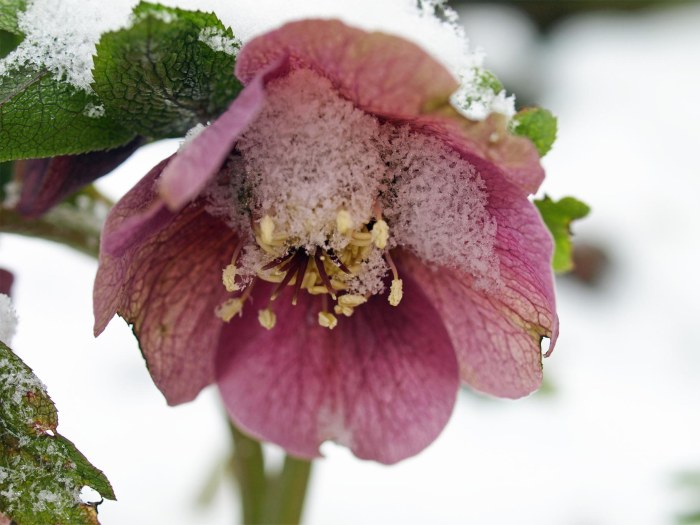
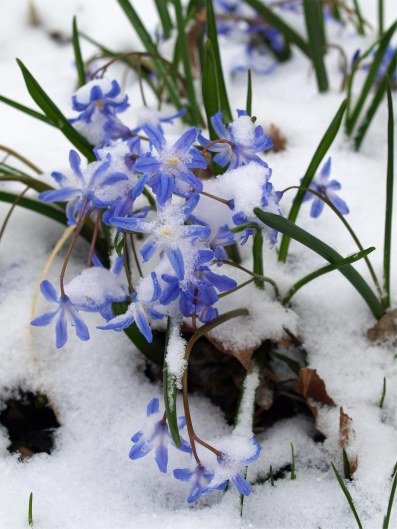
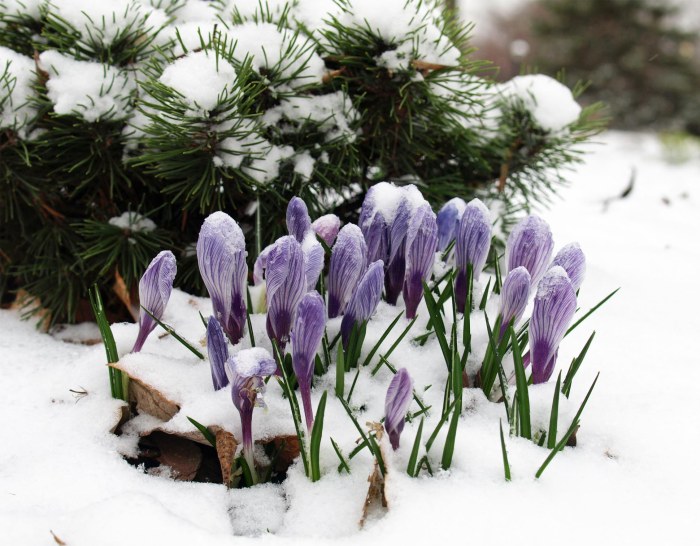
But don’t despair, Michiganders, because Easter is supposed to be 50 degrees and sunny (well, for us Trolls, anyway…you Yoopers can despair all you like because I’m pretty sure you won’t have any daffodils yet).
 Erin Bartels
You must be logged in to post a comment.