How Green Day Derailed My NaNoWriMo Plans

1995 was a pretty incredible year for music. The Smashing Pumpkins came out with Mellon Collie and the Infinite Sadness, Oasis gave us (What’s the Story) Morning Glory?, and No Doubt released Tragic Kingdom. Debut acts like Foo Fighters, Garbage, Collective Soul, The Presidents of the United States of America, Ben Folds Five, 311, and Alanis Morisette’s Jagged Little Pill flavored the radio waves with a hit or two or three. dcTalk gave us Jesus Freak and Jars of Clay’s Flood could be heard on every station, sometimes simultaneously. Everclear, Silverchair, Radiohead…

And, of course, Green Day.

Green Day had been around for a while and 1994 saw them break out into the mainstream (to the horror of many alternateens who simply couldn’t bear to like something that was popular) with Dookie. But it’s 1995’s Insomniac that has dramatically affected my spare time for the next month.

Allow me to explain. The low brake fluid light came on in my Explorer this past week, so when I went into the office on Thursday I drove my husband’s car for safety reasons. While my vehicle is filled with the fairly low-key folk rock music of Brandi Carlile, Bob Dylan, and the Indigo Girls at the moment, my husband’s tastes run toward the much more energetic. I was already on the road when I realized I had failed to bring some of my CDs in the car and I had failed to even review what was in the 6-disc changer in the glove box. So I punched through until I found something that worked for me (FM Static) and drove to Grand Rapids.

But on the drive home, I switched over to Insomniac. It had been years since I’d listened to the whole album. As hit after hit emanated (no, leapt is the more appropriate word) from the speakers, I was astonished I had let so much time go by. What Green Day lacks in technical skill and enunciation they more than make up for in melody, energy, and sheer aural satisfaction. They may not be good musicians (or at least they weren’t in 1995) but they make some dang good music, a perfect little package of apathy and angst wrapped up with a peppy bow on top.

Now, what, you may be asking yourself, does any of this have to do with National Novel Writing Month? Well, the day this all went down was November 1, the first day of NaNoWriMo. I had been planning to either pick up on a story I’d abandoned at 18,000 words a while back that involved a woman attending an artist’s workshop on Mackinac Island, or start a new story I’d been thinking of that would involve a young woman, her cantankerous great aunt, sewing, home restoration, and recovering a lost past. Green Day has no part–no part–in either of these plot lines.

But years ago I had an idea for a story about a young guy wanting to make it big as a musician, his father’s fruitless quest to do the same, and what happens to those around them as they pursue their dreams. Enter Insomniac. Listening to that album on the way home from the office inspired me to pursue the story about the budding guitarist.

So that’s what I’m writing this month. I’m quizzing my guitar-playing husband who was covering Green Day songs as a teenager in high school and had a band in college as well (and is already training up our son to love rock).

I’m listening to Pandora’s 90s Alternative Rock station (every song is awesome). I’m channeling my years of following my husband (then boyfriend) to gigs in church basements and at outdoor festivals, carrying gig bags and amps, blaring WGRD as we barreled down the S-curve through downtown Grand Rapids in college. I’m using my own experience growing up in a house that was saturated with music (more jazz and blues than punk or hard rock) and my recent attempts at learning to play guitar.

And even though I have no outline and I don’t know where this story is really going, I’m so far enjoying the ride. And the soundtrack.

Hemingway’s Michigan

After the writers conference ended on Saturday, we drove through 133 miles of dense fog, construction, rain, and starless night up 131 to Acme, Michigan. This was not our ultimate destination, but a convenient resting place on the way to drop off our son at my sister’s house to play with his cousins (after brunch at the amazing Pearl’s New Orleans Kitchen). We then drove another 40 miles through the pouring rain to Petoskey, where we were finally going to take a free tour of Hemingway’s Michigan that we won at a silent auction last October.

Ernest Hemingway Collection. John F. Kennedy Presidential Library and Museum, Boston.

Though he lived in Oak Park, Illinois, Ernest Hemingway spent his boyhood summers up in northern Michigan, fishing the streams and exploring the wild landscape. These experiences are the basis of many of his short stories, most obviously the Nick Adams stories. Our guide to Hemingway’s boyhood haunts was Michael R. Federspiel, author of Picturing Hemingway’s Michigan and director of the Little Traverse History Museum in Petoskey. After a short time with the museum’s Hemingway collection, we all piled into Michael’s SUV and spent the next 90 minutes in literary historical bliss.

While the weather could have been better, I try to make it a point to enjoy myself despite rain, snow, or cold. And I did. I had such a wonderful time discussing Hemingway with our guide. I saw the places that were important to a young Ernest Hemingway, including the home where his pithy writing style was likely born, the general store where he picked up the letter from Agnes that told him their love affair was just a child’s game after all, the home his mother built as a getaway from Windemere across Walloon Lake, the restaurant where he and Hadley had their wedding reception, the pier he used as a model for the one in “Up In Michigan,” the  Hemingway farm now covered in forest, the library where Hemingway, in his Italian uniform, spoke to the Ladies Auxiliary about his wartime experiences.

Each spot, surrounded by the peak of fall color and bathed with cleansing drops of rain, sat unmoved and undimmed by the passage of time. These homes and businesses have been marvelously kept up, so that you would never know they were more than one hundred years old and once echoed with the footsteps of a soon-to-be-famous man. When you know the tragedy of his life, of how he purposefully, and often with a dreadful finality, shut nearly every door of friendship, love, and family that were open to him as a young man, you can really sense the heavy weight of choices and circumstances. If he could have but held to the careless, joyful days of those endless summers. If he could have held in higher regard all those people who cared about him and worried over him. Would his fate have been different?

To see the setting of Hemingway’s youthful summers in the grey pallor of a fall rainstorm is to see what was to become of him.

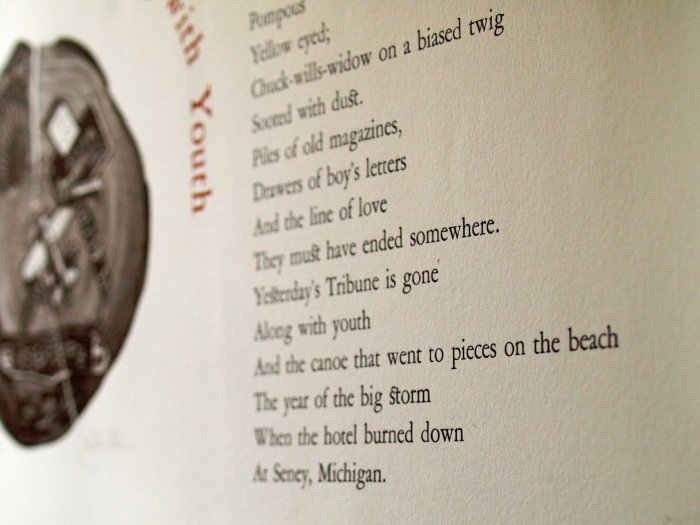
Along with the tour, the auction winnings included a signed print of a woodcut and one of Hemingway’s poems, “Along with Youth,” which seems a fitting way to end this post. He wrote it in a rented room in Paris in 1922, the year after he visited Walloon Lake for the last time for his wedding to Hadley.

~~~

A porcupine skin,
Stiff with bad tanning,
It must have ended somewhere.
Stuffed horned owl
Pompous
Yellow eyed;
Chuck-wills-widow on a biased twig
Sooted with dust.
Piles of old magazines,
Drawers of boy’s letters
And the line of love
They must have ended somewhere.
Yesterday’s Tribune is gone
Along with youth
And the canoe that went to pieces on the beach
The year of the big storm
When the hotel burned down
At Seney, Michigan.

My Take on the Breathe Writers Conference 2012

This past weekend my husband and I attended the Breathe Christian Writers Conference in the Grand Rapids area. The speakers included a good friend of ours, a former coworker, a freelancer of mine, and my husband’s agent, so I was excited to attend and see familiar faces as I thought deeply about writing. I love writers conferences. If fact, I really like the whole conference experience. The lanyards, the tables of books, the feeling of going to class, the comradery, the hum of ideas as they buzz around in people’s heads.

For those of you who may not have been to such a conference before, here’s the skinny on the sessions I attended and whether or not I think I will be able to put what I learned into action in my writing.

Writing a Personality-Packed Book Proposal by Lorilee Craker

Lorilee has had my job before. She’s been a freelancer for me. My company has published some of her books. We’re friends on Facebook. But it was so nice to finally see her face to face. She has a wonderful personality and her workshop on proposals was very well done and helpful.

Writing from Your Passion and Perspective by Tim Burns

I found the first half of Tim’s presentation interesting and helpful. He talked a bit longer than I thought was necessary on Peter’s life and I would have preferred more time for the “students” in the room to interact on the subject so we could hear from each other about where we come from in our writing. This session also led me to ask once more the question that has vexed me for more than a decade: So if my life is not laced with tragedy (as were the lives of Tim’s example writers) how exactly to I draw deep as a writer from what feels like a comparatively shallow well of experience? Can happy people with blessed lives be compelling writers?

Finding Your Voice–And Your Story’s by Dave Lambert

Former executive fiction editor at Zondervan (bonehead move cutting all those experienced editors from your staff, Zondervan) and also a former editor at Howard Publishing of Simon & Shuster, Dave Lambert was knowledgeable, had excellent illustrative examples, and had the manner of a good teacher. I think this was my favorite session by far. While developing a voice in fiction cannot be taught, exactly, and it cannot be manufactured, this session gave me a lot to think about in terms of how my POV affects everything in my story and helps define my voice over time.

Conquering Your Writing Fears by Sharron Carrns

I don’t have a lot of writing fears. More like one specific fear. Okay, maybe two. But I’m not riddled with them. Still, Sharron’s candid and thoughtful presentation, along with her very helpful handout, did help me realize that there is not one thing out of place for me in my life when it comes to being meant to write and set up to publish. I’ve always had tremendous parental, scholastic, and spousal support for my writing. My education has been just what it needed to be. I’ve worked in the business for over a decade. The only piece that I need to continue to work on is the actual writing! So this session gave me another little mental boost. Write, write, write!

Common Mistakes Novelists Make–And How to Avoid Them by Jocelyn Green

Another case where the speaker had a great handout full of clear examples (many from lovely and talented authors I work with in my publishing house). Jocelyn had much good advice to give.

Beyond the workshops, I loved Alison Hodgson‘s talk on the sort of courtship rituals involved in writing and publishing. Her piece was laced with the pain of having lost her home in a random act of arson, of wanting to write but not knowing quite how to draw it all out, of seeing herself almost as a “fake” writer, and of the continual process of coming to grips with the fact that when you are a writer, you must write. She had me cracking up and welling up the whole time. What a talented woman.

And now we come to the keynote speaker, Terry Whalin. His Friday talk, “Never, Never, Never Give Up” was great. Lots of encouragement and stories of people who finally made it because they wouldn’t give up. I enjoyed hearing his stories at lunch of his time as a Wycliffe Bible Translator and his adventures in South America. But his talk Saturday seemed scattered, less prepared than the one the day before. It didn’t seem particularly on point and instead dripped with name-dropping that a generous person would call…tacky. But by and large he has a lot of helpful resources for writers out there on the interwebs and he seems like an endlessly energetic person. His positivity will rub off on you. And that’s always a good thing.

If your interest in writers conferences has been piqued, find one in your area. Just start Googling. If you’re in the midwest, plan on joining us at Breathe 2013. I just may be one of the speakers. 😉

One Chapter Leads to the Next

As season gives way to season, so the ending of one chapter of life is the beginning of another. There are the obvious transitions–graduations, weddings, births, deaths, divorces, jobs begun and jobs ended–those abrupt moments that change everything. But unlike in books, when white space and large numerals indicate the next chapter, sometimes in life we only recognize the ending of one thing and the beginning of another in hindsight. The change is so gradual–the drifting apart of spouses, the slow fizzle of friendship, the long development of a talent until it finally defines us.

I have been through many a hobby and many an interest, as you have, I’m sure. At one point or another I have filled up my free time with stamping, painting, making jewelry, selling Pampered Chef, taking care of pet lizards and mice and tree frogs, making mosaics, developing my gardens, leading nature walks, making quilts, sewing a closet full of clothes, decoupage, seeing nearly every movie in the theaters, making paper, going to the gym…and I could go on. (You may notice the glaring absence of housework from that long list. This was not an accident.)

One hobby that I have been particularly proud of over the past six years is being a docent at Potter Park Zoo. 50+ hours of every year since 2006 I have given over to educating people about our zoo, conservation, ecology, and many different kinds of animals. I have worked firsthand with some amazing animals and some amazing people. And I have loved each moment of it. But I find that this is a chapter that is ending for the time being. Those precious hours need to be put to a different use.

I have also, for the past several years, been sewing steadily, creating around 75 items of clothing (more than 40 of those in just the last year as a regular contributor to The Sew Weekly) and more than 30 quilts. It garners me a lot of compliments and it is a fun and rewarding hobby. I have committed to finishing a quilt for my son next year and I’ll do some more outfits for the Sew Weekly to close out 2012. But I find that this is a chapter that is sort of ending for the time being.  Those precious hours need to be put to a different use.

What use? Why would I voluntarily end activities that pleased me and often helped others? For the simple reason that I need to use that time to write.

People often ask me how I find time to do all the things I do. We all get 24 hours a day. Most of us have to work to make a living. Many of us have spouses and children to care for. When I was feeling overwhelmed by responsibilities as a young mother going back to work I made a schedule for my days, not to follow exactly, but simply to see if it was possible to do all that I had to do. I filled up my 24 hours quickly and sat back to look at my work, amazed and feeling pretty satisfied that I had fit everything in. Then I noticed that I had forgotten to allow any time for showering, dressing, making meals, or even eating. So I had to reprioritize. I couldn’t make more time. I had to cut things out and cut things back. I had to reclaim time.

And at this point in my life I must reclaim time again. I must sacrifice some good things in favor of something better. Writing. In November I am doing National Novel Writing Month, devoting my extra time to writing about 2000 words each day. Beyond that, in 2013, I am devoting the time I would have used for sewing or tramping around the zoo to finishing and revising my second novel. And starting a third.

To find the kind of time one needs in order to really make a go at writing, to make it more than a hobby, one must be willing to let go of other things, even if they are good things. Because even I can’t do it all (even if to some people it seems that I can). And you can’t either.

Is one chapter of your life slowly and perniciously turning into the whole story of your life? Maybe it’s time to wrap that chapter up and start on a fresh page. If you want to write…then maybe it’s time to write.

How to Pass the Time When You Know Someone is Reading Your Manuscript

Is that a descriptive blog post title or what? If you’ve written something–anything–and then handed that precious piece of yourself off to others to read and comment on, you know what I’m talking about here.

It all starts when we begin as schoolchildren to hand in papers to our teachers. Some of us forget about it until it is handed back with a grade scrawled on the top. Others obsess about all its faults, revise even though we know it is too late, pray that somehow God will show mercy on us and inspire our teacher to give us a good grade.

In college, those of us who are maybe just a bit nerdy (we like to call ourselves “driven”) find that the longer wait time between the hand-off and the hand-back is…tedious. And then many people go on to careers where nothing is handed in and nothing is handed back, and if it is, it is rarely a piece of writing into which you have poured out your knowledge, your passion, your very self. (Am I being overly dramatic?)

In my line of work–copywriting–I turn in lots of writing. Piles Gigabytes of it over the years. But it is a rare thing when I am tied up in knots about how it will be received by the marketing directors, editors, and authors who will see it, critique it, even savage it (with a conciliatory smile, of course). My heart and soul are not wrapped up in marketing copy because I understand that those words are on the page to do a very specific job (sell the book) and the people who are editing and suggesting revision to that copy are just as keen on doing that very specific job as I am, and they can help me do it.

But when it comes to creative writing, whether you write novels or memoir or poetry or fan fic, when you hand your work off to someone else (a friend, a colleague, an agent, a contest judge, or any number of people via online dissemination) you are entering a mental and emotional state laced with tension. So how do you get your mind off it? How do you stop yourself from checking your email every hour for a response or staring at your phone, willing a text or call to come in? How do you stop obsessing over what you think your reader(s) will dislike about what you’ve written? In short, how do you stop yourself from becoming a paranoid freak?

It seems to me that one of the most surefire ways to get your mind off things is to start writing something else. If you have a notebook or a mind teeming with ideas, start bringing one of them into being. If you have no earthly idea what to write next, start doing writing exercises you can find in such books as The Art of Fiction or The Pocket Muse. But by all means, start writing something else. Pull yourself away from your finished manuscript, your familiar characters, your comfortable setting and begin creating something entirely new. Fall in love with another story. As a wise person once said, “The time will pass anyway; we might just as well put that passing time to the best possible use.”

Don’t waste your time with hand wringing  Move ahead. Then, when one day you get a call or an email from that friend or colleague or agent ready to discuss your work, it will be a pleasant surprise and you’ll be able to tell them about what you’re working on now. So, what are you going to write today?

Where Do Ideas Come From?

Anyone who writes or wishes to write inevitably asks or is asked this question at some point: Where do your ideas come from? For the person who assumes he or she is uncreative (you know who you are) the notion that anyone “thinks up” plots and settings and characters from thin air is nearly inconceivable. And even as my brain teems with characters and plotlines and settings and title ideas, I still occasionally run across an ultracreative movie (think Inception), TV show (hello, Breaking Bad), or book (The Thirteenth Tale comes to mind) and think “Who thinks of these things?” (This question also arises when my husband, a compulsive band name generator, says, without preamble, something like “Problem Attic.”)

So where do ideas come from? Naturally, I can’t speak to the experiences of others, but in my own creative life, my ideas usually come when I am doing some sort of physical activity that doesn’t involve deep thinking. Of the half a dozen or so writing projects I currently have percolating in my mind and on the page (some still just a note scribbled here or there) nearly all of them came at a moment of mental clarity brought on by physical exertion of some kind. Just one came from something someone said.

What was I doing when the rest of them come to me? Usually driving. Driving is just the sort of passive physical activity that, in me, breeds creativity. And it can’t be driving just anywhere. No, no. My ideas come on the expressway, usually on I-96 between my home in Lansing and my office in Grand Rapids (and before you ask, no, I don’t make that commute every day–just once a week). The reason they occur on that stretch of road most often? Simple: that’s where I’m most often driving! There’s nothing magical about that particular 50 or 60 miles of concrete. I’ve had plenty of ideas pop up on I-127, M-115, M-31, and various other highways. But when you have a commute that you make regularly, you don’t have to think about it. You keep your eyes open for brake lights ahead and deer to your right and left, and you’re golden! No more thought is required, which gives your mind space to breathe and flex.

I’ve had a novel idea while hiking (that largely mindless process of plodding, plodding, plodding), written much of a poem while stirring something on the stove, and I recently plotted out an entire short story while running. Hiking and running are certainly more physical than driving or stirring, but they require just as little conscious thought to accomplish, and, in fact, are often things that you can get through easier if your mind is distracted from your aching joints and the sweat trickling down your back. I had the idea for this blog post while cutting out pictures of little coffee cups from a java jacket to add to a collage in my office. Not thinking, just letting my kindergarten scissors training kick in (“Move the paper, not the scissors!”).

So next time you’re feeling uncreative, maybe what you need is some good old fashioned mindless physical labor to get the juices flowing.

Just watch out for deer.

Patience

This evening I spent more than five hours on the Interwebs researching literary agents and sending out query letters and the occasional sample of my work. This after a work day that included four hours of titling meetings (to which I phone in and watch what’s going on in the office on my computer screen) and four other hours answering emails and editing copy. And I must say, thirteen hours in front of a computer screen is a bit on the soul-sucking side.

And yet, here I am, writing a blog post. Glutton for punishment? No, just feeling the need to process.

As I work in marketing at a publishing house, I see the journey of a book from that end of things (which is really somewhere in the middle). As a writer, I know what goes into it on the very front end as well. But this middle ground, this nowhere, this limbo of finding a literary agent to represent my novel to publishers is a new world for me. One that involves much thought, much nuance, much typing with my elbows on the hard desk, much pain in the neck, shoulders, and back from too much, too much, too much sitting.

But I was inspired to renew my search today because yesterday my very dear husband, best friend, and fellow writer secured a literary agent of his own. I was so happy for him I couldn’t stop smiling for over an hour. And every time I think about it, I smile some more. We write in different genres and for probably vastly different audiences, so there’s no jealousy there. Though I must say, he snagged representation pretty quickly (so don’t let anyone tell you it can’t be done–it’s just that it doesn’t happen that quickly very often). And now he begins the long, slow, nervous journey from representation to a publishing contract.

I shall begin my wait to hear back from busy agents with too much on their plates. And I shall try to perfect my practice of patience in the process.