Time for a new poll. Vote on your favorite genre of fiction to read. Did I miss yours? Choose “other” then add it to the comments section! Check back later for more results. I’ll leave this poll on the sidebar for a while.
An Ambitious Writing Plan for 2013
 It seems to me that there is quite a push to get writers to believe they can write a novel in a month. NaNoWriMo, blog posts, books. If you’re a full time writer or someone with an already thoroughly sketched out or outlined idea, I think that is true. Or maybe if you just type ultra fast. But I don’t think I’m among your ranks.
I have my own fairly ambitious writing plan for this year, however. In May or June I plan to release a novel. But that’s not the real ambitious part (because it’s already written). By the end of 2013 I would like to have a collection of short stories to put into book form. And I would like to release them throughout the year as Kindle Singles, little ebooks for $0.99 each. And I would like to do this once a month.
To think I can pull this off strikes me as ambitious, but not quite foolhardy. So I plan to break up each month of 2013 in such a way that I can write, revise, edit, format, and release a short story into the cybersphere regularly, like the slow drip of an IV.
How will I accomplish this? I believe it may work out this way:
- Weeks 1 & 2 – Write
- Week 3 – Revise and edit
- Week 4 – Format and release
This seems reasonable to me at the moment, in the glow of a fresh new year. We shall see as we go, I suppose, if it is in reality. I already have ten stories partially imagined or scribbled about in my notebook. One of the stories that will be in the collection is already written, though I cannot release that one until after a particular contest is finished in March. So I will save the release of that one to be my one cheat, my back-up in case of a bad or very busy month.
Does this strike you as a little naïve? Am I fooling myself here? Perhaps. But you can’t fail or succeed until you try.
What are your writing goals for 2013? I’d love to hear about them.
Sew Long, 2012
It’s been a busy sewing year for me as I participated in 44 challenges at The Sew Weekly (the very last one is yet to be posted). Here’s everything I made this year. If you want to see all the Sew Weekly posts, here’s a link to my posts. Click each one to read it, page through to find them all.
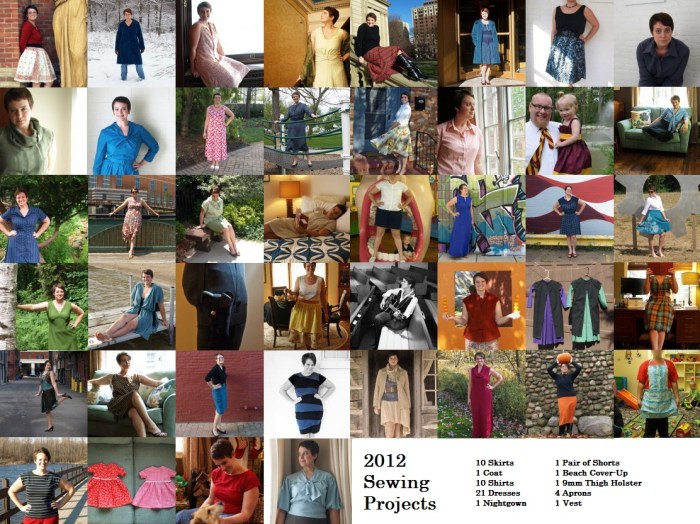
The one that hasn’t been posted yet (and that I’m not entirely sure will be posted) is one of my favorites. Here’s a sneak peek, in case any of you happen to be interested.

In the coming days I will celebrate my 12th anniversary and my 33rd birthday, along with another family Christmas and New Year’s. It’s a busy time of year and I look forward to a fresh start of writing, blogging, and living in 2013. See you on the other side…
Perception Is Reality . . . Well, Almost
 “This smells like an old timey poultice that has just been removed from a wound.”
This is what my husband said as he walked into the living room with a mug of Sleepytime tea.
“It’s chamomile. It’s supposed to smell like apples,” I countered as I drew near to sniff the offending liquid. It smelled exactly how it was supposed to smell. Like yummy, soothing herbal tea.
My husband is not a tea drinker, and is especially not an herbal tea drinker (why bother if there’s no caffeine?) but he was going to muscle that poultice tea down anyway. The night before he had not slept at all. Not one blessed minute. So this night he was doing everything he possibly could, piling on all the useless advice he’d heard over the past five years, in a desperate attempt to trick his mind into shutting down for the night. Magnesium, valerian root, sleeping pill, sleepytime tea, and a few other things I don’t recall now. As he rattled of the ingredients to his sleep-inducing cocktail, I remarked that he was probably the world’s foremost connoisseur of insomnia cures. Much good that did, though, as whether they worked or not seemed to be a bit of a crap shoot.
He did sleep that night. But insomnia is not really what this post is about. It’s about perception. Specifically, perception of writing. Your writing, perhaps.
I thought the tea smelled fine. My husband thought it smelled like it had just been extracted from the germ-infested seeping wound of some filthy Dark Age peasant. I like tea. My husband does not.
In writing, as well as any other field that seeks to involve other people’s senses, desires, prejudices, and emotions (think advertising, movies, music, just about any media you can imagine) a stark black and white sense of reality does not matter, and many would argue it cannot be determined anyway. What matters is how people perceive what you’ve created.
In other words, if I write something I think is unique but others think is commonplace, it is commonplace. If I write something I think is edge-of-your-seat but readers put it down because they don’t feel the drive to keep reading, it is not edge-of-your-seat. If I write something I believe takes on deep issues but the reader dismisses as shallow and sophomoric, it is not as deep as I think it is.
Ouch. Criticism reveals our writing’s most persistent flaws. It’s hard to take at times, just as it was hard for my husband to swallow that tea. But criticism, even the mean and spiteful criticism, can strengthen our writing if we apply it correctly. Even a tirade can be turned into constructive criticism if we read it with the right spirit and thick enough skin.
But here’s the kicker. You are a writer. You are an artist. And even if people do not receive your work as you hoped they would, you have a message and a vision. While properly applying criticism to our writing does produce better writing, there is such a thing as too much compromise, when your writing and your story become someone else’s because you are trying to please too many people.
If you are confident that an element of your writing is right for your story, that it serves your story in a way that it would not if you changed it (perhaps the way a character acts or your point of view or the style in which it is written) then leave it alone. Sometimes people criticize things because they are not exactly like everything else they’ve read. Sometimes they criticize because they had a really crappy day and they need to lash out at someone. Sometimes they criticize because they are trolls. Be courageous. Be willing to be different. But only after you have truly and honestly considered your reader’s opinion and have a good reason for disregarding it (and there are many legitimate reasons to reject other’s opinions).
When I initially gave my novel manuscript to a few friends and colleagues to get feedback, there were a couple things that everyone said I did really well. And there were a couple of things that were distracting flaws. I had to choose how much of those perceived flaws I was going to change. If only one reader mentioned it, I might leave it as is. But if almost everyone mentioned it, I knew I needed to think hard about how to address it. And then I had to decide if I had really addressed it adequately once I did make changes. (I’m still not sure.) But I also had to decide if I was willing to sacrifice something I felt was necessary to retain the style of the storytelling.
Perception is reality for the reader. You can control the reader’s perception up to a point, but you cannot change the lens through which they read. So do your part to make things understandable. Do your part to create and mold the perception. But accept the fact that another reader may see your work differently, may catch your vision in a way the first reader didn’t. Maybe every single reader isn’t really the right audience for you. Maybe you’re happy with a smaller audience that truly understands and appreciates your writing for what it is because you are all looking at it through similar lenses.
I’m the tea drinker in our family. My husband will never like tea, no matter how many different kinds are out there, no matter how much sugar, no matter how it’s dressed up. He is not the “audience” for tea. And tea growers don’t grow for him. They grow for me.
Who is your audience? Your real audience. Write for them.
Why didn’t I think to describe someone as “mouldy?”
After a rather long hiatus, I have once again picked up Virginia Woolf’s abridged diary in the evenings. I’m absolutely enraptured with Woolf’s ability to use a few precise, often unexpected words to describe a person or a situation. Here are a few I’ve underlined.
“Roger is becoming one of the successes of the day as a painter of perfectly literal and very unpleasant portraits.”
“I doubt that anyone will say the interesting things but they can’t prevent their coming out.”
“Whether people see their own rooms with the devastating clearness that I see them, thus admitted once for an hour, I doubt. Chill superficial seemliness; but thin as a March glaze of ice on a pool.”
“Being an editor has drugged the remnants of ambition in him, and he is now content.”
“Sometimes everything gets into the same mood.”
“In my heart, too, I prefer the nondescript anonymous days of youth. I like youthful minds; and the sense that no one’s yet anybody.”
“I meant to write about death, only life came breaking in as usual.”
“It annoys me to be like other wives.”
“She has been working over these old stories so often, that they hold no likeness to the truth–they are stale, managed, pulled this way and that, as we used to knead and pull the crumb of bread, till it was a damp slab.”
“Ethel’s [tea] was a ghastly frizzly frying pan affair.”
“No I don’t trust him; I don’t trust any human being, however loud they bellow and roll their rs.”
“Such is human nature–and really I don’t like human nature unless all candied over with art.”
“I know why I am depressed: a bad habit of making up the review I should like before reading the review I get.”
“Here at the age of forty-five are Nessa and I growing little wings again after our lean years.”
“And now there’s the Femina prize to record–an affair of dull stupid horror.”
I’m happy to be once again immersed in the world of a very thoughtful writer who truly considered everything in her life and felt the compulsion to write about it–parties, visitors, scenes on London’s streets, the impact of a solar eclipse, books, homes, hairstyles, the subtle interplay between couples. Everything was literary. She inspires me to see all of life through the lens of what I might write about it.
We Play at Politics, and Yet, Life Goes On…
So, Michigan seems to be getting a bit of press lately, with the voting on Right-to-Work legislation and angry and sometimes violent protests at the Capitol, just down the road a ways from my house. Having friends on both sides of the issue and also because this space is not about politics, I’m certainly not going to take any stances here or push my own opinion, though I have one. Instead, I’m going to give you some peaceful pictures of places in Michigan where no one is protesting, except perhaps a squirrel chittering at a stray dog nosing around its tree.



Now then, let’s all take a deep breath and know that the world will go on, season to season, no matter who is elected at any level of our government and no matter what does or does not get signed into law. The natural world cares not about Right-to-Work, because the trees and the animals must all do their work anyway, with no pay or benefits, with no unions, with no thought of fairness or coercion or sustainability. With no bitterness or rancor, a tree grows, a flower blooms, a bird builds its nest, a squirrel gathers its hoard of nuts and seeds for winter.
And life moves on.
Sweet December (or…Be Careful What You Pray For)
For those of you who don’t know, I tutor a very nice Chin family in ESL once a week and have been doing so since they arrived from Burma/Myanmar two years ago. The parents struggle, but the two school-aged boys, Moses and David, are doing quite well, especially Moses who is now asked by many of his Chin friends to come with them to appointments to translate. (Aside: it seems to me that refugees have more appointments than anyone I have ever met.)
This wonderful family invited my family to come to their apartment Saturday night for a celebration. This was right after I had asked them if they planned to celebrate Thanksgiving. They swiftly told me about “December One,” which they called Sweet December, and which, in my limited understanding of what they told me (there’s a difference between being able to speak English and actually speaking English after all), seemed to be a celebration of when they first arrived in America, like their very own personal Thanksgiving. I gladly accepted the invitation, despite my fear that I would again be served intestines, and started thinking of a way I could serve myself at the meal.
As my husband typically works Saturday evenings, just my four-year-old son tagged along with me on Sweet December. When I got to the Lian home, I could tell from outside that the place was full of celebration–kids yelling, people singing, lights on in every room–and I assumed that the already large family had invited some other friends from their church, which meets in our church building Sunday afternoons. Moses met me on the dark porch and explained that we would go in once the song was done. A moment later, he opened the door.
You know how Lucy must have felt seeing Narnia for the first time? Or how Dorothy surely felt when she opened the door of her dark gray house and was confronted with the bright and colorful world Oz? That’s kind of how it was when Moses opened that door. The dark concrete porch was awash in golden light and instead of seeing the dozen people I expected, it was more like fifty. One hundred deep brown eyes in tanned faces. Plus the children who were running about and playing. Altogether I don’t think it would be an exaggeration to place the total number of people in that one apartment at about 75. At least two thirds of that number were seated on the floor in the living room, facing the front door, and looking at me and my son as we squeezed in and added our shoes to the veritable mountain range that already blocked the front closet and much of the front door.
Moses pointed me to two empty kitchen chairs along the edge of the sea of people seated on the floor, the only two chairs I saw in the entire room. Now, being one of only two white people there (the other being my son), and being a good liberal arts graduate and stuffed full of oodles of white guilt from all of my white professors, I felt distinctly uncomfortable sitting “above” all of the Chin people in the room. Heck, even if I sat my 5’9″ self on the floor I would tower over these petite people. So I told Moses no, we would sit on the floor. But he again gestured to the chairs.
Then I looked to my immediate right and saw their pastor and his wife seated on a sofa in the front of the room. I realized that they had given me the chair because my husband is the pastor of our church and I, his wife, would be honored the same way he would. Coming from a country in which they are persecuted for their Christian faith, the Chin have the utmost respect for clergy. So I sat down and tried to figure out how I had thought I was coming to a family gathering when I was now so obviously in a church service. At least I wouldn’t have to worry about being offered intestines.
After another couple songs, I sent my son upstairs to play with the other small children, many of whom already speak English like natives. He gleefully joined them and I didn’t see him much for the next hour. Back in the living room, Moses took the chair next to me in a valiant attempt to help me understand what was going on. While people were talking he would lean in and say in his very soft voice, his words slurring together, that this was a prayer or this was announcement time or this was a group song. Most of the time I couldn’t quite make out what he was trying to tell me because, despite it being a church service, the din from the children upstairs, in the kitchen, on the staircase, and even sometimes in the living room, was constant and seemed fairly loud to someone who grew up in the Lutheran church with a very German sense of decorum (i.e., no talking, no fidgeting, and certainly no messing with the keyboard or standing right in front of the speaker and staring up at her as though you were a living pulpit…which, as you may have guessed, happened later that night).
But the wonderful thing about being part of a worldwide body of believers is that even if you aren’t quite sure what someone else is saying, and even if you only catch occasional words (Abraham, Hosanna, Jerusalem, Christmas, December, God is good) you still know the story. Moses gave me an English Bible and told me the passage that Pastor Hrang’s wife was going to speak on. Luke 2:11-… well, to be honest, I’m not sure where she ended, so I kept reading until verse 21. The story of the angels announcing to the shepherds that Jesus was born and the shepherds going to see the baby in the manger.
And even though I speak very limited Chin (I know that watermelon is dawnzuk–though I’m sure I’m spelling it wrong) I could still follow some of her sermon. I had to fill in enormous gaps, but when you know the whole story of God’s people, it is not difficult to do. She mentioned Moses, so I thought of Moses being sent as the deliverer of his people Israel from the whips of the Egyptians. Then I thought of Jesus the deliverer, sent as a little baby to save the world not from human oppression but from spiritual death. She said Hosanna and so I knew she was talking about Palm Sunday, when Jesus road into the streets of Jerusalem on a donkey, entering to the shouts of people asking him to save them. She moved her hand up, looked to an unseen hill, and I knew she was talking about those same people yelling “Crucify him!” and taking him to Golgotha to be executed.
After that, there were fewer things I could understand. No more familiar words, though she gestured several more times to the cross. But it was enough. I knew the story.
During this service there were also several prayers given by several people. I could recognize only the words Christmas and Amen. That, too, was enough.
Perhaps the strangest thing I witnessed that night was when everyone in the room prayed individually, not silently or taking turns as you would in an American church, but out loud and all at once. A cacophony of loud and fervent voices lifted to God in adoration. It took me so much by surprise I felt extremely uncomfortable for a moment (remember: German Lutheran). And I knew somewhere in the back of my mind that all speaking at once might not be looked upon favorably in the pages of Scripture (husband tells me it’s 1 Corinthians 14:26-33).
All the same, I felt compelled to join my thoughts and prayers with theirs and offer them up aloud to God (though at a much more restrained volume–God’s not hard of hearing, after all). And further checking into that Scripture shows me that it is talking about an orderly worship service and speaking in tongues. This service was certainly orderly and any speaking in a different tongue from the one everyone knew seemed to be done by me. So I thanked God for bringing these people safely out of a land of persecution to a land of religious freedom. I thanked him for the opportunity I have had to serve a few of them. And I asked him to show me and my church how we could serve them further.
And that’s where I went wrong.
There are prayers that God seems to take a long time to answer–months, years, decades, lifetimes. And there are prayers that God answers almost before you’ve said Amen. This was one of the latter kind. The service ended, strange food (though not intestines) was served, my boy came into the room for a doughnut hole and some water, his hair plastered to his head with sweat from running around constantly, and a woman asked me (through Moses) if I knew if there were any other people at the church who could help her niece and nephew with their homework.
Ah, yes. Homework.
One of my primary gripes when coming home from my ESL tutoring with this family for the past two years has involved the boys’ homework. In a large city with as many refugees and immigrants as ours, I simply can’t believe we don’t have a better system for intensive English instruction as the primary discipline of a new transplant and instead send students home bearing pointless and inane worksheets that will never help them succeed at life or even secure a job (like the crossword David was supposed to fill out last December in which every answer came from the song Rudolph the Red-Nosed Reindeer and ‘Twas the Night before Christmas–seriously).
Immediately I wanted to help these young people. Then I thought of how many junior high and high schoolers are in the Chin church and how many willing volunteers we might get from ours. The numbers didn’t match up. One thing that might make it more feasible would be if we had one big tutoring time scheduled at a central location that all students needing help could get to, transportation being an issue for almost all of them, and that the volunteers could easily reach. Like the church.
I asked Moses and this woman’s niece (I really couldn’t hear her name in all the noise) if they thought that those who wanted homework help could stay after their church service ended around 4:00pm. It would be so much easier to get volunteers to come to a central place. If we had even three people there for a couple hours, how many kids could we help decipher instructions, understand complicated concepts, write with proper grammar?
Remember a week ago when I posted this little gem:
I wonder if you’ve ever had the same epiphany, that your life, energy, and efforts were too focused on yourself. Assuming the world doesn’t end in a few weeks, what are you going to do differently in 2013? Where will you put your efforts? Will you spend your time entertaining yourself and thinking of ways you can further your goals? Or will you conscientiously look for ways to serve? I want to look beyond myself and I pray for the passion and focus to do so. I want to be one lone oak leaf that, in dying to self, can live in such a way that my efforts ripple outward and touch every corner of my pond.
Yeah.
And on Sweet December I foolishly prayed for more service opportunities to present themselves. But I hope I’m not a big enough fool to ignore a very clear answer to prayer. Now I must trust that the God who answered that prayer will also give me success in finding volunteers to fill the need. So if you’re a praying person, maybe you’ll say a little prayer for me today.
Seeing Beyond Myself
We’ve recently had some lovely frosty, clear mornings in mid-Michigan and I’m glad I had my camera handy when I was dropping off my son at school.

Mornings and evenings in cold weather are what make the dark and dreary winter months more bearable, and may even lift them to a level more on par with the wonder of springtime.

There are so very many lovely things in this world, to be found in all seasons.

We woke up this morning to a beautiful dusting of light snow, though most of it is melted now. The trees are all bare, but for a few that keep their leaves rather tenaciously, like the oaks. Puts me in mind of a little poem I wrote last November I’ll share with you here.
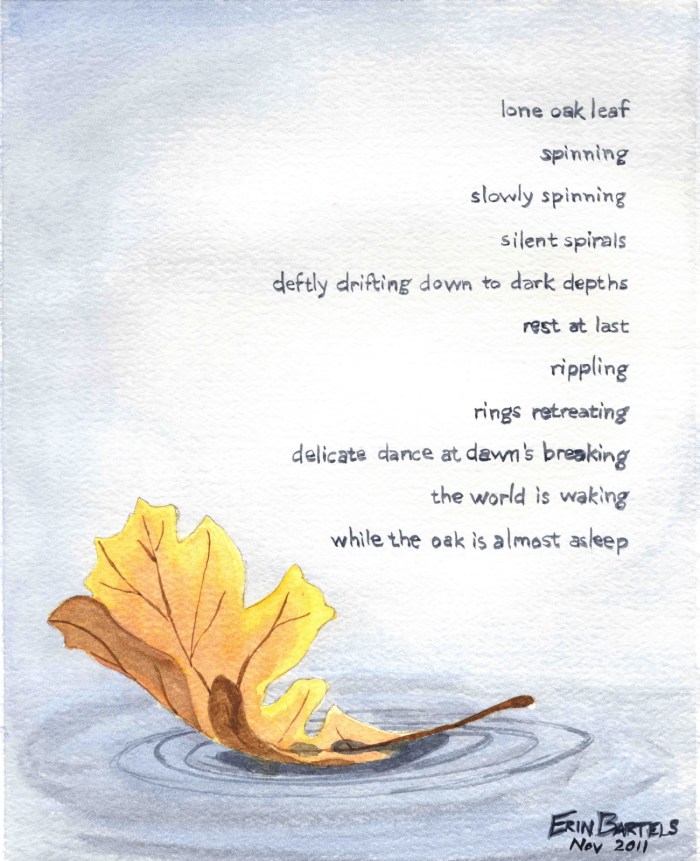
I think that may be the last thing I painted, an entire year ago! I’ve been getting the itch to paint again, though my usual spot in the sunroom has been taken over by model trains for the winter.

The waning months of the year are when we start getting those “Top Whatever of 2012” lists sprinkled across various media outlets, and before that silliness begins, I’m taking a moment to analyze my own year.

I’ve spent most of my free time in 2012 sewing clothes for myself, contributing to the Sew Weekly, and editing a novel. It’s been a very self-focused year. I was convicted of that this morning. As we near the beginning of Advent and the beginning of winter, I hope to turn my thoughts and efforts more toward others, which, as a writer who tends toward introversion and introspection, can sometimes be difficult to do.

I wonder if you’ve ever had the same epiphany, that your life, energy, and efforts were too focused on yourself. Assuming the world doesn’t end in a few weeks, what are you going to do differently in 2013? Where will you put your efforts? Will you spend your time entertaining yourself and thinking of ways you can further your goals? Or will you conscientiously look for ways to serve? I want to look beyond myself and I pray for the passion and focus to do so. I want to be one lone oak leaf that, in dying to self, can live in such a way that my efforts ripple outward and touch every corner of my pond.
“All is amazement and confusion.” — A Review of Detroit City Is the Place to Be
One of my avowed reasons for starting this blog is to bring you reviews of books about or set in Michigan, and/or written by Michigan authors. While I intend to review both fiction and nonfiction, both new releases and those decades-old, my first review (nonfiction) is oddly timely as the book has just released. I found it calling to me uninvited on the front table at Schuler Books & Music, a Michigan independent bookstore with locations in the Grand Rapids and Lansing areas. I hadn’t planned on starting reviews until 2013, but I cannot help but press you to buy this book. Even at hardcover prices it is well worth your hard-earned cash.

Detroit City Is the Place to Be: The Afterlife of an American Metropolis by Mark Binelli
Refreshingly nonpartisan and presented without the author’s own ego and agenda getting muddled up in things (a flaw so common in nonfiction books that take on difficult subjects), Detroit City Is the Place to Be is simultaneously a lesson in how we got here and how we might possibly get out of here. A Detroit area native (though he now lives in New York City), Mark Binelli covers almost every angle of the problem of Detroit, including historical and current racial tensions, the explosive growth and painful contraction of the auto industry, the eroding tax base and lack of resources, the distrust of outsiders, the blight, the fires, the violent crime, the music, the ruins, the drug culture, the despair, and those small, shimmering pockets of positivity (one almost can’t call them hope just yet) that while things may not quite have bottomed out, the city really has nowhere to go but up.
Binelli weaves a comprehensive and yet somehow still comprehensible tapestry of facts, statistics, and personal stories that gives the reader the big picture of Detroit but doesn’t miss the importance of the details. Even for a Michigander who has been hearing and reading about Detroit’s decline for decades, there are plenty of jaw-dropping moments. In these pages we meet real Detroiters: UAW members losing hope, teen moms grasping a better life for their children, “hustlers” coming up with their own work when jobs are nonexistent, concealed pistol enthusiasts, urban prairie dwellers, guerrilla lawn mowing brigades, and many more. Whether they stick with Detroit because they can’t afford to move or out of a solid sense of loyalty to their family history and their city, they are in it for the long haul and they are not (quite) ready to give up yet.
As one of those people says in Binelli’s book, “Detroit isn’t some kind of abstract art project. It’s real for people. These are real memories. Every one of these houses has a story.” And as Binelli himself says, “Detroit, if anything, is a place where the past cannot be shook loose. It hangs on, tenaciously, creeping over the city like a slow-growing mold, until–this begins to seem inevitable, if you get into a certain mood–the entire place will be nothing but past.”
This is not a book of solutions. It’s not a plan to rightsize a monolith of the nearly bygone modern industrial era. It’s not a crunchy, hippified manifesto on returning to subsistence farming and turning abandoned houses and factories into artists’ studio space. It’s not a vision for a utopian society of light rails, rooftop gardens, and flashy tech jobs. All of those elements are to be found in Detroit City Is the Place to Be because there are earnest people proposing scenarios like these, but they are not exactly championed by Binelli. Rather, like a good, impartial journalist without an ax to grind (amazing, right?) he puts it out on the table for the reader to chew on, bones and all. He leaves the situation in all its absurdly complicated glory because to come to the end and present a “solution” to the problems plaguing Detroit would be the absolute most naive and insulting thing to do. Real life is complex enough. Real life in Detroit is perhaps even more so. And it’s refreshing to read an author who gets it, who knows that you can’t solve a problem like Detroit with a five step plan imposed from the outside.
We naturally want a tidy solution to be discovered (as though people just haven’t been looking hard enough for the past, oh, let’s say 80 years). But we do a disservice to the people living the nightmare on the ground in Detroit (or in other complicated, violent, and seemingly hopeless situations, as this can all be extrapolated to other post-industrial towns and even to volatile areas of the world such as the Middle East) when we imagine that a few policy changes or a few new companies moving to town will solve the problem. Short of a sudden and unprecedented inflow of free money (which doesn’t exist, of course) the rebuilding of this great city will be slow and painful and no one will be completely happy with it at any stage.
Though I’ve never lived in Detroit, both sides of my family are part of its history and growing up we took several trips a year down I-75 to visit grandparents and cousins. Like an intercontinental funnel, various streams of my ancestors made their way first to Canada from Ireland, Scotland, England, and Germany. After pit stops in Ontario ranging from 10 to 125 years, they entered the United States through Detroit. They were farmers, machinists, shop girls, cigar rollers, cabinetmakers, printers, ad men, mechanics, and middle management in retail stores. And slowly over the past two generations they have fanned out from Detroit and are taking my family history west, north, and even to the Eastern seaboard. But Detroit feels like the center of it all to me, the crux of family history. Detroit is where my people are buried.
My great-grandparents farmed land that got swallowed up by the creeping suburbs (and may now very well be in the process of returning to nature, as it were). As a girl, my grandmother performed traditional Scottish dancing at the opening of the Ambassador bridge. My first experience with a race other than my own was playing with my grandparents’ black neighbors. My grandfather’s basement was peppered with tools he had probably pilfered from GM. A Thanksgiving pastime when we visited the Detroit area after the leaves fell was to drive around and gawk at the enormous suburban homes of basketball stars, musicians, and executives. Now people go to gawk at decay.
As a realist in general, I cannot be wildly optimistic about the future of Detroit (and the bulk of Binelli’s book certainly didn’t nurse any idealistic notions that may have been trying to take root in the deep recesses of my subconscious, despite his more hopeful conclusion). But as one who trusts in the transformation of individual lives through the work of God, I can’t be hopeless either. I agree with Binelli’s implicit message that policy changes and business tax breaks and film crews cannot save Detroit on their own. But the spirited people who refuse to leave, who patrol their neighborhoods, who create beauty from ashes–those are the ones who, one by one, family by family, can keep hope alive.
For those of us on the outside, it’s good to remember that before you can save something you must care about it, and before you can care about something you must be educated about it. Detroit City Is the Place to Be is an education. It’s Detroit 101. Whether readers (like myself) use what we learn to try to make a difference is up to us. But we couldn’t have a more concerned, honest, and gentle teacher than Mark Binelli.
I highly recommend this book to every Michigander; to anyone interested in big cities, the post-industrial age, urban planning; to anyone tempted to write Detroit off as a lost cause. It will ground you in reality even while it points to a faint light in the distance that we may reach if only we are brave enough to travel a treacherous road.
Note: The quote in the title of this post is from a description of the city of Detroit after the Great Fire of 1805, found on page 45 of the hardcover book. The quote reads in full “The town of Detroit exists no longer . . . History does not furnish so complete a ruin, happening by accident, and in so short a space of time. All is amazement and confusion.”
On Being True to Your Muse
 Here’s what I don’t want to write: vampire stories, tales of the coming zombie apocalypse, stories about dystopian societies, YA fiction about wizards and witches, bodice rippers, cozy mysteries, romantic suspense, historical romance, romances in general, crime stories, murder mysteries, courtroom dramas, sadomasochistic fanfic, or almost anything else that seems to be commercially viable today.
Here’s what I do want to write: thoughtful, slow-moving, character-driven literary fiction that subtly asks the reader to examine herself, ask the hard questions, and think deeply about the world she lives in.
Here’s the problem: does anyone publish what I want to write? Hmmm.
Publishing is a business and businesses are all about making money (as they should be). I’m not making any judgments against publishers; I work for one (and so them making money = me getting a paycheck). But as I read about what deals are in the works at the big five (seriously, more publishing contracts for Twilight fan fiction?) I am slowly coming to the realization that if I don’t want to write what most traditional publishers want to publish, I must come to grips with the fact that my writing will perhaps not find a home at a big traditional publisher, even if there is an audience for it out there. After all, I am not so self-centered as to think that I am the only one in the world who wants to read something that is subtle, thoughtful, and literary rather than something that is sophomoric, simplistic, and pandering. (Oh, crap. Did I say that out loud?)
If this is the case, folks, then why write? Why spend the time and creative energy on something that will not bring enormous profit and sudden fame? Here’s why: because good writing is worth doing for its own sake. I know, I know, that sounds like a mother soothing her child after he is passed over for the lead in the school play (“Sweetie, you did your best and that’s all that matters.”) but stick with me here.
It feels good to be praised for our work. When we are young, praise is available from parents and teachers. We are rewarded for our diligence and creativity with good grades, a spot on the refrigerator or bulletin board, a merit scholarship, special cords to wear on graduation day. As adults, we are rewarded with a few pats on the back at work, perhaps, and hopefully a pay raise or a promotion. And for creative artists of all kinds, who are not getting a grade or a paycheck for our work, what gives that sense that others care, that others value what we create? Why, what better measure of our worth than the fact that people will pay for it? After all, if someone doesn’t want to buy what I make, what good is it?
Some food for thought: Vincent Van Gogh produced more than 2,000 paintings and sketches. During his lifetime, he sold just one painting. One. It was his Red Vineyard at Arles, which I’d wager most of us have never seen because it is not one of his more iconic works. Today, along with Picasso, Van Gogh paintings garner the highest prices at auctions, with several recently going for more than $100 million each.
The fact that he was commercially unsuccessful in life did not mean he was untalented. It doesn’t mean he didn’t create beautiful works that would one day be appreciated. And even if his work had never become posthumously popular, those who ended up with his paintings in their homes would most certainly have displayed them because they thought them beautiful and meaningful. His worth is not measured by his slim bank account in life–it is measured by his genius, his enduring expressions of beauty.
The lesson should not be lost on writers of less commercially viable genres. Commercial success would be lovely (or really, some aspects of it would be lovely though I can think of several I’m glad to live without) but it does not determine someone’s talent or worth. Just as blockbuster movies are often (though certainly not always) shallow, pointless, and artless escapades dressed up with copious special effects, some New York Times bestselling books are not art. Some are. But many simply are not.
If you, like me, are a writer who finds herself or himself creating in a non-commercial genre for a more niche audience, don’t give in to the temptation to compromise your vision for commercial success. Yes, you could manufacture some of that stuff blindfolded. But don’t. There’s enough of it out there already. Create your art for its own sake. If you want it to be available to others and are having trouble getting the entrenched world of traditional publishing to take a chance on you, you can always self-publish in ebook and/or print-on-demand format (after you know it is absolutely your best work and you’ve had several conscientious and intelligent readers and an editor look it over to suggest revisions and make corrections). Art is meant to be shared, after all. But don’t silence your muse. Because if you don’t write what is in your heart, who will?
 Erin Bartels
You must be logged in to post a comment.