Celebrating Progress, Planning Ahead, and Challenging Yourself

Over this past weekend I finished writing January’s short story. Now the man/fellow writer of the house will read it, give his feedback, help me to catch any errors, and show me how to format it for Amazon. I’m pretty excited that the first story of the year will be “on schedule” such as it is. Makes things so much easier to maintain when you start off with a bang.

I very much enjoyed writing this story, which I’ve retitled to Beneath the Winter Weeds. I can’t say that each story will be set in time during the month in which it is written (and certainly for many stories, it will not matter so much when they happen) but it was a fun challenge to write a story that felt immediate.

OLYMPUS DIGITAL CAMERANow then, how am I deciding what to write about when? If I plan for a story to take place during a particular time of year, that is when it will come to life. I know one is in early spring and a couple are set in summer. Beyond that, I know some stories will have female protagonists and some male, and as much as possible I would like to switch back and forth between those so that people don’t feel I write for women exclusively. So both of these elements have helped me arrange my thoughts on which story to put my focus on next.

I have also already mocked up covers for nine of the twelve. For most of these, I have an image and a title and little else in terms of notes on what these stories will be about. I think it will be a fun challenge to approach story creation this way and to see how the title and cover may change as the story develops. For those not yet mocked up, I have particular images I want to capture (all covers will have my own photos on them) but I have to wait until the snow is gone and then go to a couple particular places to take the photos I envision.

Thanks for coming with me on this year-long writing experiment! I hope you’re thinking some creative thoughts of your own. Whether you write novels, short stories, poems, or just in your journal, why not give yourself some creative challenges to have fun with? Try coming up with a title and perhaps an image, then write to that. See what comes out. If you have trouble getting started, try a book like The Pocket Muse or its sequel for some writing prompts.

Happy writing!

A Writing Tool You May Not Be Using (Yet). Hint: It Involves Robots.

It can be difficult to find the weaknesses or errors in one’s own writing. We read over missing words because our brains know they should be there. We write mind-bogglingly long sentences, those great structures built of words, nesting clause within clause within clause, little knowing how someone who is coming at it fresh, who hasn’t seen the blueprint, will work it all out and tease the correct meaning from our tangled strings of nouns, verbs, and adjectives. One important way to get feedback is to pass our work along to willing readers who will be encouraging and yet honest, and who also hopefully know a thing or two about plotting, pacing, and prepositional phrases.

But before passing your tender, raw writing on to another human being, perhaps you should be trying robots first.

One of the best ways to really hear your writing for what it is is to make use of the increasingly sophisticated text-to-speech capabilities of your word processor, your e-reader, or various programs you can download. My preferred method is something called NaturalReader. You can download a free version here, but I recommend buying a few voices (I use Crystal) that sound less like robots and more like…um, let’s say cyborgs. Simply cut and paste any text into the program and you can listen to it, either via your computer speakers or converted to an mp3 file that you can listen to on your iPod.

I probably listen to close to a hundred book-length manuscripts using this software every year for work. I do my work reading this way for convenience and as a time-saver. Listening to a manuscript rather than reading from a page, I hear things that I wouldn’t necessarily always notice (which I might then decide to pass on to the editor if it becomes too distracting). Irritating repetition of a word, phrase, or way of describing something (such as “Her heart fell along with her valise”), sometimes a mere paragraph away.  Missing helping verbs or spots where an author changed the sentence structure at some point but missed the removal of a now superfluous word. Overuse of a description, as though the author had forgotten that the “lawman” had already been described as “blonde” many, many times in the book (as though the color of his hair somehow had anything to do with his professional competency).

And everything I pick up in others’ manuscripts I can pick up in my own using the same technology. Hearing your work read aloud, even by a slightly robotic voice, brings into sharp relief those little mistakes and irritations that you want to fix before you send your work away to another human being. It makes you notice when you need another paragraph of transition. It shows you that you forgot an article or changed tense or forgot to pluralize something. It shows you misspellings you already read over ten times without noticing.

If this tool isn’t in your toolbox yet, I strongly encourage you to add it. It’s free or cheap, it can save you small embarrassments, and it can make you a more efficient self-editor.

Plus, there’s just something about hearing a robot read your story that is bizarrely satisfying.

The Way It Seems to Work

FlakeI’m sure you’ve had this experience. You make a plan to do something, you start executing that plan, things are working, things are cooking, and then someone comes along with an “opportunity” for you that, when it comes down to it, you just can’t pass up. It will take time, energy, and creativity (which you have already earmarked for your planned work) but you just can’t pass it up because it will give as much as it takes–more experience, connections, and, oh yeah, money. And suddenly your perfectly apportioned calendar becomes bloated and more complicated. You start to get nervous and you think to yourself “I don’t know about this…”

Ever happen to you?

As you may have guessed, a nice, paying writing opportunity was dropped in my lap this week and I have decided to pursue it. I have also decided to keep my promise to myself and any potential readers out there to write and self-publish one short story each month. I also need to finish pulling together a proposal for a writing conference, make a quilt for a friend, clean my house up before my mother arrives for a visit (today), and, what was that other thing? That’s right, my full time job. Thank goodness there are still three more months before I need to think about yard work.

Just like that the very lovely January feeling of finally having your calendar and your goals under control dissipates into a vaguely uneasy sense that you will get it all done (because you have to) but you might not always enjoy it.

There you have it. Opportunity comes along at inopportune times. But you still need to grab it and run with it and realize that, with a little crazy ambition and an understanding spouse, you are hard at work blazing the trail to the life you truly want–the writing life.

You know what? 2013 is going to be a great, crazy year.

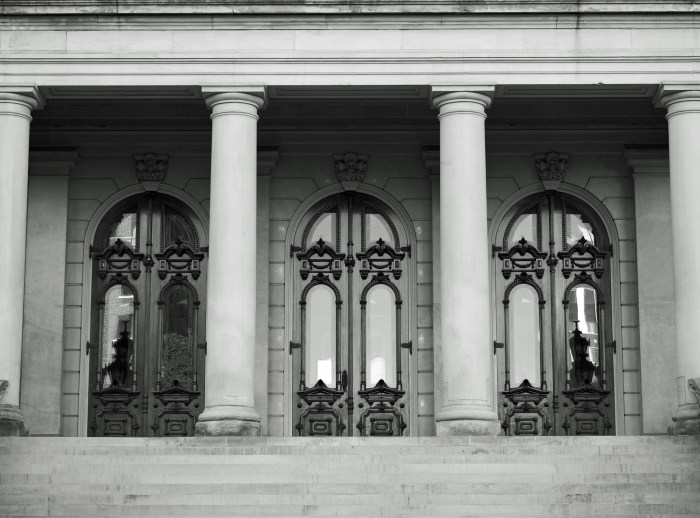
The Capitol Building

As I mentioned a little while ago, I’ve decided to start a new feature here that highlights places in and around Lansing, Michigan, in case you live here or ever find yourself wondering if visiting the state capital is worth it. Also, I like to brag about my state, and while many people know of the wonders of the lakeshores, sometimes the interior of the state gets left by the wayside. So here we go, and what better place the start than the Capitol Building?

I just happen to be good friends with someone who knows more about the Capitol Building than most people know about their parents, spouses, children, or inner selves. That means I’ve heard a good deal about this lovely building over the years. But as I can never remember it all, I always welcome more little tidbits of information from her.

Designed by architect Elijah E. Myers and built between 1872 and 1879, the current capitol building was preceded by a wooden one in Lansing, and before that the capitol was located in Detroit (it was moved to Lansing, a mostly unknown non-town in the swampy wilds of central Michigan, in 1847). The current building is beautiful inside and out and well worth a visit if you find yourself in mid-Michigan, especially during these cold months when you might want to retreat indoors. There is a really well-done self-guided tour, but there are also full time tour guides and many docents who would love to extol the building’s qualities and regale you with its history.

I have been lucky enough to have been taken for a walk above the etched glass ceiling tiles above the house chamber and even up over top of the domes (there are actually two of them, one inside the other) and into the lantern (see photo below) just below the spire. It pays to know the right people.

The interior is especially interesting as nothing is really what it seems. Marble columns are actually expertly painted wood. Copper chandeliers are actually a combination of nine metals (none of which are copper). The seemingly tiled floor of the rotunda is actually glass (who makes a floor out of glass?). The dome looks like plaster to me, but it is actually cast iron. The limestone flooring is peppered with fossilized sea creatures and corals, hinting at Michigan’s ancient history when it was the floor of a great sea.

As in many public buildings, it seems that every detail signifies something else. To really get the most out of your visit, I suggest setting up a tour with a guide or docent. (See if you can get Valerie Marvin; she knows everything, as evidenced in this episode of Michigan Under the Radar.)

Imagine working every day in this gorgeous building. May it inspire our public servants to fulfill their calling with honor, dignity, and grace.

Sneak Peek at January’s Short Story

I’m already hard at work writing January’s short story, which I’ve tentatively titled Winter Weeds. And because procrastination is an integral part of writing (and because I have to get to it at some point in order to upload everything to Amazon) here is my current cover mock-up. You may recognize the photo.

Winter Weeds Cover Mock-Up

As I’m plugging away at this story, I am enjoying the challenge of capturing a setting in vivid words. The temperature, the way the light hits, the thin, faint smells of winter. This is probably my favorite kind of writing. Such a fun challenge to try to describe the essence of something physical and visual in mere words on a white page.

When are you at your very best as you write? Dialogue? Action sequences? Bringing emotions to life? Think about whatever type of scene you like most to write, the kind of thing that got you jazzed about writing in the first place. Are you still writing scenes like that? Has the joy of writing slipped away? Has your technique stalled or improved over the years?

Today, write something you absolutely love to write, whether or not it is attached to any work in progress. It may just take on a life of its own and become your next great work.

The Editing Secret You Know (But Are Trying to Forget)

Balancing the Baby

The observant among you will have noticed something rather off about the photo above. The rest of you are wondering why I would post a boring photo of my fireplace. If you are in the second lot, look again. See it now?

That baby should not be there. And really, it’s a pretty poor Photoshop job anyway, so you may be suspecting that the weeks-old baby on the mantel is not in actuality sitting up there under his own power. Two photos taken, one with my husband on either side, holding up our infant son several years ago, knit together quickly to make it appear that the boy just jumped up there on his own and was casually relaxing. In hindsight, we should have used a tripod.

I post this photo to illustrate a writing truth that you have probably already heard, but of which we all need to be reminded now and then. Sometimes you write a scene, a chapter, or an entire book and place a baby somewhere it doesn’t belong. A turn of phrase you are particularly proud of that really doesn’t fit the tone of the rest of your work, a supporting character you love but can’t justify because he doesn’t move the story along, a bit of melodramatic indulgence in place of hardworking, compelling storytelling.

These are the babies on your mantel. They don’t belong there. You need to remove them. And you know it (usually). If your babies blend in too much, perhaps a reader with keener eyes can help you identify them.

You don’t have to toss your babies out in the cold and forget about them. You just can’t leave them up on the mantel. It’s distracting. Tuck them away in their cribs until you find a better place for them in another work. Keep that turn of phrase, that great character, that bit of melodrama in your notebook; they may all someday turn into new stories where they fit perfectly.

An Ambitious Writing Plan for 2013

Edison's LightbulbIt seems to me that there is quite a push to get writers to believe they can write a novel in a month. NaNoWriMo, blog posts, books. If you’re a full time writer or someone with an already thoroughly sketched out or outlined idea, I think that is true. Or maybe if you just type ultra fast. But I don’t think I’m among your ranks.

I have my own fairly ambitious writing plan for this year, however. In May or June I plan to release a novel. But that’s not the real ambitious part (because it’s already written). By the end of 2013 I would like to have a collection of short stories to put into book form. And I would like to release them throughout the year as Kindle Singles, little ebooks for $0.99 each. And I would like to do this once a month.

To think I can pull this off strikes me as ambitious, but not quite foolhardy. So I plan to break up each month of 2013 in such a way that I can write, revise, edit, format, and release a short story into the cybersphere regularly, like the slow drip of an IV.

How will I accomplish this? I believe it may work out this way:

  • Weeks 1 & 2 – Write
  • Week 3 – Revise and edit
  • Week 4 – Format and release

This seems reasonable to me at the moment, in the glow of a fresh new year. We shall see as we go, I suppose, if it is in reality. I already have ten stories partially imagined or scribbled about in my notebook. One of the stories that will be in the collection is already written, though I cannot release that one until after a particular contest is finished in March. So I will save the release of that one to be my one cheat, my back-up in case of a bad or very busy month.

Does this strike you as a little naïve? Am I fooling myself here? Perhaps. But you can’t fail or succeed until you try.

What are your writing goals for 2013? I’d love to hear about them.