Wildflower Wednesday: Fringed Gentian

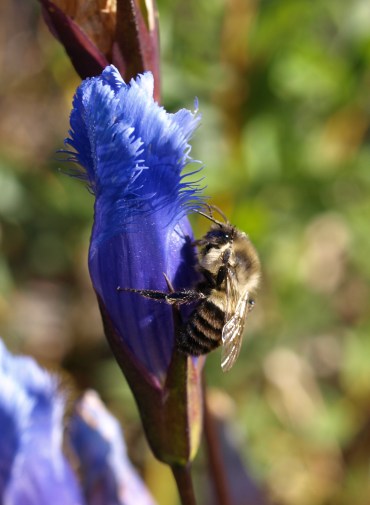
Fringed Gentian

Common Name: Fringed Gentian

Scientific Name: Gentianopsis crinita

Habitat & Range: wet prairies & meadows, along streams and lakes

Bloom Time: late summer & fall

About: I see fringed gentian regularly up at Camp Lake Louise, but I only have pictures of it from odd years because…it’s a biennial! It takes two years to bloom and, like most wildflowers, should not be picked or dug up. Since 2013 is an odd year, I was on the lookout for them on our trip this year, but it’s been a cool summer and the late summer wildflowers were not in bloom yet when we were up there.

In addition, like many other wildflowers, it depends on a mycorrhizal relationship. In other words, it can only grow where certain bacteria or fungi are present in the soil, so if you decide you are the special exception and you’ll just go ahead and take that plant home thank you very much, it won’t grow in your yard anyway, so please leave it be and bring home some nice photos instead.
Fringed Gentian

The fringed gentian has been the subject of some poetry over the years, including

Emily Dickinson

God made a little gentian;
It tried to be a rose
And failed, and all the summer laughed.
But just before the snows
There came a purple creature
That ravished all the hill;
And summer hid her forehead,
And mockery was still.
The frosts were her condition;
The Tyrian would not come
Until the North evoked it.
“Creator! shall I bloom?”

William Cullen Bryant

Thou blossom bright with autumn dew,
And colored with the heaven’s own blue,
That openest when the quiet light
Succeeds the keen and frosty night.

Thou comest not when violets lean
O’er wandering brooks and springs unseen,
Or columbines, in purple dressed,
Nod o’er the ground-bird’s hidden nest.

Thou waitest late and com’st alone,
When woods are bare and birds are flown,
And frosts and shortening days portend
The aged year is near his end.

Then doth thy sweet and quiet eye
Look through its fringes to the sky,
Blue–blue–as if that sky let fall
A flower from its cerulean wall.

I would that thus, when I shall see
The hour of death draw near to me,
Hope, blossoming within my heart,
May look to heaven as I depart.

and Robert Frost 

I felt the chill of the meadow underfoot,
But the sun overhead;
And snatches of verse and song of scenes like this
I sung or said.

I skirted the margin alders for miles and miles
In a sweeping line.
The day was the day by every flower that blooms,
But I saw no sign.

Yet further I went to be before the scythe,
For the grass was high;
Till I saw the path where the slender fox had come
And gone panting by.

Then at last and following him I found–
In the very hour
When the color flushed to the petals it must have been–
The far-sought flower.

There stood the purple spires with no breath of air
Nor headlong bee
To disturbe their perfect poise the livelong day
‘Neath the alder tree.

I only knelt and putting the boughs aside
Looked, or at most
Counted them all to the buds in the copse’s depth
That were pale as a ghost.

Then I arose and silently wandered home,
And I for one
Said that the fall might come and whirl of leaves,
For summer was done.

Fringed Gentian

Reference: Wildflowers of Michigan by Stan Tekiela; Adventure Publications, 2000

Wildflower Wednesday: Columbine

Columbine


Common Name: Columbine

Scientific Name: Aquilegia canadensis

Habitat & Range: dry, open woodland in partial shade throughout the state

Bloom Time: spring further south & summer further north

About: One of Michigan’s more exotic looking wildflowers, the columbine is a favorite of our Ruby-Throated hummingbirds and butterflies. The photo you see above is of a true Aquilegia canadensis, but you’ll find other colors around, especially closer to towns where cultivated columbines have escaped and seeded. Columbines cross-pollinate and you can get some really pretty hybrid colors. Seeds may be collected from these wildflowers if you want to try them in your garden, but please leave the plants themselves alone. Also, these can nearly always be found at native plant sales. My heavy clay soil has not been very hospitable to them, but if you have sandier soil, give them a try. During hot summers a columbine may die back, but it will likely return the next spring.

Reference: Wildflowers of Michigan by Stan Tekiela; Adventure Publications, 2000
Wildflower Wednesday: Motherwort

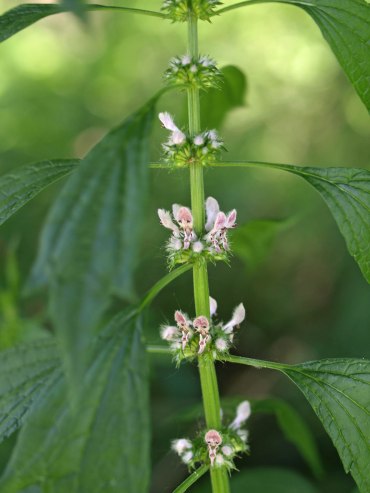
Motherwort

Common Name: Motherwort

Scientific Name: Leonurus cardiaca

Habitat & Range: fields, edges of woodland, possibly your yard

Bloom Time: summer

About: Remember my explanation of the “wort” in plant names? Well, the common name of this plant suggests that either you use it when your mother is coming to visit (perhaps to calm your nerves?) or it looks like a mother. Or, more probably, it was used to treat some sort of menstrual disorder and/or aid in labor. The observant among you may have noted that the scientific name suggests that the plant may be used to treat heart ailments. The very observant might notice that there are also hints toward lions (LEOnurus) and another common name for this plant is Lion’s Tail (I’m thinking that is due to the shape of the leaves).

Motherwort was introduced from central Asia as a medicinal plant, so it is not native. However, like many Asian introductions to our state (carp, emerald ash borers, etc.) it is widespread, though thankfully not so destructive as some others. It shows up in overgrown back yards where some previous resident may have had an herb garden. But, as with all herbal remedy plants, do your research and be very careful when using them. Sometimes a plant is safe in a particular form or in a diluted amount but dangerous and even deadly in other forms and amounts. Be especially careful with herbs during pregnancy. Sometimes they are purported to help a pregnant woman’s health but actually they can cause cramping and even contractions. So never go by just one source (especially not an Internet source or an old herbal you found in a used bookstore) but check multiple modern reference books for the best information.

Wildflower Wednesday: Wild Lupine

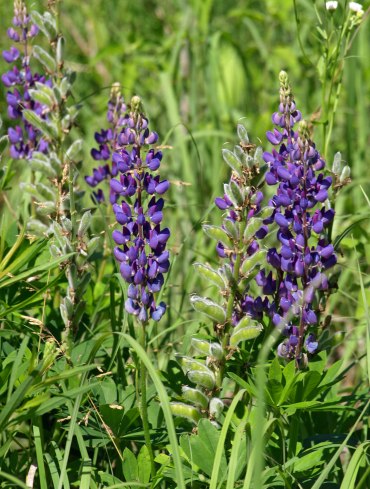
Wild Lupine

Common Name: Wild Lupine

Scientific Name: Lupinus perennis

Habitat & Range: sunny fields & open woodland in the southern half of the Lower Peninsula

Bloom Time: late spring & early summer

About: Wild Lupine is the only host plant for the threatened Karner Blue butterfly caterpillar. In order to maintain the health of the plant and the existence of the Karner Blue, please NEVER cut, pick, or transplant Wild Lupine. This is a good general rule to follow with all native wildflower species. Enjoy them where they are, take a picture, and leave them be. If you love the look of Lupines and want them in your garden, there are many domestic varieties to choose from that form pleasant clumps of flowers. Or, if you’d like to be part of the solution to the Karner Blue butterfly’s plight, get native plants that have been grown from seed at your friendly neighborhood university plant sale. Calvin College and Michigan State University both have yearly plant sales in May that include important native plants.

Reference: Wildflowers of Michigan by Stan Tekiela; Adventure Publications, 2000
Wildflower Wednesday: Spiderwort

Summer is such a fun time to walk meadows and woods, listening to birds, watching butterflies and dragonflies, and spying out wildflowers. I have scads of photos of Michigan wildflowers, many of which I’ve identified, some of which are still a bit of a mystery. I thought perhaps that some of you nature lovers out there might enjoy a regular feature on wildflowers during the warm months. Thus I bring you the inaugural post in the Wildflower Wednesday series. Some of them will be common, others may be rare, all will include a bit of interesting information, like basic facts, uses, and lore.

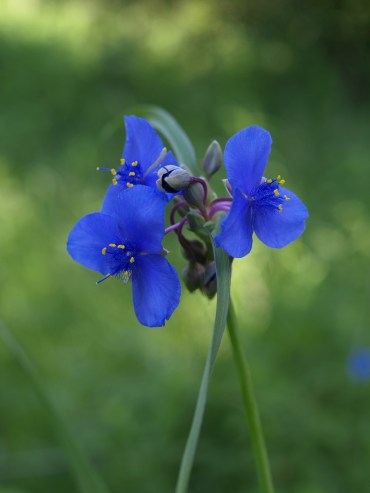
So without further ado, I bring you the Spiderwort.

Spiderwort

Common Name: Spiderwort

Scientific Name: Tradescantia

Habitat & Range: meadows & fields in the southern half of the Lower Peninsula

Bloom Time: spring & summer, one to three blooms opening at a time in each cluster of up to 10 flowers

About: There are about 70 species of Tradescantia, many of which have interesting common names (Scurvy Weed, Moses in the Cradle, Wandering Jew, etc.). The name Spiderwort may come from the sort of spidery look that a clump of these plants have, with their long skinny leaves resembling a spider’s legs, or perhaps the stringy sap that looks a bit like a spiderweb if the leaf is torn apart.

Many plants have the suffix “wort” attached to them. This is a Middle English word that was often used in naming plants. Generally the first part of the name would indicate the area of the body that could be healed using the plant (as in Bloodwort, Bruisewort, and Woundwort–which is also a fine name for evil rabbit overlords) or it would indicate something about the shape of the plant. Often the only reason it seems people used a plant to treat a particular ailment is because it looked like a certain part of the body (Lungwort, for example). If it also happened to be medically efficacious, that was a bonus. For a nice long list of “wort” plants, click here.

Spiderwort comes in a nice array of purple shades, from lavender to nearly blue. Occasionally you see a pink or white form. They clump nicely, which makes them a useful garden plant in partial shade. These perennials are very easy to care for (really, you don’t have to do anything to encourage them–one of many lovely things about using native plants in your gardening).

Reference: Wildflowers of Michigan by Stan Tekiela; Adventure Publications, 2000