Lessons Learned While Overdoing It #2: Small Graces

A landscape like that of Pictured Rocks is one of immensity. Lake Superior stretches on past the horizon in varying shades of green, turquoise, blue, and violet. The pristine blue sky arches to space. The faces of the cliffs explode from the waves. The soaring canopy of green rustles overhead.

But throughout our weekend hike at Pictured Rocks, my sister and I were careful to take note of the small things set in our path. I’m a “noticer.” My sister joked that while I was busy noticing a miniscule red and yellow fungus in the undergrowth I would be eaten by a bear. Sadly, we saw no bears, but we did see flowers, ferns, stones, fungus, insects, squirrels, snakes, rabbits, deer, and chipmunks. Always chipmunks.

Here are some of the small graces we experienced as we were pushing through the pain.

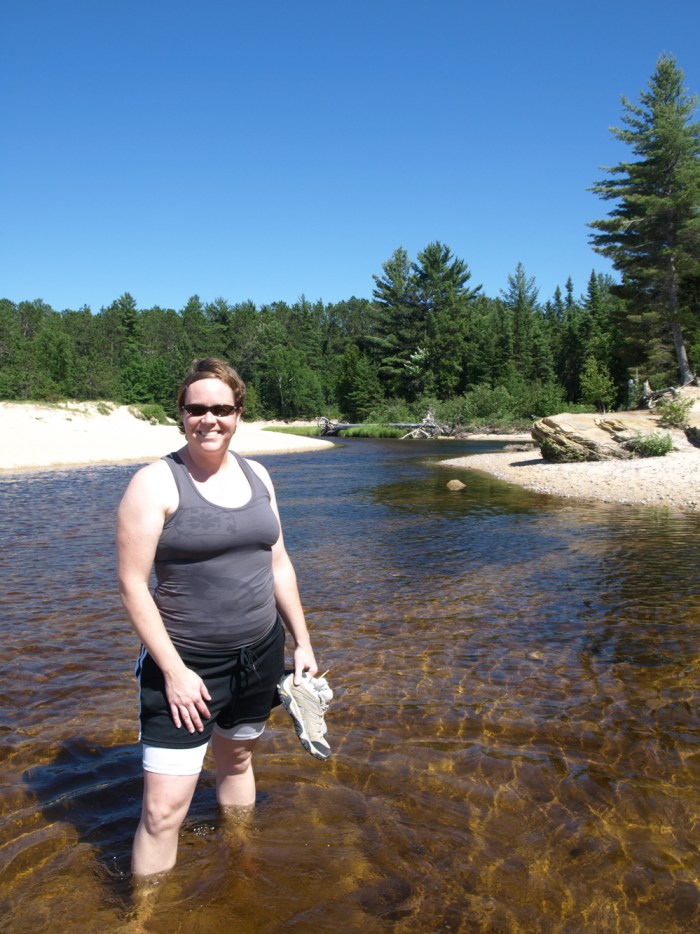
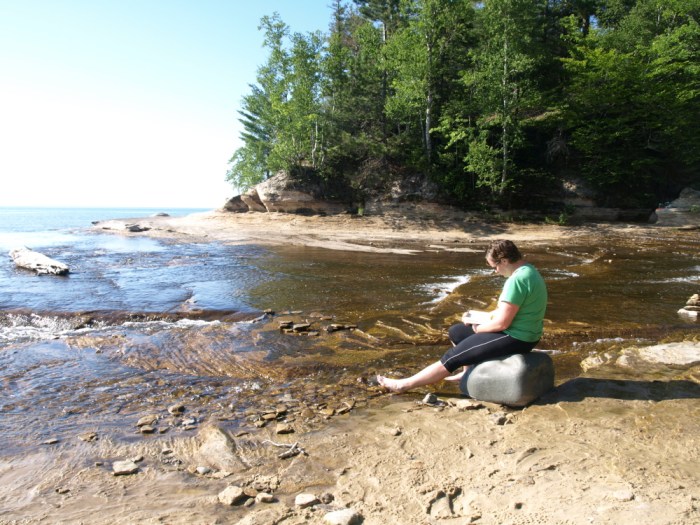
Beyond the sights, we heard eerie and thrilling bird calls we had never heard before and smelled the freshness of Lake Superior and pine forests. When you are exerting the kind of effort we were, you also appreciate with true gratitude the small graces of cool breezes off the lake, cold water from the rivers, and the frigid waves of Superior. That’s probably why so many of my photos are of our feet in the water.

It’s focusing on these gifts of comfort and beauty from God that makes it possible to overdo it without complaint. Sure our feet hurt, our shoulders were sore, our joints were aching, we were thirsty and rationing water. But that’s just hiking. Complaining doesn’t change it, and, in fact, it makes it no fun. I’ve been on hikes and nature walks and tours with complainers young and old and I have to tell you, there is little that grates on me quite like someone who is whining about heat or cold or bugs or boredom and not appreciating the beauty of a place.

And that’s how it is in the rest of life, too. You can focus on the negative  and moan about the things that make you uncomfortable or unhappy and bring everyone around you down with your constant discontent and never notice that all around you are small graces. All it takes is a shift in focus. All it takes is taking your eyes off yourself and looking instead to the gifts that have been lavished upon us by a generous hand.

Lessons Learned While Overdoing It #1: Perseverance

For some people, hiking 12 miles whilst carrying approximately 75 lbs (Is that an exaggeration? I’m not sure.) on your back is not difficult. I know this, because a few of you passed us on the trail last weekend. You were cordial and saved for later any eye-rolling or disparaging comments about our slow progress at the end there. And my sister and I appreciate that.

During the four mile span from Chapel Beach to Coves Campsite, I asked myself a number of times why, exactly, I had decided on 12 miles for our first big day on the Pictured Rocks trail. After all, neither of us is in stellar shape. I hadn’t been hiking in probably ten years. My job entails sitting, reading, typing, and, very occasionally, talking out loud. My sister also sits a lot in her job, though she has certainly been to the gym more recently than me. Still, why 12 miles?
I kept coming back to the inevitable: we had to end our hike where we began it because we didn’t have anyone picking us up. We had to get back to the parking lot at Miner’s Beach. So in order to make the 7+ hours drive to Pictured Rocks from Lansing (via Elk Rapids) worth it, we had to camp more than just one or two nights. And so we needed to get as far away from the car as possible that first day so we could make our way back at a more reasonable pace. This makes sense, right? Right?

In my infinite wisdom, I figured that doing 12 miles the first day, rather than leaving the big hike for the last day, would be smarter. We’d be more energetic, fresher, more excited about hiking. Also, we would be without injury, pains, blisters, bug bites, etc. that might slow us down near the end of the hike.

So it was that I found myself trudging (it can’t really be called walking at that point) through the hardest terrain of the entire hike, glancing about now and then for a clearing we might collapse in should we fail to reach the campsite before sunset (or before one of us expired). During these four miles, which felt to both of us like far more than four miles and I’m simply trusting that the National Park Service isn’t lying outright to us all about the distances between sites, I had a little talk with God.

Now, I’m of the belief, first of all, that there is a God, that he can and does hear prayer, and that he is all-powerful. I reasoned with myself that God could, if he so desired, physically move the Coves campsite so that it was closer. He could make it appear around the next bend or up the next cursed flight of “stairs.” (Is it just me, or is it way easier to climb those inclines without the aid of stairs?) However, if some other person was hiking toward Coves from the east, and if that person was praying that God would move the Coves campsite closer to them, who would God answer?

God could move the Coves campsite, but I knew that he wouldn’t. What purpose would it serve? Nothing but my own comfort. And I don’t think that God is particularly interested in my own personal comfort. I know he is loving, but so is my father, and I can tell you there were times when Dad wasn’t terribly interested in my own personal comfort. (For instance, I would have been comfortable with a later curfew but I think he disagreed.)

So, I knew that, despite his love for me, God would not move the campsite. What then, might I say to God as I stumbled over roots and leaned away from the edges of sandy cliffs?  Between my heavy breaths and occasional grunts I asked for endurance. I asked for the strength to make it as far as I knew I had to go that night. I asked that my sister, whose hip and heel were obviously in pain, would not be injured and would feel well enough the next day to hike again. I asked that he help us keep pace to make it there before dark.

You see, there are many struggles we cannot escape in life. God does not promise us a life of happiness and comfort. We do not deserve a certain level of prosperity simply because we are on this planet. We are not entitled to a certain level of education. We were not all born for great things. Most of us are just normal. Some of us will have health problems. Some of us will have trouble finding work. Some of us will do worse than our parents. Some of us will fail. But God doesn’t move the goals closer to us simply because we are weak and tired and in pain.
My husband and I recently had to explain to our four-year-old son that we will not let him win games simply because he wants to. We’ve been playing Sorry!, a game that is almost entirely determined by chance rather than skill or wit, and when the boy finally lost his first game, there were lots of tears. We had to explain to him that when people let you win, either by letting you cheat or making the game easier somehow, it doesn’t feel as good as you think it will. Winning because someone feels sorry for you is no victory.

In the same way, God does not make the game easier. He doesn’t move the campsite. But, if we ask, he may help us become a more graceful loser. He may give us the mental push we need to push through the pain and make it to Coves after all. We don’t grow when the bar is lowered. We grow when there’s no choice but to reach the goal as it stands.
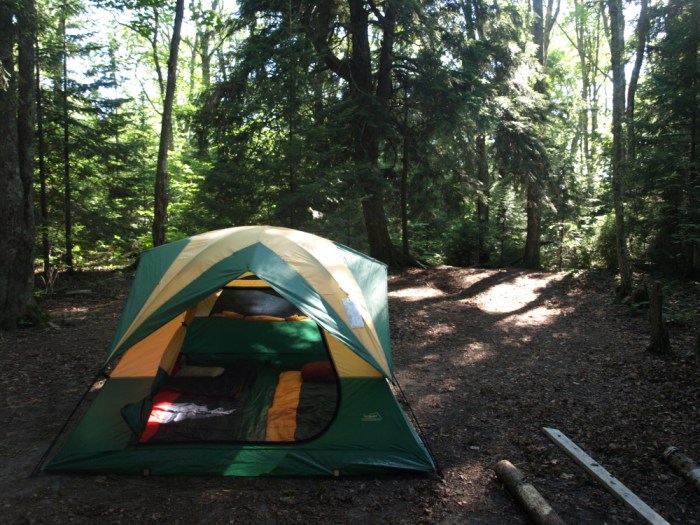
We did reach Coves campsite before sunset. We pitched our tent, lurched down to Lake Superior to filter water, ate up some of the weight from our packs, and went to sleep. And the next day, though we were both very stiff, we started out. And you know, once you start walking again, you find that you really can do it. Your muscles stretch back out, your joints aren’t so angry with you anymore, and you can finally enjoy the scenery that you were silently cursing the night before. You can even laugh at the “stairs” which you must now traverse a second time.

2 Women, 3 Days, 27 Miles, and an Entire Can of 40% DEET Bug Spray

What sort of weekend excursion should two 30-something, slightly overweight women with desk jobs take? If you said “Hike 27 miles of the rugged backcountry terrain at Pictured Rocks National Lakeshore” you’d be right. We might not be the most fit people in the world, but my sister and I are rabid lovers of the outdoors and luckily don’t mind taking on a challenge in our down time.

Our reward for this was great conversation (sans interruptions by children or commentary from anyone else), fantastic scenery, and true appreciation for things like cold water, cool breezes, food in non-bar form, and soft beds and pillows. Oh, and showers.

Here are some things I learned whilst on the trail.

1. 12 miles is really about 4 miles too long for the first day.

2. If you get 40% DEET bug spray on your lip, it will start to go numb.

3. I now fully appreciate John the Baptist’s cry in the wilderness to “make His paths straight.”

4. My sister is really awesome at her very stressful job.

5. When you know you have to climb yet more inclines, you can somehow make yourself do it.

6. Michiganders are blessed with some of the most stunning scenery around, yet too few of us take the time to get out and appreciate it.

7. During the past 46 years of national park status and funding, the National Park Service has failed (or hasn’t seen the need) to put mile markers on any of the trails at Pictured Rocks. This would be helpful.

8. The ubiquitous Nanny State has yet to extend its reach to Pictured Rocks, where one can stumble around on the very edge of sandy, unstable cliffs (and, in fact, must do this in order to reach many campsites) without a railing in sight and without signing any sort of waiver. (The only rails are in place only to protect a few choice natural features from erosion. Human beings are left to their own devices or stupidity.)

9. There’s nothing quite like standing completely alone on an empty rocky shore after sunset and contemplating the vast darkness of Lake Superior.

10. When my little son is old enough, I will bring him to this amazing place.

To see more pictures from Pictured Rocks National Lakeshore, click here.

Hiking Pictured Rocks National Lakeshore: An Introduction

Thirteen years ago during a sweltering summer heat wave I joined my fiancé and my future father-in-law, sister-in-law, and brother-in-law at Pictured Rocks National Lakeshore for some backcountry hiking and camping. It was my first hiking trip. I was nineteen. Despite the record heat, a huge thunderstorm the first night, and the hatching of about 7 billion black flies that loved nothing more than swarming our sweating brows and biting us fairly relentlessly, I loved it. Over the years, I went on a few more trips with my husband’s family, and once just the two of us, in various state forests and trails. But my own family didn’t hike. Or camp. Or even vacation all that much. (I realize that not everyone would consider carrying your home and food on your back for miles every day a vacation.)

Nevertheless, when I suggested to my sister a few months ago that we start going on an annual sisters’ hiking trip, just the two of us, she was totally game. What better place for our first trip than Pictured Rocks National Lakeshore?

This coming weekend, my big sister and I will be hiking along the gorgeous shores of Lake Superior, looking for fantastic rock formations and waterfalls, slapping mosquitoes and black flies, and sharing some quality time sans progeny.

The National Parks Service website for Pictured Rocks has a free 191 page PDF detailing the history of the park. In case you’re not inclined to read that much, here are a few excerpted portions that can act as a bit of a mini history lesson on how the park came to be (full text can be read here). One helpful note: it really starts on page 30 (for some bizarre reason, all the chapter end notes are at the beginning of the PDF).

The National Park Service was the last of the public agencies to turn its attention to the north woods and its problems of resource management and economic development. Isle Royale, the first national park in the north woods region, was established in 1941. Local efforts to establish parks at Indiana Dunes and Apostle Islands were frustrated by a federal establishment that failed to see the recreational potential of the inland seas. It was only with the Great Lakes Shoreline Survey in 1958 and the federal government’s expansive approach to regional redevelopment in the early 1960s that the National Park Service became a force in the protection of Great Lakes landscapes.

The national lakeshores of the Great Lakes have all had a challenging management history. In 1987 a Sierra Club spokesman referred to these units as the “orphans of the National Park Service.”

The NPS article mentions that the North Woods region had a difficult time of it transitioning the local culture and economy from one of almost exclusively logging and mining operations to one focused more on tourism than extraction.

The Pictured Rocks and the Grand Sable Banks are two of the most striking scenic features in eastern North America. The multicolored sandstone cliffs stretch for fifteen miles along Lake Superior’s south shore. The Grand Sable Banks are a dramatic four square mile perched dune created 10,000 years ago by the last glaciation. Between these spectacular features is a landscape of inland lakes, spectacular waterfalls, and miles of sand-graced strand. Had this area been located near the early population centers of the United States it would have emerged at an early date as a major tourist destination. But geography assured Pictured Rocks region a very different history. While tourism and urbanization embraced and degraded Niagara Falls, Mammoth Cave, and the Hudson River valley the Upper Peninsula of Michigan remained a remote resource frontier. The Pictured Rocks were little known and seldom seen by out of state visitors until after World War II.

Despite the serious exploration and mapping of the region in 1820 (the Lewis Cass Expedition), the shoreline still failed to gain much national interest. In the early 1800s, people were far more interested in finding copper deposits than in developing hiking trails. There were a couple attempts mid-century to develop hotels and tourist areas, but they did not succeed. It seems that Mackinac Island was about as far north as most tourists could hack.

After 1846, the Lake Superior country had to compete for attention with the vast and widely heralded vistas of the Mountain West. When Horace Greeley of the New York Herald editorialized “Go west, young man” he meant the Lake Superior country. Yet the Mexican War changed America’s conception of its frontier to the far west. The mineral resources of northern Michigan continued to be developed, but by the 1850s, the northern lakes region ceased to attract much national attention. The strongly romantic images of the Pictured Rocks created by Schoolcraft and the other scientific explorers retreated from public consciousness. While the Keweenaw became famous for copper and the Marquette Range for iron ore, neither was an attraction for the genteel travelers of Victorian America.

The handful of tourists who did visit the Pictured Rocks required heroic determination. Artist A. L. Rawson spent part of two summers exploring the area in the mid-1860s. In May 1867, Harper’s New Monthly Magazine published his extended account of the Pictured Rocks illustrated by eighteen drawings. Rawson was not disappointed by the “fairy-like forms and colors” of the cliffs which he esteemed were “a truly grand procession of wonders, not equaled in its kind in all the world.” Although Rawson strained to convince readers that the region was “a pleasant summer retreat” he had to admit to “some few disadvantages, the chief of which is the appalling fact that it is about two or three days’ canoe journey, either way, to a beef-steak.”

Over the second half of the 19th century, the area was bought up by rich industrialists who created expansive and exclusive clubs for other rich folk who wanted to try being “rustic” for a while and hunt game. But finally in the 1920s, more “normal” people got the chance to see the Pictured Rocks on regular boat tours. The Depression put a stop to most of what little tourism was happening before WWII. Luckily, though, the region was a prime candidate for reforestation by the Civilian Conservation Corps, and during the 1930s a transformation began that would eventually take the Upper Peninsula forests from clear-cut stump graveyards to a flourishing ecosystem once again. And after the war, with American industry at its zenith, there were finally the resources and the will to make it a bit easier to get around the Upper Peninsula.

In the 1950s, with the explosion of automobiles, a northern Michigan vacation was made much more accessible to the many Americans who were now taking much needed vacations. More and more people could afford summer homes Up North. And when these urban people saw how lovely and how valuable the scenery was, irrespective of its economic possibilities, they started to work to preserve and protect it.

The depth of emotion that summer cottagers began to attach to the north woods is illustrated by the memoir of James R. Bailey, a lower Michigan resident who grew-up spending his summers at a cabin on Grand Sable Lake. “When I was a child growing up in Ithaca, Michigan, it seemed that my whole life was consumed with my next visit to the Cabin. I found security in the fact that the Cabin was there, no matter what happened in my life I knew that the Cabin existed, in all its beauty, in the harsh Grand Marais winters, the grizzly Canadian winds and the unpredictable Spring rains. It was there alive, not only in my memory but in reality, I didn’t have to actually be there, just knowing it was there added to the comfort level of my state of being.” Ironically, in 1985 Bailey lost his family cottage to the Nation Park Service’s land acquisition program.

The NPS article has a detailed explanation of all the various steps that were taken, thwarted, and taken again to make the Pictured Rocks a national park, and it is an interesting read (if you’re into that sort of thing). But since I know most of you probably don’t fall into that camp, I will tell you that the first bill to reach the Senate wasn’t until 1961! And it wasn’t until 1966 that the Pictured Rocks were finally declared a National Park. It was the first lakeshore to be thus designated. And this momentous turn of events came about more than 300 years after the first recorded European visitor, a French trapper and fur trader by the name of Pierre Esprit Radisson, who first encountered the Rocks in 1658.

Now, 354 years since Radisson floated through the cold waters of Lake Superior, my sister and I will be hiking this marvelous landscape. Upon our return, you can rest assured I will have plenty of photos to share!